
-
Brake Adjusting Procedures-Jon
Posted by Hector on August 7, 2013 at 9:17 amJon,
I have read in a forum comment that you authored a brake adjusting procedure. Where is it?
Hector
Kevin replied 13 years, 1 month ago 8 Members · 12 Replies -
12 Replies
-

Hector,
I’ll have to see if I can find it. However here is the short version.
First it requires the emergency brake to be released so make sure the coach is chocked to prevent it from rolling.
The procedure does not apply to coaches with automatic slack adjusters. All manufacturers of automatic slack adjusters do not recommend manual adjustment. Automatic slack adjusters will look different than the one shown below.

In the photo of the slack adjuster look above the white label and note that there is a 9/16 hex head adjusting bolt. Surrounding the hex head is a spring loaded sleeve. Using a 9/16 wrench, push the sleeve down and once the sleeve is down rotate the hex head adjusting bolt clockwise until it will not turn any further.
You will have just tightened the brake shoes to the drum. Then turn the wrench 1/4 to 1/3 turn. That backs the shoes off the drum. The wheel should turn freely without brake drag and the brakes are adjusted. When you remove the wrench insure the sleeve returns to its original position around the hex head adjusting bolt because that locks the bolt in place and prevents turning.
Hope that helps
-
Jon & Hector,
I would be glad to post a copy of the procedure. When I was a member of POG ( yes, I too have been denied entry) I downloaded a number of pertinent articles related to maintaining my coach and they are invaluable! Hector, good to hear from you.
-
Tom,
If you have a procedure please convert it to a PDF file and post it as an article. Thanks.
-
A friend of
mine had moved up to a newer Prevost with disc brakes on all axles. He was
complaining that the brakes felt soft, they felt like they didn’t have as much
stopping power as his old Prevost with drum brakes. I called a friend in the
shop at the Prevost dealer and ask him. He said it’s not uncommon for the slack
adjuster to be over greased. The excess grease formed a cushion between the
adjuster and the caliper piston causing a softer feel. He said remove the
grease fitting and lock up the wheel like you normally do when adjusting the
brakes and most likely a hand full of grease would come out. He was correct. He
said that grease fitting only needs a tiny amount of grease. After I went
through this procedure on all calipers it made the brakes feel much better, my
friend was happy. Anyone else had this problem or heard of it? This has been
about 2 years ago so some of the particulars may not be correct.Ken
-
We have been preaching about over greasing for quite a while. This is an issue on the early Rockwell disc brakes that use calipers and the biggest concern is overgreasing can prevent retraction of the caliper and overheated brakes.
It does not apply to drum brakes or the Knorr Bremse, but any grease applications to the slack adjuster pivots on disc brakes should be a small shot only.
-
The calipers on my H3 have a valve that when the brakes are tighened will force the extra grease out. So far the brakes have been great since I put all new pads on.
-
I
know I’m repeating myself, but I was the victim of a shop over
greasing the caliper and it cost me a set of new rotors and pads.
This was on an XL and those calipers have 2 grease fittings and if
one is over greased (the outside zerk I think) it will prevent
the brake pads from disengaging.
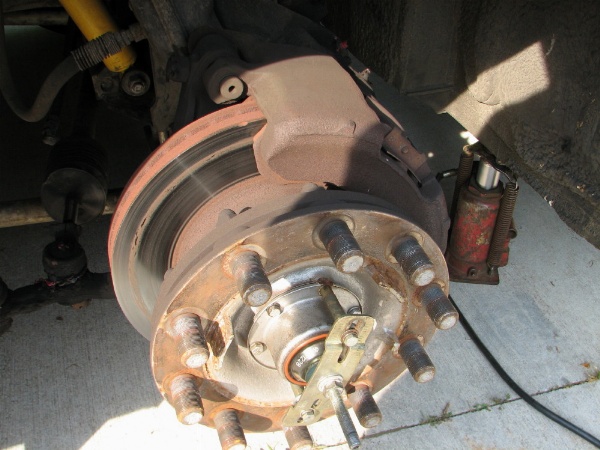
It’s that outside zerk on top that if over greased, will cause you problems.
-
Tom,
This biggest problem I see here is the deplorable condition of the paint on that brake caliper…..
-

No excuse is there Paul? He hasn’t owned his coach very long so that might be on his to-do list.
-
I thinking about the wrong zerk all this time. I do not remember my 1991 H3 having that zerk. Is it for the slide pin? The one I was referring to is the one on the screw mechanism between the slack adjuster and the calipers. I also misspoke about how to activate the overflow valve, and that is open the calipers as far as possible.
-
Tom,
I did not think your vintage coach had disc brakes. The grease fitting that can cause the disc brake calipers to remain applied is on early disc brake coaches that have slack adjusters. Later models have internal adustment mechanisms and no slack adjusters.
The disc brakes with slack adjusters have two grease fittings on the slack adjuster shaft, one near the adjuster and one about halfway to the disc. If those are overgreased the potential to inhibit the relase of the brakes is high. My rule of thumb on any fittings associated with brakes is about half a shot of grease. Doing that I have not had any issues.
Log in to reply.