
-

I have a sheet from Marathon that presumably came with my coach it says:
Steer: 125 psi (365’s)
Drive: 120 psi (315’s)
Tag: 95 psi (315’s)
At a rally last year I heard one fellow who operates a trucking company say that he always keeps all his tires (all 18 of them) at their design pressure, 125 psi. He said that with this configuration he is able to run his tires our to their maximum tread life and never has had any problem, and, that he does it on his coach as well.
I asked the Prevost guy about that and he said that “yes, that’s okay, if you don’t mind the ride”, so, in other words, the varying pressures are mostly a function of ride and the minimum pressure required for a given axle weight. Nothing wrong with the maximum, just a minimum is specified by the tire manufacturer for a given weight.
So, I decided to give it a try. On the trip out of Phoenix, I drove north on I-17 in 100 degree weather. Some tire pressures were lower than I’d like at about 110 PSI so I was searching for a truck stop. At a rest area along the way, I pulled out my trusty Fluke IR Digital Thermometer and measured all the tires. I was astounded to find one of the tires at 160 degrees F, and others in the 110 to 130 degree range. The tires on the toad were 110 degrees, which was a miracle since the black pavement itself measured 150 degrees.
125 PSI filling pressure is extrordinarily hard to come by unless you own the compressor. Many truck stops make it hard to find air, and when you do the hose is cracked and/or broken and the pressure is iffy. I kept trying, however, and finally got my tires all aired up to 120 psi all the way around. The coach’s AUX air system, by the way, can’t do it, and so that was not a consideration.
Now, I make it a habit at every stop to do a quick walk around with the IR Thermometer. I’m happy when tire temps stay at or below 125 degrees. The tag tires are always the hottest. I can’t measure the inside drive tires, however, if one of them were low there should be an abnormal indication on the outer wheel since it would technically be overloaded. Also, I do use a pressure gauge every morning, right before I start out.
There is one problem that has been perplexing me, however, and that is hot versus cold pressure. I’ve seen tire pressure rise as much as 15 to 20 PSI after a run at highway speeds. In other words, I’ve seen more than 130 PSI when the tires are warm off the highway. Suppose then, that pulling into a truck stop, one front tire reads 130 PSI and the other, 110. The one that says 110 is clearly low, but, should you raise it to match the other (130 PSI) tire? I won’t do that and instead go with 120 on the low tire.
I’ve also noted that the tires on the sunny side (those in direct sunlight) also have higher pressure due to heating. This is true, rolling or sitting still. How important is this? I don’t know.
-
The Prevost manual for my coach says:
“Weigh vehicle fully loaded and pressurize according to tire
manufacturer’s recommendations.” It goes on to say, “Incorrect tire
pressures cause increased tire wear and adversely affect road holding of
the vehicle, which may lead to loss of vehicle control”.They include this nifty graph:
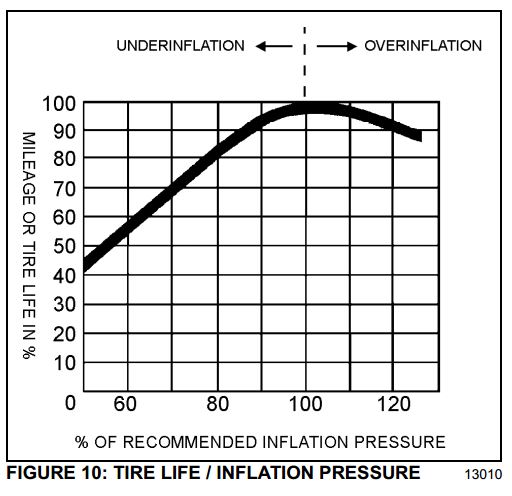
Which says to me that when deviating from the manufacturer’s ideal pressures, over inflating is better than under inflating. Under inflating by 10% reduces tire life by about 10%; whereas, overinflating by 10% reduces tire life by only around 5%. It also says to me that slight, 5%, under or over inflating isn’t a big deal with tire life span being the tradeoff, especially in our motorhome application where we age out before we wear out.I need to check the math but I seem to recall that we gain/lose 0.5 psi per 1000′ of altitude. So setting your tires to their ideal pressure at sea-level and then peaking at Eisenhower Pass will increase your pressures to 105 psi, or 5% overinflated. Setting them to the ideal 100 psi at the top of Eisenhower Pass and then driving to sea-level will net you a 5 psi drop for a tire pressure of 95 psi. So, during ordinary driving we can have pressures that routinely vary +- 5% from the manufacturer’s ideal setting. Tire pressures vary around 2% per every 10 deg F change in temperature. So if you set your tires to 100 psi on a comfortable 70 deg F day and you drive to balmy 120 deg F Las Vegas, your cold pressures will have increased by 10 psi. Along with all of this we’re warned by the tire manufacturers to never exceed the pressure rating embossed on the tire’s sidewall. In a perfect storm scenario I can foresee a 15 psi change in cold tire pressures from their ideal manufacturer’s setting. We may believe that we’re acting conservatively and safely by overinflating, but under the right conditions you can exceed the maximum pressure of the tire, especially if we set ’em and forget ’em. My method is to run the manufacturer’s cold pressure recommendation and check pressures every day and adjust as necessary, and to not get too freaked out over a plus or minus 5% deviation.
-
A substantial increase in temps due to driving is going to increase pressures which is why all pressures are to be checked when the tires are cold. Cold is a relative term because you may be in ambient temps of 50 degrees in the morning and 100 degrees in the afternoon.
So if you travel to temperature extremes it might be best to leave the pressures as they are if you are overinflated when arriving in FL in the winter from MN. But if you leave FL with the proper inflation, when you get to MN in the winter (who in their right mind except for Mark would do that?) you are going to have to add air.
Fred, I shoot the 8 tire temps in the center of the tread including the inside duals so I have all the readings. I am not looking for any specific value because the temps vary with conditions, but I am looking for consistency among all the readings with a small variation between the sunny side and the shady side expected. I run at the Michelin pressures plus 5 PSI and with rare exception all 8 tire temps almost always fall within a 5 degree range.
I shoot the temps at the wheel as close to the hubcap edge as possible to do a quick check of bearing or dragging brake conditions. Those readings are also within a small range with the drives a little warmer.
-
Here’s an example of the effect of temperature on tires.
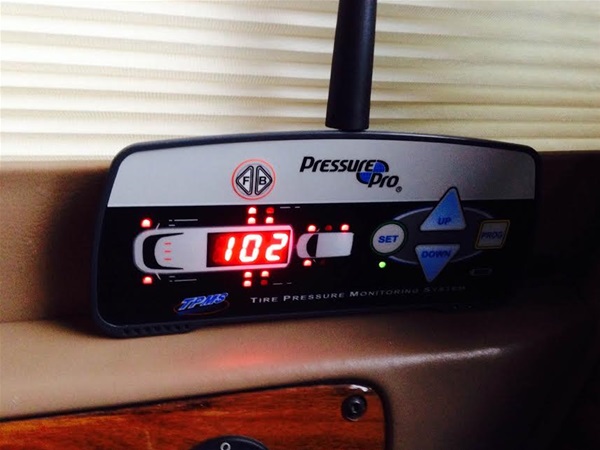
This morning it’s 51 degree’s, yesterday it was 70 and tire pressure was at set psi of 105
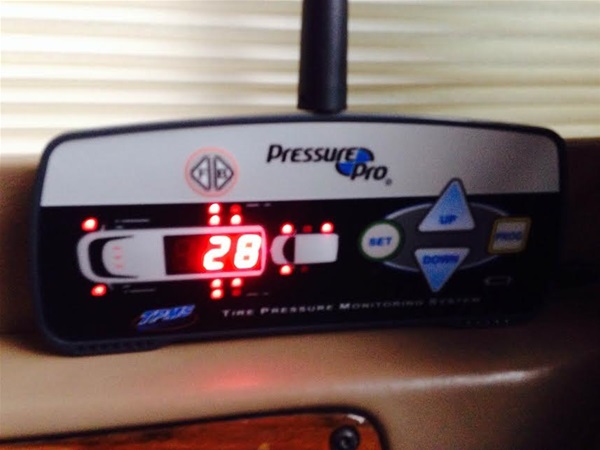
Here the Jeep left rear is setting the alarm off because of cooler temps.
You do of course just push a button to check your tires don’t you?:)
And regardless of what dribble you see on other sites, throw away those inner drive tire extensions.
-
Here is what happens to valve stem extensions, even with the rubber grommet.
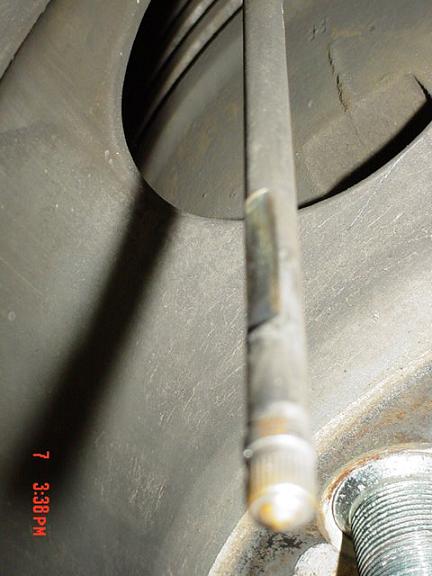
That wear was with the grommet in place and it was almost completely through the extension.
Even if it does not wear (it will no matter what anyone says) the extra stress from the added length can eventually cause a fatigue failure of the valve stem where it makes the bend.
Anybody that still uses valve stem extensions has a high risk of loss of air on the inner drive tire.
-
For a little less variation( temp vs. pressure ) I inflated all my new tires with Nitrogen instead of air,they claim no condensation with it and a lot less heat variation. I still get a air pressure increase after 3-4 hours of daytime driving,around 5 psi,on all axles. Lacey, 99 H 345 Angola.
-
Since the air in our tires is 78% nitrogen to begin with I suspect the benefits to inflating with nitrogen are so small (if any) as to be immeasurable.
Even the tire manufacturers are neutral on the topic.
http://http://www.michelinman.com/tires-101/tire-care/tire-maintenance/how-to-check-pressure.page
-
My coach is a 45′. The axle weights for mine are on a weight slip in the coach. can’t remember the weight but 90# was correct per the Michelin chart. My new tires, I believe, are the XDA’s. Can’t believe you don’t notice the noise…
-
According to: http://www.getnitrogen.org/pdf/graham.pdf
“Because of the size of the N2 molecule in comparison to the O2 molecule, N2 permeates thru rubber more slowly. This is the primary reason for filling tires with N2 – better maintenance of tire pressures. O2 permeates approximately 3 – 4 times faster than N2 through tire rubber.”
The moleculer sizes of N2, O2, and H2O are roughly 3.16 Angstroms, 2.96, and 1.40, respectively, so it appears that in time, as the O2 and H20 permeate out, our tire’s internal gas approaches pure N2.
I don’t know about others, but I’ve never seen any signs of water, dampness, or humidity inside a freshly dismounted tire. They’re always bone dry even though we constantly top them up with wet air!
-
I’m sure others have had the same thought, but say you do go down the Nitro route for tires, what about the residual ‘air’ that is already in the tire carcass when it is mounted on the rim. Do they suck all this out before pumping in the ‘pure’ nitrogen? I think not.
-
I’ll translate the analysis David provided in language even Tom can understand.
If you use air in your tires after a while those pesky water molecules and oxygen atoms will bleed out and all remaining will be pure nitrogen.
How did I do David?
-
How did I do David?
Jon, you did Ideally, but what else is new! 🙂
-
I’m still trying to figure out Angstroms. Are you sure that wasn’t Amsterdam?
-
The nitrogen was installed when the tires were new no other air was used. Lacey,99 H345
Log in to reply.