
-
Battery or charger issue
Posted by Allan on December 6, 2017 at 1:16 pmI was planning on taking the coach out today as it a beautiful sunny day. The engine would turn over….not a sound. I suspect the chassis batteries need replaced. On the dash the voltmeter shows that it is pegged over 32 volts. I have changed the original Liberty charger to the newer Marinco trickle charger. I have left the charger on when the coach is not in use. Could I have fried the batteries. As a side note the leads from the charger (2 positive and 1 neg or ground) was hooked up to the posts identical to the former old charger. I was informed this was correct…..but I am still wondering. In event I will test each battery individually and replace all if needed.
Archived replied 8 years, 10 months ago 14 Members · 20 Replies -
20 Replies
-

I should have edited my post…..the engine did not fire as I suspect the batteries, all or one of them, is dead. Just wondering about the volt meter indication being plus 32 volts and if the trickle charger is not wired correctly or the unit itself is defective.
-
32 volts would fry the batteries fairly quickly but your fuel gauge isn’t registering. I would check the batts and check all voltages when done with another voltmeter if necessary to confirm.
1984 96" with 8V92TA
(remodeled Liberty Coach)
Greenwood, MO -
32 volts will destroy a battery pretty quick.
This has been said before, but I will repeat. After the chassis batteries have been charged by driving, the bus can be shut down and without a trickle charger or any charging go for months and the batteries still have plenty of power to start the bus.
If the batteries do not have sufficient power to start the bus after a period of storage (a couple of months for example) then the batteries are at end of life or there is a phantom drain on the batteries.
In both cases the solution is not to keep a maintenance charge on the batteries but to replace them or eliminate the phantom drain.
Just to put this in perspective, 32 volts not only could be sufficient to start a fire in a system designed for a nominal 24 or actual 27.7 volts, it has the potential to damage electrical components.
-
Jon thanks for the information. I turned the trickle charger off and will test and likely replace each battery. I did not know the charger would be an issue after having left it on the past month. And your thoughts regarding a fire or potential electrical damage downstream of the batteries really concerns me. I will in future only use the charger when the batteries are showing low voltage and cross my fingers I did not cause further harm to various electrical components.
-
The Marinco is likely a smart charger, 3 stage and should go to float around 1326 volts. It can be wired for 12 or 24 volts and possibly you wired it wrong. The original charger probably was a straight 24 volt.
Your picture shows a dead fuel gauge, was the key on? I would check the actual voltage at the batteries.
-
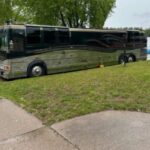
No the photo was taken with ignition off. The fuel gauge goes to empty or shows empty when the ignition is off.
As for wiring the charger I took both positive leads, which I believe are separate 12v leads and hooked both together to the positive binder post in series to provide 24 volts. The ground or common lead was hooked up to the ground binder post. This is identical to how the old Liberty bulk charger was wired. The major difference being the old Liberty bulk charger had one positive lead and one common/ground lead. So I am scratching my head if I wrongly wired the new charger or not, but the wiring diagram that came with the operating manual suggests what I have done is correct. PS my electrical skills are on the low end…..my comprehension is slightly better.
One thing that strikes me is what Jon said in his post….after having driven the coach there is no need to have the charger on afterwards as the batteries are or should be at full charge. I suspect I cooked the batteries after my last ride and I think I am lucky not to have started a fire. So my lesson is only to use the charger only if the battery voltage is low….regardless if the charger is a trickle charger similar to the Marinco unit or the original bulk Liberty charger.
-
I replaced my Liberty installed 24volt charger (probably state of the art at the time of install) with the Marinco; but didn’t wire it that way. I’m away from home and don’t have access to the wiring diagram I used. I think I posted it to the forum. Search for it and you might find it. I’ve also posted once or twice the safe precautions and procedures I used to remove my batteries. Search for that too. They are highly acclaimed; I think Jon might have complimented me on them. It’s not that I’m so smart, I just followed Jeff Rowe’s explicit instructions to the letter and heeded his warnings of what would likely happen if I screwed up.
-
This is a 24 volt charger for two 12 volt banks. This is what they use at Night Train Coach Leasing where they have 125 coaches. You hook the banks up separately
-
Thanks Dick. You supplied me with your electrical schematic in a private email to me back in the fall of this year. I will wire the charger according to your diagram…..if it passes the Jeff test then that’s good for me. I will take all precautions removing and installing the new batteries……and label everything and photograph the wiring prior to removal. Thanks…..I will keep all those that are interested as to progress.
1999 XLV X-6872, liberty #440 -
I see no reason why a smart charger, properly wired, cannot be left on. In fact, I would assume that is desired. Do we not leave our house battery banks on charge continuously?
-
Ditto what Joel said.. The only precaution is you don’t have the AC 110 volt power being supplied to the charger on an inverter circuit, where it would be on while driving.
-
While technically leaving a smart charger on all the time will likely do no harm isn’t the fact it has to be on all the time a concern?
I suppose if you take enough Motrin every day you can mask a brain tumor and I see the need to leave a charger on all the time you are finding that to be acceptable on your bus to mask what might be a serious problem.
-
Tom had “The only precaution is you don’t have the AC 110 volt power being supplied to the charger on an inverter circuit, where it would be on while driving.”
I would add that even if you have the charger connected to a plug not supported by an inverter it has to be one that would not be energized while the engine is running. This means that if the plug is hot when connected to shore power / generator and you run the generator while driving (like for extra air conditioning) that is not good. Just remember that you do not want to have two charging systems competing with one another such as the charger and the alternator.
-
We already have two charging systems at work if we are running the generator while in motion. Unless you turn off power to your inverters every time you start the generator.
All have some means of voltage regulation so there should be no issues.
-
Actually, on the rare occasions I am running generator (with inverter charging) and engine, I usually get the red alternator charging lamp on dash which I assume means the engine driven alt has dropped out. If I run this way for a significant amount of time, I will turn of the inverter charge mode.
Log in to reply.