
-

Dale,
What do you have for house batteries? If the inverter/charger isn’t working your batteries are probably toast. With as few as 3 4D’s or 8D’s, if the batteries are fully charged and in float, you can expect them to be still at 12v overnight with the normal small loads on such as the fridge, tv and some lights. With properly sized battery banks and inverters, some can run 1 or 2 A/C’s for a short period of time providing the converter set it up that way and the inverters are big enough. Example, my Marathon has 6 4D’s and can run up to two cruiseairs for a short time using 2 Trace 4000 inverters.
-
I’ve got 4 Group 31 deep cycle batteries. That’s what the bus was set to take. They are brand new. My inverter is an ancient Trace U2512SB. My buddy used a meter on it and verified that it is only putting out about 40v on each bank. That is what my gauges were showing inside too.
I don’t know what my A/C system is in the bus. I know it is a big house type unit. It’s enclosed in a box that sits in the center of the third bay. Then it has walls closing it in, so I have just barely seen it when I was working on the inverter. Should the inverter run the big central units for a while too?
Sorry if my questions are basic. Still trying to learn how these systems are supposed to work. I read about lots of things that my bus apparently does’nt have… Like an auto start on the gen if the batteries reach a certain level.
-
Dale,
There is a great deal of difficulty answering questions of a technical nature on a forum not only because we lack the ability to see or hear the issue, but because we rarely get the big picture. To add to the confusion on your specific issues you have a conversion that few of us are familiar with and it is set up as an entertainer and not a motor home.
Now that does not mean we are not able to offer advice or even pretty good solutiuons to the problems, but we have to rely on you, your eyes and ears, and the information you provide to us.
To start, your issues need to be taken as individual specific problems, with all listed to the best of your ability all at once, along with a complete description of your coach and its systems.
Here are some questions I would ask after I see your list. Does your coach have house batteries as well as chassis batteries? We know your chassis batteries are new, if you have house batteries how old are they, have they been tested, and aside from the inverter how are they charged when the engine is running? Do you have an alternator for the chassis and a separate one for the house? If so is the house alternator 12 volts or 24? If it is 24 and you have a 12 volt house DC system that would explain the 2nd equalizer. Right now I still cannot figure why you have the second equalizer.
Do you have Prevost full coach air conditioning or just dash air? What air conditioning do you use when the coach is not running? and when it is running? Describe your type of house air conditioning….roof airs? Cruise Airs, RVAC?
One thing I am puzzled about is you list your coach as 45 feet but an early 90’s model? I don’t believe Prevost sold 45 foot coaches until 94 (I’m guessing) and I think they had series 60 engines. What engine do you have? and is it a 45 footer?
How many inverters do you have?
I don’t mean to overload you, but with an abundance of information about the coach and its systems your specific problems may be easily answered. Or not.
-
Chances are your fine pole to pole or on gen set and nothing else. the Ac unit sounds like something I might have tried as a home builder in the past to save $$$. The best available Inverter with a huge battery bank of that vintage would run a roof top around 1 hour— please feel free to dispute me guys figuring 14 amp draw for ac at 120 volts. plus any other loads. Plus you have only 4 wet cell limited power batteries that you really can’t discharge very low without damaging. Even I have learned power management and now my Air condition loads are measured in single amps draw. (6) . I know your doing LED and other things to extend your off grid and off gen time—your headed in the rite direction.. keep the faith. Bob
-
Dale you mentioned that you don’t have a multimeter, you need to get one and learn how to use it, even if it only the check voltage and curcuit continuity.
You maybe trying to get to much out of your batteries, I doubt that your bus came out of the converter set like that. I would measure the space you have for batteries and talk to Tom about getting a new set of batteries. Most likely you had 4 d4’s or d8’s. Then I would check if you have votlage coming out of the inverters capable charging the batts. If you don’t have an inverter manual to a internet search for it. My 1992 bus came of the lot with converters to supply 12 power and a separate charger to charge the batteries, since been changed to inverters). You may have the same set up. So look at names on boxes and do internet search on them to see what they are. Also look for switch that maybe have been disconnected.
On the old vanner jump you batteries to the terminals and check to see it you get the 12, 24 volts out of it, if you don’t it is junk and can be removed or it needs to be replaced. I do not think one inverter works for both the engine and the house batteries. So the Vulcun may have put a second one in for the house batteries as someone told you to run off the alternate alternator, but you still need one for the engine batts.
40v WoW, Check the voltage coming off the big terminal on the second alternator.
As Jon said with fresh batteries you inbalance light will go out but if your vanner is not working it will be coming back on down the road very soon.
You can see why you need to get a digital multimeter? it anwers a lot of question for you.
-
Dale
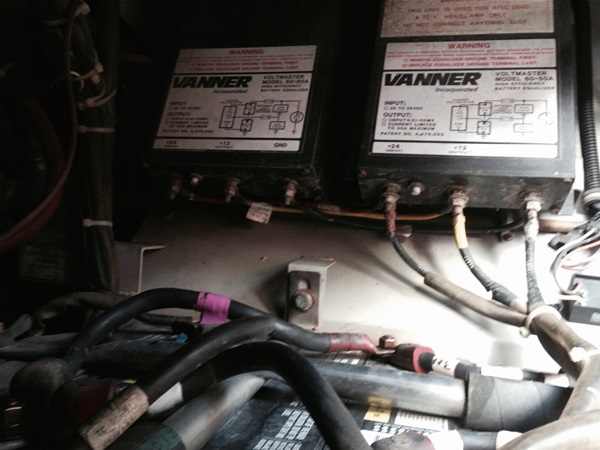
On my 1991 chassis (m1838) I have two vanner they are connect in parallel.
-
The two Vanner set up was superceded at some point with a single 100 amp unit instead of dual 50 amp units.
-
Thanks guys. As we type, I am parked in Hueytown, AL and Bruce from Vulcan will be going over my bus tomorrow. I figured, since he built it and many others just like it that it would be smarter to let him at it instead of someone who first had to figure out what he did and then how to fix it.
I’ll answer some of the questions the best I can…
– I do have full coach (OTR) air intact. It also does not work. It has been converted to r134 and I am assuming it just leaked all the freon out.
– I have a basement air unit, that I have never seen enough to tell what it is. I saw enough to know it is a big enclosed unit. Couldn’t see any name brand on it. It worked until the other day. I can still hear the compressor kick on but just no cold air. Squirrel cage fan to cool the bay doesn’t work. My buddy thinks that is causing the unit to,get hot and kick off.
– Bruce (from Vulcan) told me that the auxiliary alternator replaced the second Vanner in my system. It is 12v and directly charges my house batteries when going down the road.
– I have a bank of three Group 31 deep cycle batteries for the house. They are new. The are charged by the charger side of the inverter when the generator is on, and it senses the alternator and let’s it take over if we are underway. Both of these systems have been checked with a meter and are functioning properly.
– We have pretty much determined that the inverter is just not working. We verified this with the meter and it was only putting out about 40v on each side. That is what my gauges show.
Actually, I am feeling like this is all going to be easy. All wiring to start batteries, house batteries, generator, and everything seem to be working as they are supposed to. Values are as listed in my book, and verified by Bruce. The culprit just seems to be the inverter. I think I’ll have to replace it. I think I’ll have to replace the squirrel cage fan in the A/C bay,more at least the condenser on it and that will get my house air working again. I’m going to buy 30 lbs of r134 and get a garage to leak test and fix the bus air. Bruce feels confident he can have this thing traced out and fixed in an hour or two. Of course, I’ll update and improve the system later, but just getting it all working now will take a load off my mind.
Not sure if I got all the questions answered. But I’ll give more info tomorrow after Bruce spends some time on the coach. Thanks to all of you!
-
Jon, I just looked this up on the Prevostcar website…
1992 – Prevost introduced a long wheelbase 45-footer, the XL-45 Entertainer, engineered for traveling entertainers. It outsold all other competitive models.
So apparently, I have a first year XL-45.
-
Dale,
Just to help you understand the relationship between the inverter and the engine driven alternator and the generator and shore power think of it this way:
Any time you have 120V power to the inverter, whether it is from the generator or shore power the inverter is a battery charger and power to the alternator passes through it to supply power to whatever is on the inverter circuits, like a refrigerator or outlets or the TV. When you do not have 120V input to the inverter it draws power out of the batteries to supply power to those same circuits.
When you run the engine the house alternator is the battery charger, but if you are also running the generator the inverter is also functioning as a battery charger. You can charge your house batteries from two sources because both the alternator and the inverter (in charging mode) have the ability to regulate the charging current to the batteries.
Unless your coach has been provided with some form of circuit interrupter to prevent the inverter from charging batteries when the engine is running your inverter is always functioning as a battery charger as long as it has 120V input.
All of our coaches are set up that way.
-
I would think that if you were really suppling 40v to lead acid deepcycle batts you would have a rotten egg smell that you could smell throughout the park if not hear as that hydrogen boils off.
-
Greg,
If i am understading correctly, the 40v would not be going into the batteries. 12v DC is coming out of the batteries to the inverter that sbould make 120v AC. Bruce adjusted some stuff and it is working. The odd thing is that are getting 90v out of the back of the inverter, but have 120 at the outlets. How in the world does that happen?
-

Dale,
Don’t be too alarmed at reading 90V. If you make a peak-to-peak voltage reading of what’s coming out of an outlet at home it would be 170VPtP. We measure AC typically as a Root Mean Square value for pure AC waveforms. For power coming from our utility RMS voltage would be VPtP * .707. So, that’s how we arrive at utility power being 120VAC.
What comes out of a modified sine wave inverter is not a pure sine wave. So, depending on how many steps there are in square wave that is coming out of your MSW inverter, 90 Vrms could be acceptable.
-
Dale your are saying 40v and 90v as in AC not DC volts. I would think you are not getting an accurate measurement out the inverter if you are getting 120VAC down stream. Scratch in to the metal with the probes when you make the measurements, so you get a good contact especially with the ground.
Log in to reply.