Prevost Community Forums

Find answers, ask questions, and connect with our
Prevost Community around the world.

  • Battery isolator check?

    Posted by Richard on December 2, 2020 at 11:46 am

    I am probably not thinking about this as I should, but I need some guidance and / or clarification as to how I can tell if my battery isolator is functioning properly and is there a typical work life of the isolator? The reason I am asking is, although everything seems to be working ok, but the isolator appears to have gotten pretty warm due to some evidence of heat related signs around the connection points. I have not witnessed any evidence in progress, my coach is always on an automatic maintainer between stretches of starts, and both my start and house batteries are fairly new and have not shown any signs of weakness or ??? Is there a good rule of thumb regarding the replacement? I haven’t yet, but I understand how to check for continuity direction of the posts, but is that all that has to be done to check if its good or not? It is a vintage Liberty coach, but well maintained and has been good to me. Thanks for any feedback and this great community….

    Richard

    Dick replied 5 years, 9 months ago 6 Members · 5 Replies
  • 5 Replies
  • Chris

    Member
    December 2, 2020 at 4:03 pm

    The isolator in our 1999 Liberty failed about two/three years ago; 18 or so years of life. I suspect they don’t last forever. I’d think about where and when I travel with the coach. Do you foresee getting yourself into a situation where you DON’T want to replace it? I bought the replacement from Liberty in Stuart and installed it myself in West Palm Beach at the All-Prevost show. Liberty had the best price. Not sure if mine is the same as your’s.

    What kind of maintainer do you use to keep the batteries up? A smart, multi-stage charger?

    What’s your Liberty build number? You must have an early one.

  • Archived

    Member
    December 2, 2020 at 4:44 pm

    Richard, To the best of my knowledge your coach preceded Liberty conversions that use the large finned isolators of newer models.

    Your isolator is a solenoid (relay) that is energized when the alternator has output. In other words it is in the output circuit of the alternator, but is open thus separating the house and chassis batteries from each other until the alternator has output.

    If the house batteries are deeply discharged I can envision the current flowing through that relay being high, combined with old contacts with some resistance it is likely it will get warm.

    Whichever means of isolation you have you know if it is working merely by using a multi-tester to measure voltage at each set of batteries and noting a voltage rise when the engine is started. If the two sets are not isolated voltage readings are going to be identical so when checking with the engine off add a load to the house batteries, or check voltage as the engine starter is engaged. In neither case should each set show the same voltage.

  • Dick

    Member
    December 3, 2020 at 12:41 am

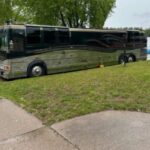
    Beautiful bus, outstanding paint job – Jon! Absolutely dwarfs your big ‘ol Hummer! Nice set-up. 🙂

  • David

    Member
    December 3, 2020 at 3:23 pm

    Thanks for the feedback, I will take a picture of it and upload.

    As for the maintainer, I will take a picture of it too.

  • Billy

    Member
    December 3, 2020 at 4:39 pm

    Generally speaking a coach used in a normal manner doesn’t need supplemental battery charging. However there needs to be some qualifications to that statement.

    First, all Prevost conversions I have ever known need nothing to keep the chassis batteries charged unless there are phantom loads such as might be the result of an owner or mechanic hooking something up to them because they happen to be a convenient source of power. Chassis batteries should have no current draw at all when the bus is turned off with the exception of the modest current required to keep the memory of the DDEC engine ECM alive. Your coach pre-dates DDEC so you should be able to go for months without the need to charge the chassis batteries.

    The house or conversion batteries are a slightly different story. Your vintage conversion likely did not have inverters when built, such as we know them today. It may have even had a 12 volt DC motor driving a small generator to provide limited 120V AC power for use when the generator (diesel powered) was not running. Later versions used an inverter, but not an inverter charger as we use today. To provide charging current for house batteries generator or shore power would be used to power converters which is a fancy word for a dumb battery charger that put out a constant voltage. That converter had the ability to boil batteries if left on too long.

    If you have an isolator as we use today you may also have a modified electrical system compared to what was first installed. To help answer your questions. the more info you can share will make an understanding of your coach much easier.

Log in to reply.