
-

Chuck: Is there any reason why you didn’t go with the Guest 2613A vs the Guest 2611A? The 13A is 20 amps and the 11A is only 15 amps.
I think I just answered my own question …. the 20amp 2613A will be available in Q1 2015.
Chuck and everyone else:
The chassis batteries were not strong enough to start the engine on Saturday. The coach has whatever Liberty put in for a chassis battery charger back in 1999 (Megnetek or something like that). Ran the generator for over 2 hours and the gauge said the batts went up only 2 volts. Fan not running on the charger. Jeff Rowe said it was probably junk, called it a boat anchor, and to replace it with a Guest. So we’re going to hook an old Buick onto the thing and pull it out of the engine compartment.
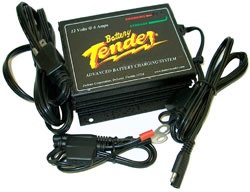
Using the PC search skills that Tom taught me I’ve read quite a bit about chassis battery chargers. Guest is the most popular, at least one owner is using the popular Battery Tender brand (someone doesn’t like Battery Tender because its charging voltage is too high), and another owner says only the IOTA brand will protect our buses from burning to the ground (inspite of I think Tom or Jon saying that if a Guest sets our coaches on fire we can beat the fecal matter out of him).
It looks like all the Guest chargers are now Mariner chargers.
I’ve also concluded that most if not all of these chargers have 12 volt output leads and if you need 24 volt charging you use two pair to get to 12 volts. I wonder why they don’t have actual 24 volt leads.
So … I’m going to order a Guest 2611A , I can’t/don’t want to wait until the higher capacity chargers come out in early 2015. I am just a little bit concerned that the instruction manuals for 2611A and the ones coming out in 2015 make lots of references to “trolling motors” and I’m going to install these on in a Liberty Prevost Motorhome. I would be much happier if the referenced “trolling motors”, large boats and small yacts, luxury motorhomes, and Prevost motorhome conversions.
Also it appears the Guest doesn’t have a cooling fan where I think the IOTA has a fan and the boat anchor I currently have has a fan. Not having a fan a problem?
Am I headed down the right path on this? What do the rest of you think?
Dick
PS: I noted in the instructions that charger should not be installed over the batteries or hung from the ceiling (like my current charger is). Fumes from the batteries could damage the charger and hanging from the ceiling doesn’t allow for proper airflow. Either or both of those situations could have resulted in the fires referenced above and in other threads.
-
I have had 3 different types of chassis chargers. The first coach used a converter as a chassis battery charger. I used that often until I found the phantom load that was pulling the batteries down. But I never left it on without monitoring it so I never had issues.
The second coach had a converter but apparently a different type. It appeared to be a multi-stage, but like the first I would never leave it on long enough to damage a battery. I only used to to replace a charge because I had been working on the chassis and I drew the batteries down.
The current one, also installed on the coach by Liberty is a Guest charger. I have left it on to recharge after I have depleted the batteries, but as a three stage charger I am comfortable doing that. All chargers were ceiling mounted over the batteries. The last two installations however the batteries were covered with a panel or in the case of the existing coach a panel and a metal cabinet.
The key for me however is I just don’t trust many things, including battery chargers (except my inverters) so I am monitoring them when they are on and not leaving them on 100% of the time like a battery tender.
Chassis batteries should not lose the charge unless you are depeting the charge by leaving on lights or the key for whatever reason. Other than that my chassis batteries will literally go for months just sitting and still have power to spin the engine.
I have always bought Delco 1150 chassis batteries. They require no maintenance and I replace them at 5 years of age regardless of how well they still perform. I tried to stretch the life of the original batteries on our first coach and ended up having to replace them while on a trip. Wasn’t worth the savings.
-
So if I go with the Guest Charger- do I need to puchase two chargers? Is it one unit for two batteries? Or one unit for all four?
Tully
-
Dick, you need a single 2611A. Just make sure you hook up the leads as in the 24volt diagram. I mounted mine on the sloped bulk head wall. Leads were just long enough.
-
The Guest 2611A has two12 volt charging cords.
Our coaches have two 12 volt batteries in parallel hooked to two more parallel batteries in series.
As I understand the logic, charging the two 12 volt arrays separately will assure that each of the arrays has the maximum charge before lowering the charge rate thus assuring that all of the batteries are charged as much as possible. This tends to guard against one battery exhibiting full charge (or a faulty cell) and therefore causing the array to shut down prematurely.
The instructions are easy to follow to hook up as described above and by others in this thread.
The 2611A is a 3 stage charger which makes me more comfartable about leaving it operating full time.
As an interesting side note; I have left the original single stage charger installed so that I can use it as a backup for the 2611A in the event of a malfunction. It being a single stage charger does not allow it to keep the batteries topped off automatically as the invertors or smart chargers do.
That’s my 2; hope it is correct and worthwhile to someone.
-
The 2611a has been discontinued, but the current workable unit for replacement is Marinco/Guest 28106, a little less charging amps capacity, but to maintain chassis batteries, works fine.
-
I bought the Guest 2611A charger. After consultation with Jeff Rowe on how to hook it up properly, I installed it and put it into service about 3:30pm on Saturday. At this point there was no response on the dash when I turned the key. By Sunday morning the red light was out (phase 1) and the green light was on (phase 2) I turned the charger off at 8am this morning (Monday). After 37 1/2 hours of charging the dash would like up, the electric gauges worked, but I had barely had 19 volts and of course the engine wouldn’t turn over. I shut the charger off.
I’m thinking one of the batteries is bad. These are four Interstate Group 31 MHD that were new in April when Jeff installed them. I plan to pull them on Wed morning and take them to the regional Interstate facility for testing.
Any suggestions? Anyone have experience with Interstate on warranty claims on batteries barely six months old?
-
Dick,
I cannot answer the question about warranty support but I can recommend a tool to acquire.
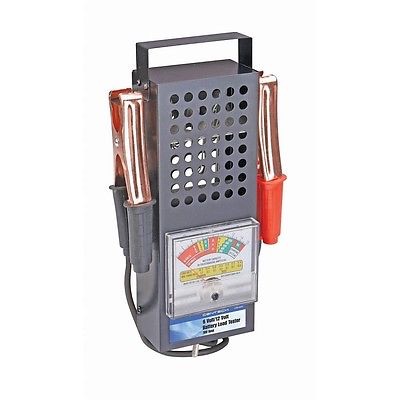
One important tool I carry but rarely have to use is a battery tester. Make sure it has the capacity to check batteries as large as 8D which I think has around an 1800 AH rating. Batteries are central to our enjoyment of the coach and having a multi-tester and a battery tester enable you to determine the reason for almost any electrical problem. It is not a big deal if we have a problem when the bus is in the garage at home, but when we are on the road it is very important to understand what is going on so we can make good decisions.
Separate your chassis batteries, and charge them individually to float. If one is bad it will become very evident because it is likely it will take a long time to get to float if it even will. Additionally a bad battery may not hold a charge. But having a battery tester will give you a very quick and accurate answer as to the condition of the batteries.
It is not unheard of to have one battery of a set go bad internally, usually as the batteries age, but even when new.
-
Dick,
You could pull a cable on each battery and load test it, that way you wouldn’t have to pull all 4. If you don’t get any satisfaction from Interstate, take your PC card to Napa for their groups 31’s and replace all 4.
-
Any suggestion on a specific brand/model of battery tester? Thanks!
-
Mine is no longer in production or offered. I have had it a long time.
The best in my opinion are the electronic type that not only tests the battery but also can do a test on the charging system Perhaps an internet search will turn up some candidates.
-
A friend who races and is in the car repair biz has used Midtonics PBT-300 for years and is happy with it:
Maxs out at 12 volts so the batteries must be separated before it can be used.
It appears the price goes very high for a 24 volt tester. Midtonics has a great video on its web site of it high end tester testing a four battery bank in a Class 8 truck, no indication of whether its a 12 or 24 volt system. I presume 24. Everything with the batteries and the alternative checked out in the demo video. I would have liked to have seen how the instrument reacted to a single battery in the bank of four with a dead cell.
1999 XLV X-6872, liberty #440 -
We have only 12 volt batteries so the 12 volt limitation is OK. I think you should seek one that goes up to 1800 so you can also test house batteries.
Log in to reply.