
-

While Jon and Gil trade Q and A and flip sides of this topic… I’ll bring up another AUX air item.
This valve which for some owners is opened to aid leaking Prevost air systems. When this valve is opened you introduce pretty much unfiltered moister air into the Prevost side.
Gil, reminded me about this often overlooked valve. Normal position is…. closed.

Valve location in drivers bay right side. Direct air feed from AUX green tank when opened.
-
That’s just wrong. I cannot tell how other converters have added their aux compressors and how they added their circuits, but the aux compressor has to go to a moisture trap or water separator or some kind if air dryer before any air can backful the Prevost aux air system.
One of the most overlooked systems on our coaches is the air system, and espcially the converter side of the aux air system. There are owners who have NEVER drained the water traps provided by Prevost or the converter for the aux air and that moisture ends up in all of the aux system, valves, devices, air bags, etc.
I cannot over emphasize how important it is to keep the air systems dry and if there is a possibility moist air from the aux compressor can backfill the coach aux system without passing through a trap, separator or dryer that needs to be changed.
Maybe Diane or Larry can quantify the costs associated with water in the aux system.
-
Jon,
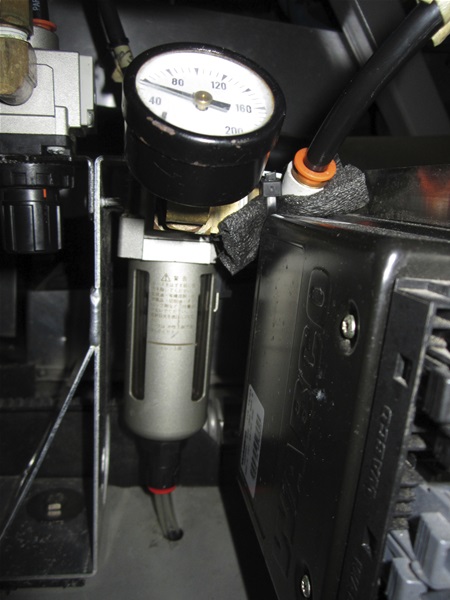
Here is the AUX air filter coming from the AUX reserve tank. I’ll admit it’s a filter but it’s not a filter dryer, mainly a dirt trap. There is some benefit to this filter but my point was supplying air to the Prevost system in an emergency thru the valve in picture without the engine running.
-
Jim go in steering bay put some ball valves on the aux lines , seat , step slide, air horns, gen air bags , waste valves, that will help you find where it’s leaking , I put one at aux comp. so I could shut it off before it went over to steering bay and check valve on rear air bags for fan ,mine would hold air for months on all three gauges and I put one before the the air came from the Prevost aux air tank to the Norgren filter in steering bay , I put it at the filter before it came into filter I would not worry about check valve at aux tank until you find where it’s leaking put valves and you will know
-
Al,
I assume you don’t have an active leveling system on your coach, like a HWH system or anything else that can continuously level the coach when parked. I also assume you can’t preinflate your engine air bags before starting the engine.
I wonder how many converters tie the Prevost and and Converter Aux air systems together.
The Prevost converter connection for Aux air has a pressure sensitive one way valve. So, when driving or when Prevost air is above some pressure, which I believe to be about 60psi, converter air can’t enter the Prevost system. The valve also doesn’t allow Prevost air to enter the converter’s aux system until it reaches the same or similar pressure. On my coach, I only use the converter’s aux compressor to inflate the engine bags, if they are down or when running the generator when parked. Otherwise, Prevost’s aux air supplies all the coach’s air needs.
I too have the Norgren water separator on the tie line between the converter and Prevost air systems. Given I rarely use my converter aux compressor I seldom get a drop of water out of the separator.
Jon,
I must have misread your post. The check valve can be installed in the right place even if the tank has a “T” to the compressor and the aux air supply.
-
Everyone needs to understand different converters set up the aux air differently. What is applicable to a CC may not apply to a Marathon and a Millennium or a Liberty may also differ from all others.
But generally all converters allowed their aux air compressor to backfeed into the Prevost aux air portion. Some Prevost coaches were set up by either Prevost or the converter to allow the aux compressor to also pressurize the brake system, although I have only seen that on one coach.
To add to the confusion some coaches can be continuously leveled via the aux air compressor when the coach is parked, key off. Others will disable the leveling system with the key off. So the bottom line is we all have to be careful when offering or taking advice relative to the covnerter’s installed aux air compressor and system.
Having said that I would urge everyone to learn their specific system and how it is set up. That is not only going to help when chasing leaks, it is also going to help you as an owner understand if you have a problem or not. As Gil mentions some coaches are set up so the converter installed coach leveling system work constantly with the key off to maintain the coach in a level condition. This requires the aux compressor to not only be on, but to be set to pressures that are sufficient to raise the coach at all positions.
If a coach is set up that way a compressor that runs frequently may be trying to maintain a level condition over riding suspension system leaks, or it may be compensating for windy conditions or people walking back and forth inside the coach. Understanding how the converter set things up allows the owner to determine how to best use the coach and how to isolate problems from normal conditions. A coach owner whose coach is not set up that way for example may not even realize coaches set up that way are going to be completely different than their own, and that system maintenance and repair will be different.
-
Yes… as Jon mentioned… the cost of drying out a wet system is horrifying not to mention the down time inconvenience and above all the danger having water in your air system.
When our airbags were removed some time back they had about a cup or so of water in them… I posted about this at the time… as it turned out our entire air system was wet… the dryer had probably never been changed and was totally clogged up. It took forever to make sure the lines were all dry, airbags replaced, new dryer installed etc. I begged the tech to change all the norgren valves at that time since they were all disconnected while the lines were being dried out… he refused saying he serviced them and they were better than new ! DUH !! Anyway the system was finally dry but we still had some leaks but nothing dangerous.
We have since replaced all the norgren valves and just replaced the dryer again for peace of mind. Almost every norgren valve was leaking we were told… so glad we got through that but the expense of doing the valves twice was very annoying. So happy to have it all fixed finally… don’t let anyone ever talk you into “saving money” by servicing an old norgren valve… I could have saved a bunch of money if I had gone with my gut on that one and not listenned to an “idiot” tech.
Needless to say we wasted thousands of dollars the first time around !!!
Don’t go there it isn’t fun!
Cheers,
Diane
-
Hello Jim! Just a quick question on our 99 H3-45 Featherlite. My aux air as of yesterdays little test drive to get things moving will only build to 60 psi. I did find a leak on the pitcock valve small tank passenger side front. Was wondering where the check valve might be located? Not sure what’s going on. A lot of back and forth info, suggestions etc in this forum. ????
-

Kent
My 2000 H3 (chassis date 1999} Featherlite aux tank check valve is on the back side of the aux tank.
BUT…
The tank is a pain in the A_ _ to get to. Lower the front bumper access, swing out the front Criusair, then look up. There is a sheet metal panel that has 3 sheet metal self taping screws across the front and a single screw in the middle of the panel. Once removed the piece of sheet metal can be slid out from the front and you will see aux tank tucked up above the Cruisair units.
Now the fun starts, the check valve is on the back side of the tank with little to no room to work with because of the Cruisair unit right below it. I was able to disconnect the air lines, unbolt the mounting brackets and wiggle the tank out and have full access to the check valve. If the Cruisair wasn’t in the way accessing the valve would be a lot easier.
Chuck
-
Thank you so much! I’ll take a look when I get back down there. Appreciate you!
-
To answer your question Jim, that is not normal. When you say Aux air goes right down what does that mean? 120 psi to zero in 1 hour? 2 hours? 6 Hours? I have more questions, but will wait til you respond to this one first.
Log in to reply.