
-

All our generator boxes need to have some ventilation and the fan has to be checked periodically.
By virtue of the fact the intake on the generator is drawing in a lot of air there is always going to be some fresh, relatively cool air supplied to the box, but a fan and its associated ducting provides the benefit of directing the incoming air to cool areas in the box that have the greatest need, such as the aux compressor.
-
Well, the ductwork that appeared to be blowing down was…….the fan blowing down into the insulation and blowing it up to look like the air was going somewhere else, see the wrinkle below the aux compressor.
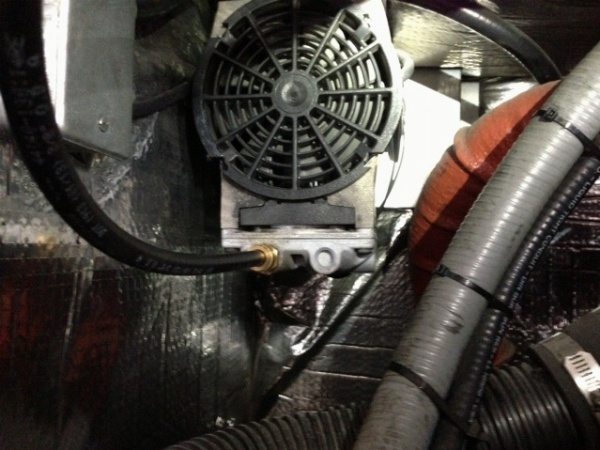 the
the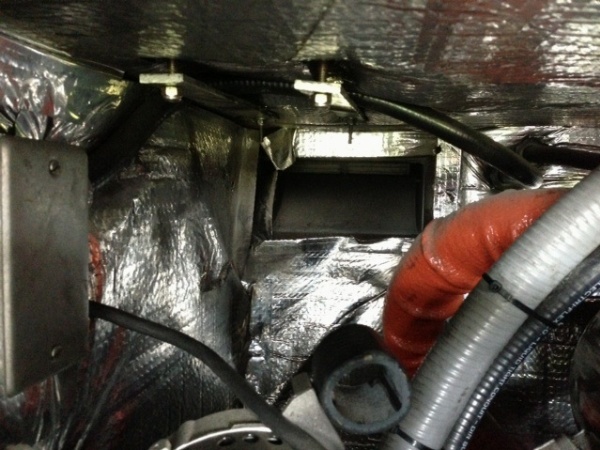
With the aux compressor removed, and the aluminum duct work removed (which directs the air down behind the compressor ), you can see how the squirrel cage fan was forcing air down into the insulation because of a raw cut edge with no molding.
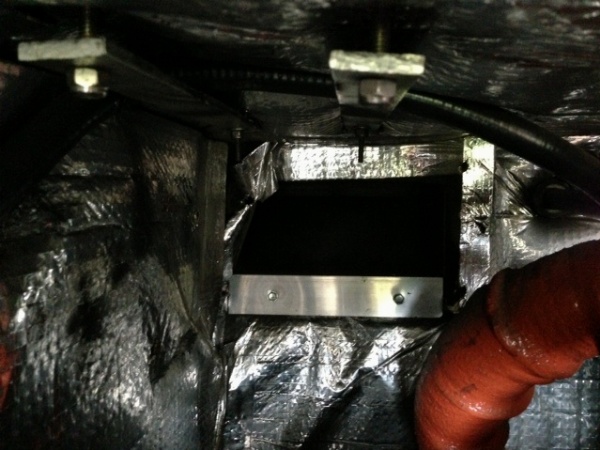
I installed a piece of 1 1/2″ angle aluminum to the edge to stop air from getting in between the wall and the insulation.

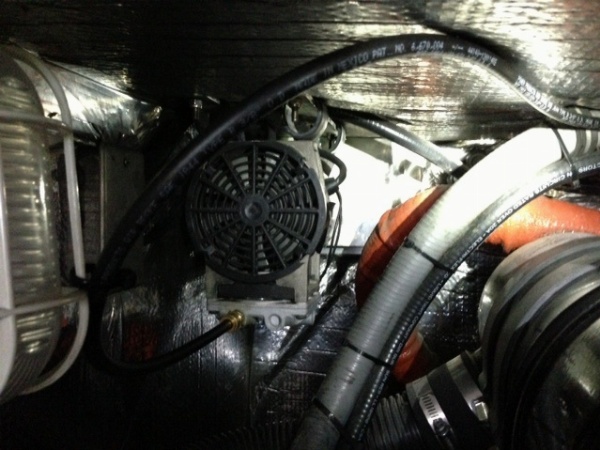
All back together, should have a cooler aux compressor now.
Thanks Jon for making me aware that there was a fan somewhere in that box!
My arms were almost not long enough to reach back there, LOL
-
Good job.
No matter how much I think I know my coaches I continue to learn how our converters dealt with the design. As silly as it sounds looking at a specific area of the coach for a while often reveals little details that we can store in our brains for future reference. I am in awe of how much thought has gone into converting an empty shell.
-
My 04 Marathon has a crappy design fault regarding the Aux air compressor.
The compressor is located in the Generator compartment, which I generally like due to its quietness. The output of the compressor feeds into a T fitting with one side going to the Aux system and tank, and the other going to a pressure regulator that serves the generator air bags.
The fault is that the generator air bag system is fed unfiltered air. Water is the big problem here. When I picked up the coach last month, the air bags were flat and their regulator was corroded and frozen. When I pressed the air bag deflate button, water poured out. Steve (at Cal Coach) told me that some guys have experienced a complete fill up of the generator bags with water!
So, I bought a new Speedaire regulator/filter combo from Grainger and installed it. Yes, it’s a complete overkill solution for a 20psi service, but the interesting note is that I’m getting a couple of ounces of water (a full bowl) almost every day down here in the South, where I’m presently located. I’m also draining the main aux tank almost every day and it’s not quite so bad (a lot less water). There is also a speedaire filter in the steering compartment but it seems to have an auto-drain feature. I haven’t heard it work and don’t know it’s condition.
Still, I’m left wondering why Marathon didn’t setup the compressor air bags after the main filter. It would have required only about 6 feet of air line to properly install.
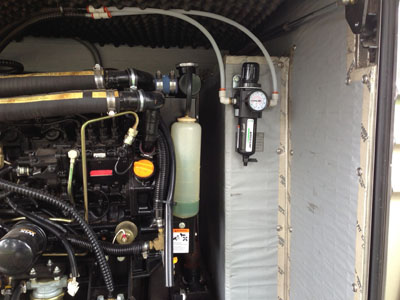
The new regulator/filter
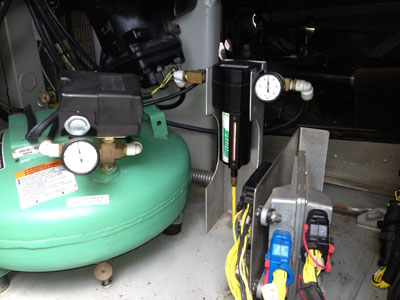
The existing Marathon filter with auto-drain feature
-
Fred, my experience with Marathon is non-existent but one thing I do know is water is a major issue with aux compressors and that aux compressors need a water trap or separator that is easily accessed for service. I also know the aux compressor connection point needs to be at the connection point identified and tagged by Prevost as the converter connection. That is in the steer compartment and I believe on our vintage coach there is also one in the area between the RH tag axle compartment and the RH engine door.
The actual physical location of the compressor is not as important as it being directly connected at the converter point and using the water trap or separator located in that area. My aux compressor is located in the middle of the coach, but its connection point is at the place priovided by Prevost so it is not much different than your set up except feeding wet air to the generator air bags is not good.
-
Isn’t the filter installed next to the aux compressor the first place air goes that leaves the aux compressor? If so, the air to the bags should be dry, if the dryer is working. I assume you aux compressor cycles quite a bit or the amount of water should be near zero when the compressor is off. If it does cycle often, why not turn it off, unless you have an air operated toilet or doors?
It looks like you have a good fix for the sympton.
-
Is your new regulator the type that adjust for temp increase of hot air ? The auto discharge type of regulator is needed at this high heat location.
Spending nearly a month fixing air leaks, unless the correct regulator is used in the mini air bags low pressure requirement the pressure will climb to a dangerous condition from high heat in the generator bay.
Attached to our regulator in the generator compartment is a tag asking for 25 lb.. For mini air bags. Yours looks the same as mine and I wonder why your at 20 lb. ?
The filter regulator under the drivers seat are known for leaking air out of the auto discharge drain. The new style SMC regulator has a better auto drain and is more reliable. I had my original rebuilt and about 6 months later found a very slow leak out the water drain hose. This time I replaced the entire regulator… $400
The last thing I see is the original drain valve on your green tank. It’s a hand tighten wheel. It leaks now or will in the future. The valve inside is a round ball against an oval for seal. As water is present the brass becomes pitted and a small leak starts. Had to shop around for a compact style gate valve to clear the narrow space.
I just wanted to run this by you so you’re not a victim of a freak accident in the generator bay.
Another item to check is the mounting of the AUX compressor on top of the generator. Over time the rubber pads had hardened allowing the compressor to jump up and down when starting and stopping.
AL
-
No, I guess I didn’t buy the temperatuire compensated model. I guess that means living on the edge 😉
I did note that the tubing I used was rated for 150 degrees F and the regulator for 125. That left me wondering just how hot we can expect the generator compartment to become. It’s probably not good in this case. I’ll have to put a remote temperature probe in there and wait until I get back to Phoenix. The compartment is force cooled with ambient air, so it’s anybody’s guess.
The 20 lbs bag pressure was a typo. I rechecked and mine says 25.
That filter regulator uknder the driver’s seat. It just looks like a filter to me. That would be the one with the yellow tube running down, just to the right of the tank?
My compressor is mounted on flat, reinforced rubber which looks like conveyor belt material. It’s solid.
Right now I’m sure I have a bunch of leaks in various spots. I’ve listened to my compressor when it shuts off and I can hear air coming back from the line, for a moment, and then it stops. Sounds like a slow check valve.
Another concern is my Prevost Aux system. It’s draining down to zero when we park. I’m not sure exactly what this system serves, other than the fan belts.
In my cursory examination of the Marathon stuff, it’s a pneumatic nightmare. Air is everywhere onthis coach and there are regulators squirreled away in numerous places, behind panels, etc.. My coach has a few “extra” pneumatic items such as a pop-up TV in the salon, and an air operated Joey bed, plus 4 air operated interior doors. Going over it all seems nearly hopeless, given that I can barely hear hissing sounds to begin with 🙂
By the way, I did find a way to hear high pitched hissing sounds. I got a “stethescope” app for my phone and so with a pair of ear buds, I can use the phone’s built-in microphone to find all sorts of faint sounds!
-
Fred,
If you have slides you need aux air. The slide seals need to maintain pressure to protect against the elements.
If no slides the need for air depends solely on how the coach was set up and how you use air devices such as pocket doors.
-
I can’t tell from your picture, but your hissing from the compressor MAY be the same problem I had. In my case the aux compressor has a pressure regulator as the last item before going into the Prevost system. If the regulator is set for less than the Prevost system air will back feed through that regulator until the pressure drops to the regulator’s pressure. The fix is to put a check valve as the last thing leaving the aux compressor. This would also provide added degree of protection for any failure of the aux regulator or tank. There’s probably already a check valve between the compressor and the tank and it should remain there. It’s just not the only one you should have.
Your configuration may differ, so check first.
-
flloyd,
Back a way’s on this Pneumatic forum dated …3/7/13…Air leak repairs. Those 63 posts might be of interest to finding some of the air leaks you might have.
I tried to find one leak and went a little nuts going after the whole system. By the time I fixed everything and spent about
$10000 I have reduced my Aux compressor running once every 7 days when parked in the bus barn.
IMHO the “mother” of all Aux leaks is the check valve mounted on the Aux compressor. As a maintenance item this valve should be changed out every 2 years.
My most costly fix was the air toilet valve and related parts costing around $5000
I hope this may be some help to you in getting a handle on the Aux system . As another Marathon owner, if I can help you just let me know.
-
Wow! Having an aux compressor that only runs once a week is a phenomenal accomplishment.
I was thrilled when I managed to get ours to run only once or twice a day.
Congratulations!
-
Thanks Paul, appreciate it.
Can’t take all the credit as Marathon was a big help installing electronic air sensor valves at many locations. This little valve holds the air in the supply line. So when we hit the button to activate an air cylinder there is a micro hesitation as the air rushes to what ever.
Clean dry air is very important on the Marathon AUX air system.
These little dudes about the size of pack of stick matches can also leak slowly. Checked for leaks on the out bound air side.
-
It is a given that our coaches either have air leaks or they will have air leaks.
It is also a given that the effort to find the leaks, repair them and keep the coach “leak free” is a never ending job of epic proportions. I believe Prevost and our converters know this and as our coaches have evolved and the use of air for the various reasons on the chassis and the house have become more widespread some efforts have been madeto minimize the impact of air loss.
There are two ways to make the loss of air less. The first is the most difficult, time consuming, and permanent. That is to follow every single air path, correct every leak, and if possible replace leak prone fittings and devices. The most obvious change is to go from push in fittings to compression fittings, but replacing such things as check valves is also on the agenda. This method of addressing leaks ultimately ends up with the owner using every single leak detecion method, including Hector’s bubbler. When the job is done however for one minute you will have a leak free coach. After that first minute the coach starts developing leaks again, but at least the owner feels a tremendous sense of accomplishment not only for the completion of a hard job, but for the knowledge gained.
The second method of dealing with leaks is to ignore most of them and install valves to hold air back from the circuits and devices that may have leaks. That works until the valves themselves start leaking, but until that happens life is good. The coach when manufactured already employs that concept to an extent. The suspension system logic uses 5 port Norgren valves that shut off all air flow when the key is off. Theoretically if there is an air leak in the suspension system ahead of the air bags controlled by the valve, the air is at least locked into the suspension so the coach doesn’t lean. Some coaches also have solenoid valves in place that (as Al describes) block the flow of air to various devices and circuits. The device or circuit may be a leaker, but if the valve stops flow to the circuit except when needed the leak has no effect on the aux air system pressure.
Bottom line………if you want a leak free coach get ready for a lot of work, but when you accomplish that goal, however you did it take a bow. You deserve it. One piece of free advice: Never turn your coach over to anyone or any shop with the instructions to fix all leaks. To do that you need access to the gold in Ft. Knox.
Log in to reply.