
Prevost Community Forums

Find answers, ask questions, and connect with our
Prevost Community around the world.

  • Aux Air Leak – I need a plan

    Posted by Clint on November 3, 2023 at 4:31 pm

    Seems I’ve got a pretty significant aux leak, I go from 125 to 50 psi in about an hour. So I need a plan on how to troubleshoot this. I’ve read lots of aux air threads and this seems like a right of passage for a new owner.

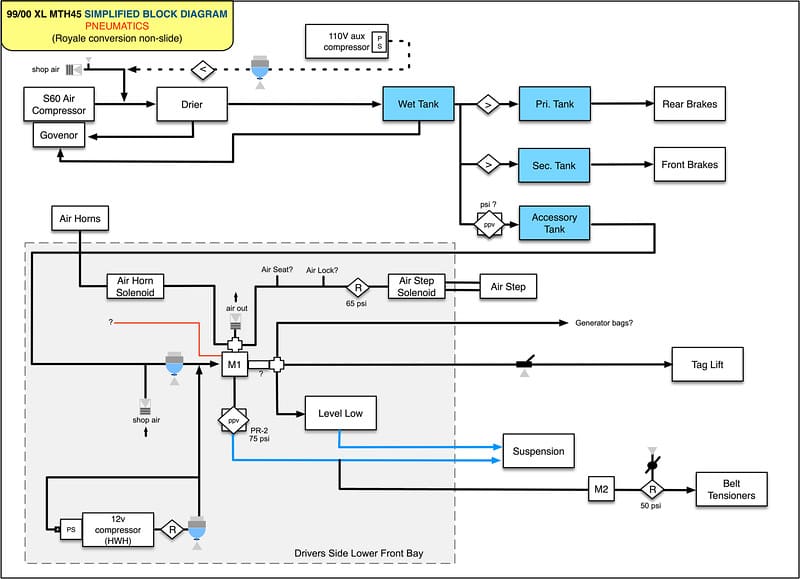
    I started by trying to identify how aux air is plumbed on my bus and creating a diagram. I also referenced the pneumatic diagram for my particular bus along with the parts and repair manuals. Unfortunately I still have some questions.

    Here’s how my bus seems to be plumbed (diagram below).

    * the 110v aux air compressor connectivity is just a guess based on it’s location in the bus, 4th bay passenger side.

    * I do not know where all the check valves are, so where I placed them on the diagram is from past experience with other coaches.

    When I get to the bus tomorrow (after a week) I expect aux air to be at zero. I leave the aux air pump off.

    I expect the primary and secondary gauges to be at 90 psi.

    Any suggestions on a sequence of test to do? Does the diagram look right? Currently while in ATL I don’t have access to get under the bus but I think much of the aux air plumbing doesn’t require that kind of access. When I get back to TN I have a pit so I can chase things down more.

    Clint & Tammy Summers
    2000 XL 45 Country Coach (rivets)
    1977 FC31 Bluebird Wanderlodge (more rivets)
    Vonore TN

    George replied 2 years, 9 months ago 8 Members · 11 Replies
  • 11 Replies
  • Jack

    Member
    November 3, 2023 at 6:27 pm

    Prevost maintenance instruction – MI22-12B

    Air tank drain sequence – revision B

    https://techpub.prevostcar.com/en/download?id=1549&type=bulletins&mode=view&file_lang=en

  • Clint

    Member
    November 3, 2023 at 7:51 pm

    Clint, that is a pretty good leak you should be able to find pretty quick.


    Clint & Tammy Summers
    2000 XL 45 Country Coach (rivets)
    1977 FC31 Bluebird Wanderlodge (more rivets)
    Vonore TN

  • Art

    Member
    November 3, 2023 at 9:45 pm

    Very sizable leak… would think you should be able to hear it.

    If you are not parked inside a quiet enclosure, perhaps go listen EARLY one morning.

  • Clint

    Member
    November 4, 2023 at 9:08 am

    I have the same type of leak. I now have the bus setting up fine after replacing all air bags and norgren valves. Now the bus air will leak down to 60 lbs in about 20 mins. You would think I could set in the house and hear that kind of leak. When the air drier wants more air you can hear air moving through the system, but I can’t find where it is coming out. I will follow this thread and hope someone will come up with an answer.


    Clint & Tammy Summers
    2000 XL 45 Country Coach (rivets)
    1977 FC31 Bluebird Wanderlodge (more rivets)
    Vonore TN

  • Clint

    Member
    November 4, 2023 at 12:40 pm

    Don, thanks for the link. That’s very helpful and the next time I’m at my TN place I’ll try and work this process.

    Yeah, I agree, should be able to hear this. My ATL storage building is near a busy road but I have an ultrasonic leak detector so maybe I can find it.

    Anyone know what the tiny red air line in my diagram above is for? I realize that per the color code standard this would be secondary air, but I’m not seeing what this would have to do with the rear braking system.

    Could it be the dash aux air gauge? Here’s a pic? Maybe Royale didn’t include one and a prior owner added?


    Clint & Tammy Summers
    2000 XL 45 Country Coach (rivets)
    1977 FC31 Bluebird Wanderlodge (more rivets)
    Vonore TN
  • Clint

    Member
    November 4, 2023 at 1:00 pm

    From reading, it would seem there’s nothing magical going on with the air system, it’s just requires some modifications that allow for better isolation to aid in leak detection.

    Here’s my stab at the manifold and ball valve approach that others have used. Hopefully next summer I’ll have some time to do this.

    I know this is old hat for many of you but I would still love to learn from past experiences, lessons learned …etc.


    Clint & Tammy Summers
    2000 XL 45 Country Coach (rivets)
    1977 FC31 Bluebird Wanderlodge (more rivets)
    Vonore TN
  • Mike, 92 Country Coach

    Member
    November 4, 2023 at 7:02 pm

    I put a check valve at small compressor line where it ties in up front and I never use aux compressor so I put in a shut off valve at compressor, Remember aux gauge is the same psi as wet tank there is no check valves between the aux and wet tank, But there is a PP1 valve on aux tank from wet tank, And can air leak back through engine compressor? That’s why I put in unloarder Kit on Bendix compressor. And does the dryer have a check valve in it to prevent air from coming back through engine compressor, I also replaced dryer

  • Chuck & Katrina

    Member
    November 5, 2023 at 4:56 pm

    Thanks Art. Roger that on the PPV between Wet and Aux, I show that on my first diagram above. I’m not sure what the crack pressure is – 75 psi?


    2000 Featherlite H3-45

    2024 Jeep Grand Cherokee

    Leesburg, FL
  • Mike

    Member
    November 5, 2023 at 5:15 pm

    Just returned from a full day of leak isolating. Long story short, it started with one P2C fitting for the air seat but quickly became game of wack-a-mole with other P2C fittings. In the end to isolate I just disconnected a bunch of converter stuff and put plugs in the manifold.

    After that, my aux air loss went from 70 psi in 15 min to no noticeable loss in an hour. I consider that a small victory.

    So now I’ve got to figure out what type of manifold and ball valve setup to get for the converter aux air.

    Everything highlighted in the diagram is now disconnected.

  • Archived

    Member
    November 6, 2023 at 7:54 am

    Clint:

    Going down the same rabbit hole as you after I get home from my current trip.

    Plan on disconnecting most of the Aux lines in the steer compartment and using a custom made quick connect to each one with the shop compressor to try to find my final leaks (so I can say I stop them all, then start over again LOL).

    Chuck

    P.S. Plan on labeling each line once I figure out where it goes.

  • George

    Member
    November 6, 2023 at 12:18 pm

    it’s a rabbit hole for sure.

Log in to reply.