
Prevost Community Forums

Find answers, ask questions, and connect with our
Prevost Community around the world.

  • Inverter Loss Warning

    Posted by Fred on June 12, 2014 at 12:22 pm

    The other night, on a cool evening with no A/C’s running, suddenly a red light came on the dash along with a buzzer saying “Inverter Loss”. Earlier, I had noticed a slight flickering of the lights and the refrigerator had been flashing a “service” light. Now my worst fears had come to pass: the loss of a 4000 watt inverter. Since the problem had followed us to more than one campground, I knew that it wasn’t the park power.

    It was late and so I pulled out the manuals and started reading. On the inverter panels, one was reporting input voltage (shore) of 104 volts while the other, 118 volts. I checked the plug and it was cool, as was the pole breaker and socket. All looked good. I cycled power and the inverter was still not happy, refusing to go into Shore/charging mode. The other leg and other inverter was OK.

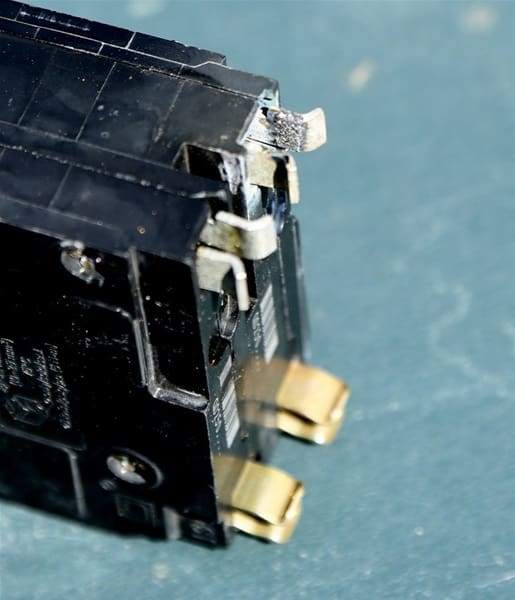
    Next, I started the generator. Everything was back to normal and both inverters were happy. This led to a conclusion that perhaps we had a transfer switch problem. The next day I contacted Marathon and they suggested that I have a look at the main shore power breaker. I removed the breaker box cover and didn’t see anything particularly amiss and measured voltage with my voltmeter. 115 on both legs, so far so good. I then proceeded into the relay box and started taking voltages when suddenly I heard some faint noises and a tiny spark caught my eye. It was the input shore power breaker. The cable leading into it was arcing at or near the connection, and the orange paint was black on the lug.

    My first concern was where to get the replacement parts. The breaker, a Square-D, was a common type, easily obtained. The breaker box backplane, also damaged, was another matter. Looking inside the box, there were no usable part numbers for the box itself so I took the cover and headed over to the local Graybar distributor here in Colorado Springs. Fortunately, the desk clerk recognized the box type and promptly produced a new one from the back room. It was a perfect match. It was a 1-gang breaker box and the cost was $33. The breaker, $60, oh well.

    Below are a couple of pictures of the problem components. Someone asked, “how does that happen”, the answer, simple: a little bit of resistance and a lot of current creates heat that, after a while, will destroy the part. Here’s what they looked like:


    Hope this helps someone 🙂

    -fred

    Raymond replied 12 years, 3 months ago 5 Members · 9 Replies
  • 9 Replies
  • Glenn

    Member
    June 12, 2014 at 10:55 pm

    Thanks, Fred. I’m glad you had a relatively simple fix, and it was an interesting read.

  • JIM

    Member
    June 13, 2014 at 7:00 am

    Everybody should keep in mind that each converter has provided the means of enabling us to detect problems. The method provided for indicating a problem is going to vary. It could be a light, or it could be a readout of voltage or some other way for us to realize something is not working as it should.

    Our job as owners is to understand how we are “informed” there is a problem because in a lot of instances the information alerting of a problem is not obvious and we realize there is a problem only when the batteries go dead or portions of the system shut down.

    As if trying to figure out how to interpret clues to issues is not enough of a difficulty, we as owners also have to interpret if the problem we finally see is related to the chassis or the house. The trouble is we always learn this stuff when something breaks or fails. That seems to be when we figure out the information was available, we just didn’t realize it was there.

    Fred’s post is an eye opener for me because I now realize I have a lot of information available to me ranging from voltage gauges, to digital amp and volt readouts, to little LED lights. But I also have a remote panel for the inverters that provides a lot of information but I don’t make looking at that information enough of a part of my scan to make sure everything is working OK. Good post.

  • Archived

    Member
    June 13, 2014 at 9:05 am

    So maybe my question will be helpful, or maybe I am just hijacking a post. In any case, here goes.

    Yesterday we had a strange beep, intermittent, that I couldn’t find coming from the bedroom. Either it disappeared when I started driving or I couldn’t hear it. After we stopped I noticed that the alarm clock next to the bed was flashing 12:00, like Jon’s VCR, so I set to the correct time. We were parked at Wally World outside of Bangor, ME, so no A/C (or even heat) was necessary and we just watched some telly on the inverters and went to bed. Around 2:15 the beeping returned, bedroom AND dash. I reset both clocks and returned to bed. A very few minutes later the bedroom clock screeches again. I reach up and reset it, which only seemed to piss it off as we fought for 60 seconds over what time it was going to be, 12:00 or 2:23. Eventually I won, but this was a game I didn’t want to play all night. It struck me that the gen auto start hadn’t kicked on, so I started it manually and slept the rest of the night.

    Why did that help?

  • Fred

    Member
    June 13, 2014 at 10:03 am

    My guess is the coach was telling you of low house voltage.

    If you had the auto-start engaged it should have sensed the low voltage and started the generator, but apparently it did not. Since we don’t know how much current draw you had it is unknown if the batteries have also shown they have a problem or if they are nearing the end of life so that is something also to monitor closely.

    The next time you are dry camping after driving and the batteries are fully charged, try to get a sense of how much current you are drawing. Lighting a lot of house lights, watching TV, plus having other normal loads such as the water pump, aux compressor and phantom loads will take the power out of batteries and as a result you may not make it until morning before they need charging. But if you have not been using a lot of power your 4 house batteries should still be above 24.5 volts when you wake up. That is the performance I see and expect.

    The second issue is to see if the auto-start failure is an isolated incident or if the Watchdog is starting to have a problem. Both can the battery and Watchdog issue can be determined on the next night of dry camping.

  • Archived

    Member
    June 13, 2014 at 10:11 am

    Many times with successive driving stoping with invertor use and then driving again, your driving will not be sufficient to charge your batteries fully.

    Using the generator, sometimes even when you are driving, is necessary!

    JIM

  • Archived

    Member
    June 13, 2014 at 11:08 am

    JIM touches on a good point that everyone should be aware of. Tom is our resident battery guru so maybe he can elaborate.

    Our coaches are setup to charge at around 27.7 volts more or less.

    However some batteries require an initial bulk charge of 28.4 more or less, maybe even an absorption charge of the same voltage before going into float. That means if the batteries are not getting the proper 3 stage charge all manufacturers suggest then the charge they carry is inadequate. To add to the problem, some coaches that can run multiple AC units from inverters while driving may be taxing the total output from the alternator and the batteries are not even seeing the charging current they need because it is running AC and other house devices.

    Our best house battery charging source is our inverter. If not running from power pole to power pole Jim’s recommendation to run the generator is an excellent piece of advice.

  • Archived

    Member
    June 13, 2014 at 5:13 pm

    I did see that the draw at the time was only 3 amps on one leg. Is the guage on the dash where I see the house voltage?

    Not too many days ago I did have an autostart happen, so it’s working, but the bus was parked outside and I wouldn’t have heard the screeching of the clock.

  • Archived

    Member
    June 13, 2014 at 8:06 pm

    I use the dash voltmeter because it is easy to see, but if I want to get more precise I read mine off the inverter remote. I think you have the remotes with the battery voltages in 1/2 volt increments so either your dash or the remote panel would be comparable.

  • Raymond

    Member
    June 14, 2014 at 10:56 am

    Ah, I never even noticed that that was available on the remotes. I will watch now.

Log in to reply.