
-
XL A/C Question
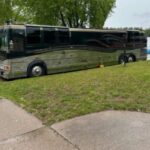
Posted by Andy on May 8, 2015 at 5:43 pmI realize there are many posts regarding A/C, and I hope I can get some input on my dilemma. You’ll see below a photo of an XL I’m renting for a very long trip over the Summer. I had the opportunity to do an overnight trip to the Bluewater Resort in Key West earlier this week and a question came up about the usage of the A/C while on the 50 amp shore power. Allow me to say upfront, that electricity and HVAC systems are far from being an area of expertise for me. So, here’s the questions:
1) As you can see in the photo, there are five A/C units on this coach. While driving, the A/C worked fairly well. However, when camped and connected to shore power, I was told that only three A/C units could be connected. While part of the issue we had was one of the A/C units simply wasn’t working, I was wondering if I’m receiving good information in that only three A/C units can operate on 50 amp power? I get confused on the 110v/220v thing and could use some guidance whether I’m receiving solid information. I’m one of those who prefers cold coach in the Summer and I was under the impression that this specific Prevost XL was designed to stay cold on the road on while on shore power. I’ll add this model has twin generators with one acting as a backup. So, the question is: Can this coach only run with three of the five A/C units while connected to shore power?
2) When the A/C units are running on shore power, is there an easy way to understand just which appliances can be operated? TVs? Microwave? Range?
]

Yes, I’m a newbie and greatly appreciate the knowlege by those wiser than me!
Peter replied 11 years, 5 months ago 11 Members · 19 Replies -
19 Replies
-

Three AC on shore power might be the max depends on what else is on if its 50 AMP
-
Running 14 amps each. start up requires 18 amps each. rule of thumb taking in several models. Plus anything else you might use. for instance hot water can easily pull 20 amps if electric. micro 10 to 12 amps To figure ams X volts = watt. Most things have a tag stating watt. Also a old unit or dirty AC will pull more amps to run. FWIW
-
That is hard to answer not knowing how it’s wired. It’s setup as an entertainer bus, not a motorhome. Rock Stars generally are not bus savy and are known to push buttons until something comes on.
They may have it wired that way so you can only run 3.
3 roof airs operating correctly should freeze you out, I don’t care what climate your in. My bus I can run 4 with tv’s and only did that one time.
It was 98 degrees with 95 % humidity, we shut the blackout shades and went back to normal with 2 running.If the bus is heat soaked pulling in, run the generator and turn them all on. Cool it down and go to shore power and run 3.
From what you are describing I don’t think they are performing as they should. Anything you can do to keep the sun out will help.
Entertainer buses are made to run on Gen power, that’s why you have 2, in case 1 goes down. They rarely plug in and if their advising only 3 on shore power I would listen to them.
Also I would shutoff at least one if you are using the microwave or convection oven and also a hair dryer
Later
bv -
Agree with Bernie…my 40ft XL2 only has 3 roof airs, most of the time I need only one, I would only ever run 3 if the coach was completely heat soaked and it will get cooled down quickly…running down the road I usually just use the bedroom ac and teh das air, maybe the salon air as well if it is super hot, and I can run two off the alternator via the inverters.
They put 3 roof airs inthe 40ft coaches and 4 in a 45ft…which I think is plenty.
-
If the shore power is 50amps, all you can ever draw is 50amps and then the main breaker will trip. All electric motors draw more than their stated, steady draw amps on start up (as stated above). After your trip, and certainly after owning a coach for a while you will become an expert on volts, amps, and watts. Watch the amp usage readouts on the electrical panel, you’ll learn.
For sevens years my office in Milwaukee was on the 11th floor of the M&I Bank building (now BMO) facing west towards the MIlwaukee river. I had an excellent view of every entertainer coach coming and going from the Pabst and Riverside theatres. Almost everyone of them had five roof air units.
Regarding the coach you’re renting this summer. Is the inside lighting incandescent or LED? If its warm out (above say 55 or 60 degrees) incandescent lighting should easily heat the coach unless its completely overcast and you have a 40mph wind. When its warm to hot out, incandescent lighting works against you in two ways. FIrst it draws lots of current; i.e. amps. If you’re on shore power running two A/C units, trying to heat water for showers, and running the microwave you need every available amp you can get your hands on and incandescent lighting is waste those amps. Second, incandescent lighting creates heat in the confined space of the coach. Heat that has to be pumped out of the coach using those precious amps from shore power. That’s why most of us are converting as of our coach lighting to LED. Much cooler, uses dramatically less energy.
The same works for lighting in your home or office.
Keep the questions coming.
-
Thank You!
I have a lot to learn! When and if it comes time to build a coach, it seems that getting a roof that’s loaded with solar panels will be a great option. Until then, I’ll have to figure out how to rig a windmill!
-
PBG,
I by no means am an expert here but couple of things that might help you out….its important to understand which AC unit it wired to which leg of your 50 amp service. On our marathon we have a techlink system that gives you real time load draw on each leg. As others have said if you get near 50 the odds of tripping something either inside the coach or outside at the pedistal increase.
After a year in the bus power management comes easy now but at first it wasn’t so easy. The only way in our bus you can run everything AC is with the geny on. 50 amp shore power is not enough to run multiple acs, hotwater heater, cooktop, dryer etc.
Hope that helps
Bill -
PGB,
Forget the solar panels. Filling the roof with them will provide some assistance with power, but you still have to learn how to manage energy due to a variety of factors.
First, 50 amp service is really the availability of 100 amps total because you have 2 50 amp legs of power entering the coach. The key to operating on 50 amp shore power is to insure neither leg exceeds 40 amps (a conservative limit). As you become familiar with a coach you learn how much current various devices require, and you learn which leg they are on. That information helps you determine what you can run and when you can run it.
This is a fairly detailed topic to try to cover on a post but suffice it to say you need to consider what devices are always going to draw current and which operate automatically and you don’t control when they draw power. For example let’s assume you want to run the AC units. Let’s assume you will run three of them. Each will draw as Bob says about 13 or 14 amps, or a max of 28 amps if two are on one leg. Inrush current on start up is quite high, but if the circuit is conservatively loaded it will not trip a breaker. That load is well below the 40 amp limit I suggest you remain at or below.
But what if the HW heater, the water pump and the auxiliary air compressor are on the same leg. Each of them might draw up to 10 amps each and you have no control over when they might kick on. That would add 30 amps to the leg exceeding the 50 amp limit and tripping a shore power breaker.
The key to energy management is knowing what you can use, and turning off those loads temporarily that will exceed the limits. For example, if you are going to run the washer and dryer you need to think about what other loads you have on. Same iwth the electric range, the outdoor grille, and even heavy 12 or 24 volt loads if you have the inverters set for a high charge rate.
One the other hand, if you temporarily want to run a lot of heavy loads, run the generator. If you are tailgating on a hot summer night, and you have all the lights on, you are cooking on the grille, you are heating chili on the kitchen range, folks are running a lot of water, the TVs are going in three places, and you want to run all your AC units you know shore power is not going to handle your needs so just crank up the generator.
-
To add to the above, energy management is different for a motor home compared to an entertainer coach.
We have a 50 / 100 amp limit on shore power, but a 20 KW generator has a 167 amp limit so there are less concerns about energy management. Entertainer coaches often do not have OTR so they are totally dependent upon the roof air units. The typical entertainer coach likely has 5 units on the roof, maybe more. They want to be comfortable so they have ample capacity to cool the coach, and even if one unit has failed they still have adequate cooling. But to run all the units, plus whatever other devices draw power generators are used and they typically are started at the beginning of a tour, and shut down at the end of the tour. Some entertainer coaches have 2 generators, not only for reliability and backup, but so one can be serviced while the other is carrying the load.
Entertainers that lease coaches are not going to worry about energy management, It is not their coach and they just don’t care. It was stated earlier they just mash buttons until something works and that is a pretty accurate statement as to their expectations. It is not their coach so the typical entertainer coach is built so it is “idiot” proof.
The motor home owner is not going to be running his generator like the entertainer coaches will do. Nobody at the back door of a hotel or arena cares about the diesel fumes from the coach. But if 50 coaches in an RV park are running their generators 24/7 it is not going to be pleasant so some might even restrict their use so you have no option but to manage energy.
As to keeping cool………..the debate will rage on about how many AC units you need running to keep your coach cool, but what is not disputable is part of energy management is to never let the coach get heat soaked so you do have to run all AC units. Once cool most coaches can stay comfotable with 2 units operating which allows for virtually all the other devices you might consider using to be turned on. Most of us just make sure the 2 AC units being run are on two separate legs.
-
Just to follow up with a question on Energy Management. For a new owner, Do you folks recommend cycling everything on/off individually to see how many amps each draws to determine what you can run at the same time and what you cannot?
Also, once you do run your generator, is your coach completely running on the generator or do you still have access to the 50 amp plugged in service?
-
Thank You again for all the helplful responses. This leads to a related question:
In terms of common courtesy to the neighbors, if I’m going to be camped at a RV park for two nights when it’s hot/humid, is it acceptable to run the generator over night if I find I need the additional cooling or if I need to operate the kitchen appliances/hot water, etc. and the A/C simultaneously?
And, one more thing…
When parked at a RV park, what’s the protocol on running the exterior coach lighting?
-
We dry camped at Daytona for the 24 hour race in January and were packed in tight. In the area we were parked in there was another Prevost and one 40 foot S&S M/H. Our diesel generator would run automatically when the batteries got low. As we got ready for bed and the generator was running I would manually turn it off, then reset the “auto-start”. Our neighbors thanked us each night as they sat around their campfire of treated timbers, used gear lube, and smoked enormous domestic cigars. With almost no draw on the batteries, the generator stayed off all night. There were lots of other generators in the area, but with the exception of the other Prevost, the S&S M/H, and us they were gasoline generators which were quiet (to a point) and didn’t smell.
We’re at an RV park in Holland, Michigan which bluntly states “no generators”.
When we’ve parked in RV parks, I’ve left the outside lights off … unless I left them on by accident.
Once you understand more about amps, volts, and watts you’ll be ready to move on to things like amp/hours and stuff like that. I think you’ll find that today’s solar panels (even if they covered the entire roof of a coach) won’t provide enough power to run much in the coach continuously let alone an A/C unit. They probably contribute to keeping the batteries of a coach topped off if its parked outside just sitting. Maybe someone else’s experience has been different or has done better research on the subject.
-
I have been down the road of overloading with AC’s. Typically the shore power we get in an RV park is low. We bought a power booster to maintain levels of power coming out of the pole ($600)
Last summer I just about blew up everything running 5 AC’s, stoves and everything else imaginable like an idiot.
As stated above, the GEN is the answer to cooling off the bus. The other answer is to go north during the summer where it is cooler.
Safe Travels.
-
I have been down the road of overloading with AC’s. Typically the shore power we get in an RV park is low. We bought a power booster to maintain levels of power coming out of the pole ($600)
Last summer I just about blew up everything running 5 AC’s, stoves and everything else imaginable like an idiot.
As stated above, the GEN is the answer to cooling off the bus. The other answer is to go north during the summer where it is cooler.
Safe Travels.
-
If we have needed our generator in any situation (even if prohibited) we have used it. It’s so quiet no one has ever noticed. We just used it 24/7 for 3.5 days in the paddock at Daytona and ours was almost silent compared to the toterhomes, other MH’s and trailers around us. We don’t leave any lights on after we retire for the night. You can see how much power individual items use by turning them on at the panel and seeing the increased draw. Any properly converted unit will not limit you much. That does not mean you can run all your AC, W&D and HWH all at once. Just watch your panel and you will learn how to stagger your appliance use without giving up any AC. Do not let the coach get heat soaked in hot weather. Geo.
Log in to reply.