
-
Working safely under bus?
Posted by Art on March 7, 2017 at 10:01 amWhat’s the safest and best way at home to work under coach? Is it stager lumber and roll upon it both duels and tag, not sure, can anyone give me some ideas ?
Bill replied 9 years, 7 months ago 13 Members · 19 Replies -
19 Replies
-

If you are working under the bus, unless it is lowered all the way down before you slide under your only option is to support it at the chassis support points. I successfully did almost everything possible from a barn floor, including changing air bags and brake chambers by raising the chassis as high as it would go and supporting the chassis.All the work you have to do takes place at the rear end or under the coach at the axles and you can sit up in there to do the work.
I now have a service pit in my garage but I still raise up the coach and support the chassis before I go under it. You likely will be reaching over things like the axles and that creates a pinch point so always protect yourself supporting the chassis at the chassis support points.
There are several ways to support the chassis. One is to build or have built supports specific to the coach.
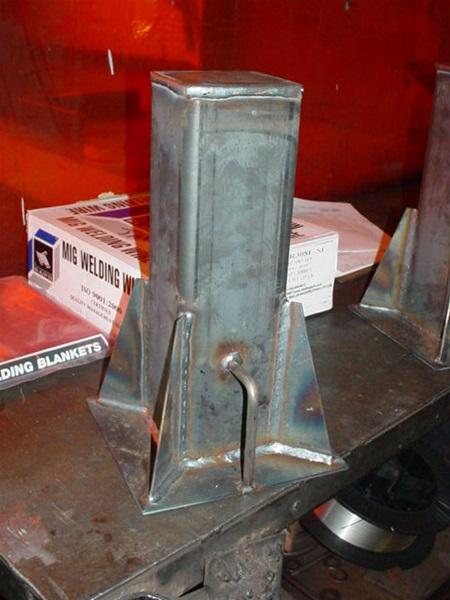
A better alternative may be from Northern Tool or Harbor Frieght such as these:
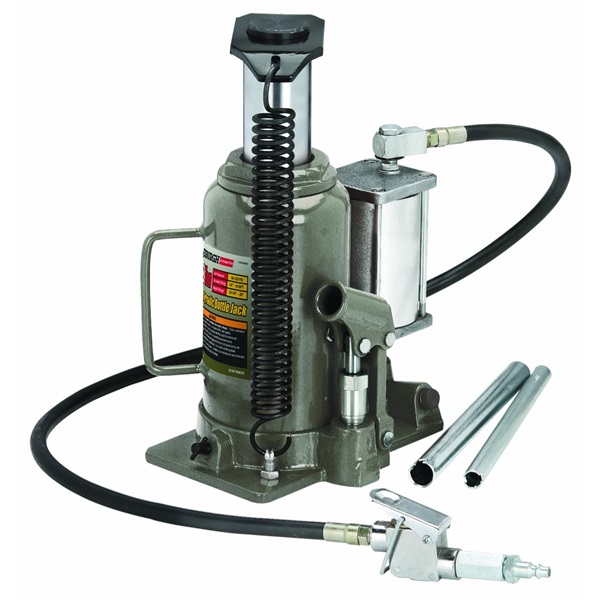
The jacks can be placed under the chassis support point with the hydraulics all the way down, and then screw the center post all the way up to the chassis. No chance of failing and if needed can be used to lift axles to change or remove tires for example.
I have and use both types of supports shown above and both work well. Driving up onto ramps is perfectly fine if the chassis is all the way down, but that kind of defeats the purpose of the ramps. BTW I have a full set of ramps capable of carrying the coach 8 inches higher, but I have not used them for the bus in 20 years, and instead use them to service my cars or dump truck, none of which will drop down like a bus on air bags will.
-
Art,
I have several friends that have wooden ramps made with 2 by lumber. Another way is raise the bus to full height with the air bags and block the frame fore and aft, side to side as is illustrated by Jon.
If you mosey over to the east Houston area, I will put you over a pit, plugged into 50 amp beside a friends Royal bus. Plus we will fill you full of Texas Brisket Bar-B-Que.
Or you could go a little further and stop at Jeff’s place in Tenn and let him do all the work.
All the best in staying safe.
-
where is the place on the frame to support when bags are up, and i do have a 20 ton air jack
-
Can I lift tag till I roll up on lumber then drop it on more lumber?
-
I built four ramps to drive the back or front up on when I need to work under it.

Gives me lots of space. The ramps are easy to build out of several layers of 1 inch plywood.
Gerald
-
Art, you might have already figured that you must have a 20 ton bottled jack or very heavy duty jack stand on each side of the coach.
-
I like that plywood idea what is the sizes of plywood how is it 6 inches? and you have a jack stand also?
Yes I do have a 20 ton bottle jack
-
Art: Just one or two bottle jacks? Sorry to be a pest, but don’t want you taking any changes. We’ve lost one Prevost owner already who went under an improperly supported coach.
-
Art,
Look carefully at Gerald’s photo. His ramps give him a little more height beneath the coach, but he is protecting himself with a pair of supports that apparently can be extended to the height needed to get under the rear support points.
A bottle jack is not going to do it. Those I have seen at best only will work if the coach wheels are at floor level because of their maximum unextended height. You have a degree of safety if you have to extend a bottle jack to get to the support point but if an air bag can fail, so can a hydraulic jack and as a confirmed chicken I want something solid to support my coach when I get under it.
-
Gerald ! what kind of jack stand are you using? can you send picture and dimension of ramps?
-
Gerald, I am seriously impressed with your ramps and would also be interested in more construction detail. I’m assuming they are actually four separate ramps.
Kirby
-
Yes, they are four separate ramps. The ramps are constructed out of 6 sheets of 1 inch laminated plywood (factory seconds @ $18 each). Cut into 1 foot wide strips. Glued and screwed together with 2 inch screws alternating locations for each layer. I used six layers going from 8 feet on the bottom to 5 1/2 feet on top in 6 inch increments. I use all four ramps for the rear to support the duals and the tag.
I put a metal handle/grip on the tall end and use a furniture dolly to move them. For about $130 for wood, screws ad glue, the ramps have worked out well.
Gerald

-
Jon: Good point on how far the post of a bottle jack can be extended up. What about making a “shim” of 1″ plywood squares a little larger than the base of the bottle jack?
Gerald: Are you concerned about driving forward “off the ramps”? Do you use a spotter? Or does what looks like a modest sized “block” at the end of the ramp stop the coach? I like the idea of using two ramps to make two lighter components rather than one really heavy ramp.
The goal of all of this to make sure that the coach is supported by something solid … not the air in the bags.
What are the opinions on drilling 3/4″, 7/8″, or even 1″ holes through the plywood ramps to lighten them?
-
I like the ramps too!
I could see where they could be cut across in between the drive and tag axle to make them smaller and easier to maneuver. Maybe an eyelet and hook attached to the side to keep them together once in place.
I’m still in awe of that garage!
Mark
-
Gerald, thanks for the details on the ramp construction. They look good, and solid too. Kirby
Log in to reply.