Prevost Community Forums

Find answers, ask questions, and connect with our
Prevost Community around the world.

  • Valve Stem Position

    Posted by Davy on February 16, 2015 at 12:04 am

    I have a question on valve stem positioning. This is the valve stem on the outside wheel of the drive axle. The valve stem is in the standard position facing the inside of the tire.

    I understand the valve stem position as it is. If this wheel is flipped around and put on the front or tag, then you would still be able to check the pressure. But I can not imagine an emergency scenario where this wheel is placed on the front or tag.

    Can this valve stem be rotated 90 or 180 degress so that it is facing outward? I like to take the tire pressure monitor off and manually check the tires occasionally and that would make it so much easier. (I understand that some of you would never put the sensor on the end of your valve stem but that is a conversation we have already had. I am comfortable taking the risk for the possible heads up to a deflating tire.)

    Maybe I am behind the curve and some of you are already doing this or maybe it can not be done because of the way the wheel or valve stem is designed. I realize the wheel would have to be removed and at least deflated to change it but the next time I have them off it would make sense to do it unless the design prevents it.

    Educate me.

    Davy

    Jim/Chris replied 7 years, 6 months ago 9 Members · 18 Replies
  • 18 Replies
  • Andy

    Member
    February 16, 2015 at 5:42 am

    It is common for valve stems to be reoriented when TPS are used. Just have it point in such a way as to make the use of a tire chuck possible. If it is pointed straight up towards the hub cap some tire chucks are too long to allow filling or checking.

    But I’ll bet you have valve stem extensions on the inner wheel.

    Be very careful.

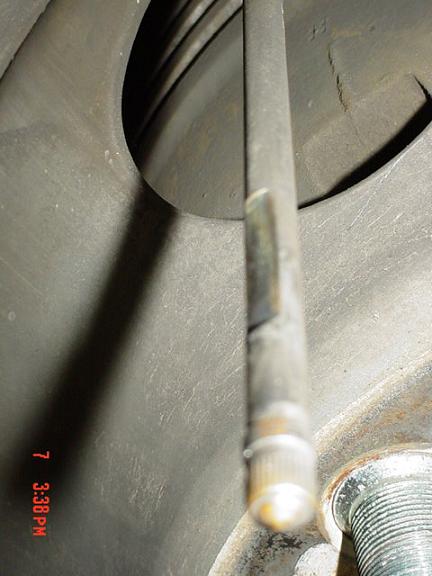
    That valve stem extension had the rubber bushing in the outer wheel. If it did not have the bushing the force from the rotation of the wheel at highway speeds would have flexerd it enough so it would have actually hit the outer wheel with the same wear pattern. In each case if the stem does not wear through the forces on the short valve stem at the bend can cause fatigue failure at some point in time. So even if you do check the extension for wear, you cannot judge if the inner stem is ready to fail due to fatigue from flexing. It is not by accident the wheel designers have gotten away from the longer valve stems and are now using shorter ones as you show in your photo above.

  • Greg

    Member
    February 16, 2015 at 8:09 am

    Davy,

    The valve stem can be rotated by loosening the nut and turning, but sometimes when they’ve been on a long time they stick and then won’t seal again. At that point, you have to break down the tire and replace the stem. If it turns easy, chances are it won’t leak. Looking at yours, when you remove the sensor, the stem may hit the side of the hole and not allow you turn it without breaking down the tire.

    I position mine to rotate in the direction of the wheel.

    Inside dual

    Tool for the inside dual to elimate any extension.

  • Archived

    Member
    February 16, 2015 at 9:29 am

    But I’ll bet you have valve stem extensions on the inner wheel.

    Sorry, Jon, I am not a betting man or I would call you on that valve stem extension bet. I removed mine shortly after PC started due to a conversation on here and posted pictures of how badly worn one of mine was. It looked very similar to the one in the picture you posted. No extentions for me.

    Thanks to both Jon and Tom for the confirmation that it can be positioned differently. I am glad to know it can be done. With the valve stem pointed the direction it is, it is hard to remove the sensor and more trouble to check the air and add air. Next time those tires are removed I will have the valve stem turned.

    I have a tool to remove the sensor from the extentionless inner valve stem. It is made from PVC too.

    Davy

  • Archived

    Member
    February 16, 2015 at 11:33 am

    Davy,

    I’m giving you free lifetime PC membership for trading a little convenience for safety. Good job. I’m glad you didn’t bet.

  • Greg

    Member
    February 16, 2015 at 12:41 pm

    Jon from your picture the that flat spot looks like a place to use a wrench to tighten the extention.

    Greg

  • Archived

    Member
    February 16, 2015 at 1:29 pm

    Actually what you are seeing is how the rubber grommet on the outer wheel contacts the valve stem extension.

    The grommet theoretically gives support to the extension to inhibit the flexing as the wheels rotate. And to an extent it does provide support. But as we all know we get dirt and grit from the highway on our coaches, and in some areas we can see where fine sand, pebbles and dust accumulate, such as on the crossmembers behind the engine. Those pieces of grit also find their way into the hole in the grommet through which the valve stem extension passes.

    Over time that is the wear pattern on the valve stem extension. Ironically the rubber grommet never wears, but the grit does wear the valve stem.

    If the grommet were to be removed you would think the problem would go away, but in fact it will not.

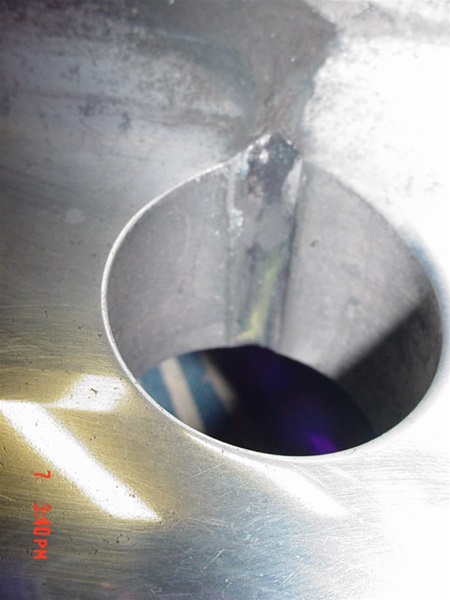
    That is a photo of a hole in the wheel in which the valve stem extension wore into the aluminum wheel because centrifugal force cause that extreme amount of flex. If you think the wheel looks bad you should have seen how the extension looked. If was almost worn through.

  • AL

    Member
    February 16, 2015 at 1:58 pm

    Anyone notice the crack in the tire sidewall on Jon’s original photo?

  • Archived

    Member
    February 16, 2015 at 2:24 pm

    That’s a casting imperfection on a brake drum. When I first looked at it I could see how it looked like an inner tire.

  • Tom

    Member
    February 16, 2015 at 2:42 pm

    “Davy,

    I’m giving you free lifetime PC membership for trading a little convenience for safety. Good job. I’m glad you didn’t bet.“

    Thanks, Jon. I am going to hold you to that if you ever do REALLY increase the dues.

    Davy

  • Jim/Chris

    Member
    February 16, 2015 at 7:39 pm

    On one of my buses, the stem support was made from very stiff rubber/plastic like material and I doubt the stem could flex at all. I just hate the extensions, but some appear better than the rubber ones.

  • Archived

    Member
    February 17, 2015 at 6:52 pm

    I did notice the mark on the tire on Jon’s photo. I did not think it was a cut but more of a wrinkle. But Jon’s tires I’m sure are too young for wrinkles. Therefore probably just a blemish.

  • Archived

    Member
    February 17, 2015 at 7:37 pm

    Careful Tommy….if Jon stops suddenly, you’ll undoubtably get hurt 🙂 Geo.

  • Archived

    Member
    February 18, 2015 at 7:23 am

    Geo is wrinkled. My tires are not.

  • glen

    Member
    February 18, 2015 at 9:07 am

    Yeah, but that little blue pill takes the wrinkles out.

  • Archived

    Member
    February 18, 2015 at 10:20 am

    Now everyone is going to want to know where to get the little blue pills that take the wrinkles out of tires.

Page 1 of 2

Log in to reply.