
-

For what it’s worth, the Federal guidelines are now for a Class E or Class F, for NON-Commercial licences for what is equivalently Class A or B Commerical licenses.
The state of Georgia now has that, though it is unclear (legally) whether required for RV use. [One part of the licensing statues state that RVs do NOT require any special license, while the Class E and Class F sections discuss vehicle weight, towing amount, etc.]
To be safe, I went ahead and got a Class E license here in Georgia… As you know, though, an officer can ticket you for anything, even if they are wrong about the legal requirements, and getting the Class E license removes (theoretically) at least one more thing they can go after…
-
Thanks to all for the comments about being over-length. I’m getting the message that if I don’t do anything really stupid I probably won’t have any problems. I don’t want to belabor the point but I am still concerned about my insurance coverage in the event of an accident. My experience with insurance companies is that they will always look for the opportunity to not pay a claim and being overlength is that opportunity. Jim Barone
-
That is one reason why you need to be sure that the insurance company or agent you deal with understands exactly what a Prevost is, what a converted coach or bus is, and that you are not driving the equivalent of a Winnebago.
We had a fire in a previous coach. The insurance company never questioned if we were towing (we were), our length or anything else. They just went ahead and covered our costs. That is not to say if we had hit someone that it could not be used against us if we did not have auxiliary braking or were overlength.
Very few of us that tow are legal in all states. But so far I have never seen anyone on any forum for the last 20 years or so ever say they were denied coverage after an accident because they were overlength.
-
Thanks for all of your responses. Great ideas all of which I will pursue.
Looking forward to meeting youin the future.
-
When I was stopped twice in Ca, my driving was fine both times; in fact, first stop first words from trooper were: “Sir, your driving was just fine. Please stand right here and hold the end of this tape measure.”
That said, I was broken down on the side of the road in Donner Pass, Ca., for 9 hours, had 3 state troopers stop to check welfare, and none hassled me.
Just had my first accident in 350K miles in Utah (5 cars totaled, 3 injuries, $25K damage to bus/trailer, not my fault). Not sure of max length in Utah. Only comment from trooper was asking how long my trailer was. I’ll let you know if I get paid.
-
Joel, I didn’t mean to impugn your driving. I’ve noticed that sometimes the racing team drivers pulling trailers drive a bit more aggresively than I would. Of course I don’t have a schedule to keep like they do.
Were you towing a car or a trailer when you were challenged/cited for length?
-
Don’t worry, I didn’t take personal offense. Simply trying to make a ststement re those people who suspect the only reason they pull you over is if you’re speeding or otherwise.
First time 40’plus 29′ closed single level trailer; second time 45′ plus 28′ stacker.
-
I had a special order trailer from Advantage Trailer in Carol Stream, IL. They built a 8.5 x 16 box with an inside height of 11 feet with a full stacker. With the 16 ft trailer, 3 foot tongue I am legal at 64 feet. Looks nice behind my Liberty H3 45. GVWR 12000 with payload 6000.
Michael Krueger.
2008 Liberty H3 45
Aston Martin DB9 -
We have a special order Bravo from Mueller Sales & Service in Random Lake, WI. 26′ x 8.5′ enclosed with a five foot tongue pulled by a 45′. From what I understand, as long as i stay out of California and Oregon (think Oregon) with the trailer I’m OK.
I would be very, very reluctant to pull any trailer behind a coach with less than a five foot tongue.
-
Is there any requirement or need to stop at any of the State Weight Stations for weight check or for inspection?
Michael Beronja
-
Nope, weight stations are for commercial vehicles only. Private coaches are not required to stop for them.
Now there are ag check points in some states that all vehicles are required to stop but they are not going to weight you.
-
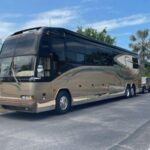
We aren’t required to cross any scales, however as soon as a person buys a coach, and loads it as it would be loaded for a trip, the coach should be weighed and all axle weights noted. This is the only way to determine the correct tire pressure for the various positions on the coach.
-
I’m real close to ’70 with this set up. I did a google earth to check out where I was headed and back did over 1000 miles no issues. Coach didn’t even know it was back there. Lost about 1 MPG pulling the rig. I’m headed to CO next week with it but will have someone else pull it into the town.
-
For many of us, driving a 40′ or 45′ Prevost is likely the biggest, longest, widest, and heaviest thing that most of us have ever driven. When thinking about driving the bus I really envy anyone how has lived or worked on a farm or has spent any time driving a large truck or semi.
We always had trailers when I was growing up … small to modest boat trailers, small open sand/grass trailer, popup tent camper, snowmobile trailer. I was towing trailers and sometimes backing them up (without hitting anything) when I was 16. Had a couple of experiences in college while in the airplane business to pull a long flat bed trailer we hauled planes and floats on, one trip from Wisconsin to Baton Rouge, LA to bring back a de Havilland Beaver. Then a few U-Haul trucks over the years and a 26’/28′ M/H out and back to California. Finally in 2005 I bought the race car, a Suburban, and 24′ enclosed trailer. Then in 2014 our first “RV” of any kind … 45′ Prevost that I intended to pull both the HHR and the race trailer (which became a 26′ with a five foot tongue) with.
As I’ve posted elsewhere, we’re 45′ + 5′ + 26′ which equals 76′ … longer than most semi’s based on how we compare to the semi’s in the rest areas.
I think to successfully drive a Prevost with or without a toad or a trailer, one must first think through the geometry of the coach and the toad/trailer. The best way to do that is to have someone else drive your coach while you stand and watch what is going on with the coach and whatever you’re pulling.
Remember that the tail of the coach swings out whenever you turn. I have evidence of this from the original owner on our coach as the engine bay door has a nice long crease in it which I’m sure happened when the driver turned left pulling out of a parking place or in a tight area and didn’t allow for the tail to swing out.
When we were looking for a coach knowing we’d be pulling the trailer, I knew I wanted independent front suspension (IFS) because I’d been told by so many the turning radius of the IFS vs straight front axles (SFA) was less. The difference might not be “much”, but with the trailer I figured I needed EVERY inch I could get. Everytime I pull out of our driveway with our trailer I go along the left edge of the pavement, drive straight across the road until I am just about on the gravel shoulder of the far side, pause, spin the wheel to the right until I’m at the lock and then proceed. As the coach moves to the right the wheels are turned so sharply that it seems like the front of the coach is walking to the right and not moving forward. Try this yourself in a large, empty parking lot. When you have steering wheel cranked to the stop … get out and look at how far the wheels are turned. Its very impressive
Whether you’re pulling a trailer, the toad, or even towing nothing … you’ll soon find out that when you’re navigating in towns, villages, turning right at intersections, etc. that you drive the coach straight as an arrow until your co-pilot is screaming at you to turn and then at the last second spin the steering wheel in the direction you’re turning, let the front of the coach “walk over”, and around the corner you go as you slowing unwind the steering wheel while you watch the back of the coach in the rear view mirror (and keep looking forward) to ensure “everything” makes it successfully around the corner without unwanted interaction with the curb, signs and their posts, light poles, and spectators standing on the curb. A successful right turn towing a trailer in a small town should always be followed with a blast of your train whistle or train horn for the enjoyment of the spectators.
Go out and practice. First practice driving though town and villages, turning right and left in tighter and tighter areas until you’re comfortable. Do this until you completely understand the geometry of the coach as it goes around tight right and left corners. Then do the same with the toad. Then the trailer. Practice in areas your familiar with.
If you’ve ever learned to fly a plane or drive a race car (under the direction of a competent competion driving instructor) you should understand what I’m laying out. I think I solo’d after about eight hours of dual instruction when I was 17 years old. Looking back I was flying an airplane (Cessna 150) after only eight hours … AN AIRPLANE!. I’ve been through a number of race car driving schools. Starting slow, learning the basics, increasing speed at a slow, steady pace I was soon driving the race car much faster given the amount of time I had been it than I had expected and most importantly I was comfortable at those speeds like I was comfortable in the airplane.
New Prevost owners, especially those with little or no previous large motorhome, large truck/trailer, semi, or farm equipment experience need to start out with the basics, practice, practice, practice (just like Paul Hornung said in the beer commercial), and progress at a steady measured state. Your confidence and expertise will be greatly enhanced by having an observer, teacher, or coach who understands how to drive a large coach and provide you with valuable feedback.
The picture below should give you an idea of how confined our driveway is and the challenge of getting everything in and out is. The driveway is 15′ wide and I’m getting a bid to add another 8′ (which will enable us to park the coach and/or the trailer on the concrete and still be able to drive around them without driving on the grass). I backed the trailer in the corner on Sunday with the Prevost, but got the front tires of the coach on the grass a few times. Fine when the yard is pretty dry, but in the spring or when wet I’m sure it will sink. Widening will make it easier to get the trailer in and out with the coach.
The first time I backed the coach into the driveway I did it in one smooth move. Times 2, 3, 6, and 7 were another story. A couple of times I had to “go around the block” once or twice to get the whole thing lined up right (the block is one mile on a side). But after a times I’ve got it down pretty good.

Final note about choosing a trailer to pull with a Prevost: Two things (1) five foot tongue. Any tongue less than five feet will likely allow the front corners of the trailer contact the rear corners of the coach. Now you’ve damaged two vehicles. This could happen backing or going forward and turning tight corners. I realize the longer tongue makes the trailer a little harder to get around tight corners (especially right hand turns in town) as the trailer cuts a tighter circle than the coach. But I would rather deal with that than the risk of trailer and the coach colliding. (2) Lots of lights on the side of the trailer. I didn’t spec extra lights on the side of our new Bravo when I bought it. I’m going to add between five and eight LED clearance lights along the sides on both the top and the bottom of the trailer. I’ve found this is really, really needed at night when backing and moving around in dark areas. We sit 45′ to 50′ away from the front trailer looking through multiple layers of glass into the mirror with lots of glare from the interior of the coach (even with all the lights out and the dash lights turned down). Having a ton of lights along the side of the trailer will give you a much better perspective of where the trailer is in relation to the coach and where you think you want it to go.
Log in to reply.