
-
Tire Cupping
Posted by Michael on June 1, 2016 at 7:11 pmHowdy All,
I have two questions about tire cupping.
My front passenger side tire is cupping on the outside first tread row. The Driver side front tire is fine. All the tires are three years old and I only have about 50,000 miles on them.
What causes cupping and why is only one side cupping?
Thanks – Michael
AL replied 6 years, 3 months ago 12 Members · 16 Replies -
16 Replies
-

Alignment, bad suspension parts, wrong tire pressures, bad balance can all impact tire wear. Have you done an alignment on your coach? Also, the right side tire seems to sometimes wear more because of the crown of the road.
-

Cupping or scalloping as you are describing is usually related to balance and or worn shock.
-
Check your shocks!
It could also be a broken belt in the tire.
-
River ware or cupping on the outside can be the bell crank bearing beening loose or the drive axle radius rod bushing worn on both sides or the drive axle panhard bar bushings and alignment out
-
In this case, everyone was right. Tire balance was fine and so was the inflation. The tire dealer said the shock could be bad, the alignment could be out or some of the items Peter mentioned could be the cause. In any case, the tire was still safe to use.
The tag tire on the same side was fine, so we swapped the steer with the tag after the tag had it’s balance checked and the pressure was adjusted in both tires in accordance to the axle swap.
I think a visit to Prevost – Ft. Worth is in my future.
-
Michael,
Putting a cupped tire on the tag will accelerate the wear pattern. I put a cupped tire on the tag and in 5000 miles steel threads were visible.
The only place to put a tire with unusual air is on the drive. Good thing you have all 315 so you can do that.
-
Michael,
If you haven’t been to Prevost Ft Worth, I highly recommend them. We are there now–they just fixed our cycling air guages mentioned in another thread. While Leno was looking for the air leaks, he also spotted some worn-out bearing on the connecting arms on the rear axle, so of course we had them replaced. They have done outstanding work for us. -
Jon;
Thank you for the tip. I wonder why the wear pattern increased on the tag and would not increase in the drive position?
Per;
I have also had good luck at Prevost – Ft. Worth. I am heading there this week.
Michael
-
OK Guys,
Here are some photos of the tires and what I found out at Prevost – Ft. Worth.
I needed new shocks on the steer tires and an alignment was recommended. The Michelin dealer in Las Vegas also made the shocks and alignment recommendation. I was hesitant to do a six wheel alignment because the only wheel position that showed wear was the passenger side steer tire where the cupping occured.
When the alignment was complete, it showed the passenger steer tire was toed in too much. All the other positions were perfect. I was told that since the driver sits on top of the left steer tire, he steers the bus so that the left tire drives straight down the road, so any discrepency in toe is then magnified on the passenger side.
The alignment operator also told me the cupped tire is going to wear quicker than the other tires because it is already damaged and does not strike the road evenly.
I also replaced both front shocks. OEM’s not Koni’s. I’ve always used OEM’s and been happy with them. My front axle is not very heavy and I don’t have any slides. Country Coach didn’t overload the front axle.
Michelin Tire Wear Poster
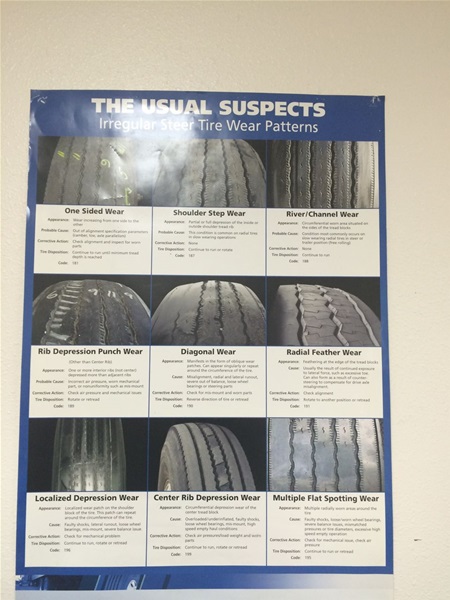
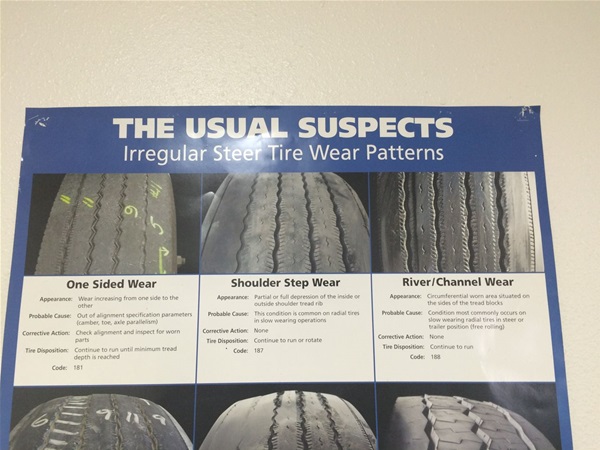
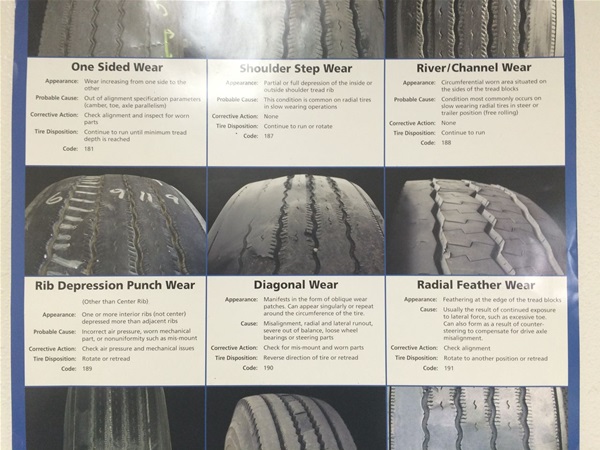
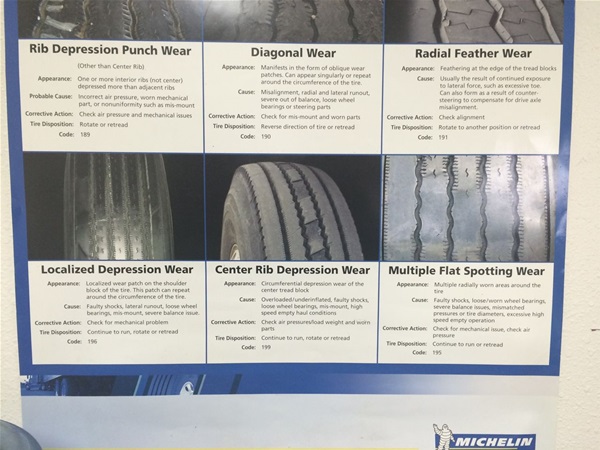
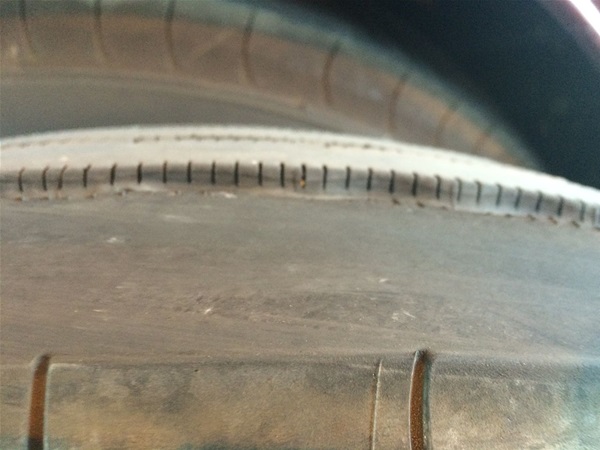
Steer Tire – You are looking across the tire seeing that the first tire tread is almost completely gone as compared to the second one.
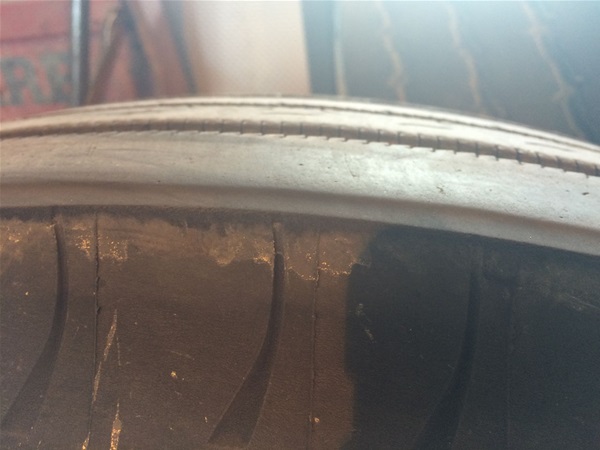
Tag Tire – You can see there has only been a small amount of wear on the outside edge of the tire.
These tires have about 50,000 miles on them and are three years old.
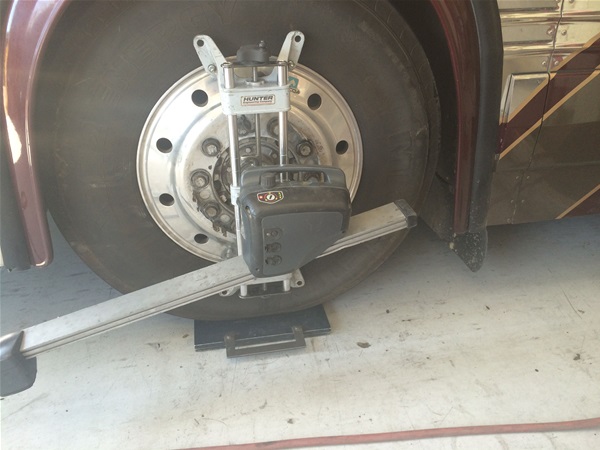
Driver Side Steer Tire with alignmment equipment
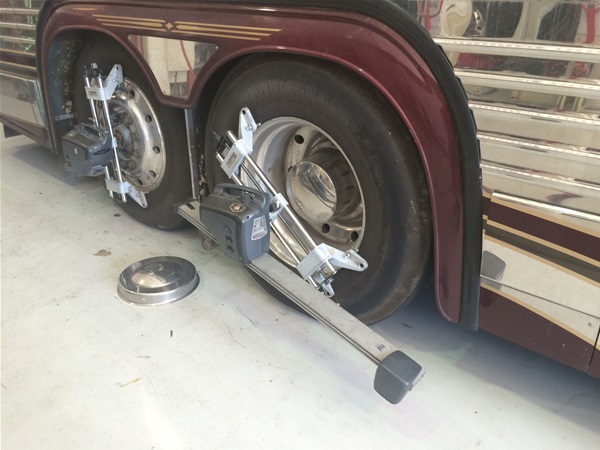
Passenger Side Drive and Tag Tires with alignmment equipment
I can now drive like Jon. Set the cruise control, put on the Lennon Sisters, point it straight down the road and then go to the kitchen, make a sandwich and take a nap.
Michael
-
That just isn’t true. Like Tom, old folks don’t go to the kitchen to make a sandwich. They go to the potty, and then take a nap.
-
I don’t have a sense of scale, but I think you are seeing a normal wear pattern.
If you have read of issues with 365 tires losing chunks of rubber from that location it is because Michelin was getting complaints regarding the wear pattern you are showing. It didn’t affect tire life or safety, but it concerned those with those tires. So when the 365 tire was designed for Prevost a much smaller area across the tread surface at the edges was designed into the tires, and between that edge of the tread surface and the tread pattern was what Michelin describes as a “de-coupling” groove.
The bottom line is Michelin traded one problem for another because some with 365 tires had relatively large sections of rubber tear from the 365 tires at that point.
If you really want to do a better evaluation of your tire and get accurate information do a search on line for the Michelin commercial tire owner’s manual. It has almost 300 pages but the amount of photos and information will provide you with as much information about your wear pattern as you will ever want.
-
One photo appears to show mudflap bracket that you see behind duals. So, im guessing the tire in question is a tag tire. Scrubbing around corners are brutal on tag tires. Appearance that the sidewall closest to tread edge has scuffed the pavement too. Air psi maybe matched to weight chart for michelin, but reduced air in the 80 psi range cause tag tire to literally lay over while turning. We run 100 on ours
-
With all due respect to Co-bus I am a strong advocate of using pressures for tires based solely on axle weights. As a result my tags are so lightly loaded the chart minimum pressure is 80 PSI based on heavier loading than my actual.
If I use the formula for calculating tire pressures my tag should be at 70 PSI, but I opt to never go lower than the chart minimum listed pressure.
I never lift my tag unless I am moving at walking speed with my steering wheels turned to their maximum and have never had my tires, tags or steers show any cupping or unusual wear.
Log in to reply.