
-

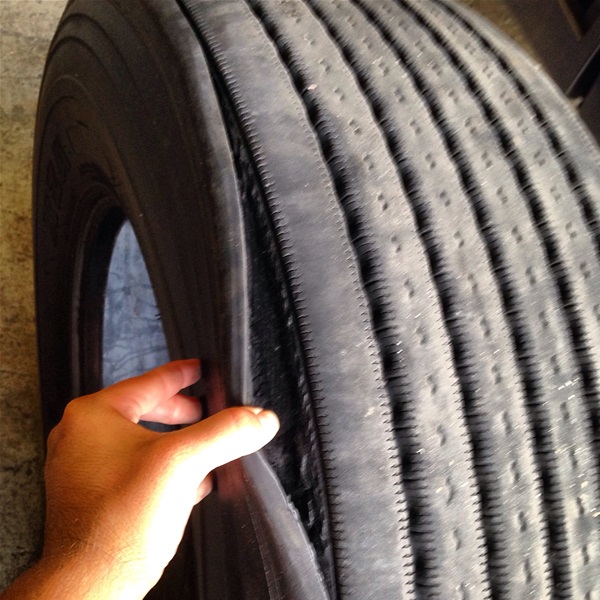
Sounds like a no-brainer, but make sure to do a good quality check of your bus, including tires, before you get on the road. This just arrived at our shop.
-
That is the second such failure I have seen this month. I’ll wager running on low pressure contributed to the problem.
-


This happened running on a nice smooth road at 55 mph. My operator said he was in the ditch before he knew what happened. He was a very experienced driver. I guess you never know how these trucks/coaches will react.
-
I hope he is OK.
That tire failure looked like more of tread separation than a blowout, but regardless it is instructional to see how quickly a tire failure is going to require immediate and correct actions on the part of the driver. What I think of whenever I see the video Al is good enough to keep reposting is I hope when (not if) it happens to me I will respond properly and I will be paying attention to my driving and not distracted. I don’t think we have much of a chance if we are involved with something else such as tuning the radio or talking on the cell phone.
-
On another bus forum an owner of a homebuilt conversion reported on his recent experience with a blowout.
He said he was doing 65 MPH on I-64 when the left front blowout happened. He did not say he hit the accelerator, but he did say he never touched the brake, he retained control and moved it onto the shoulder. He did not use the brakes until he was at low speed and on the shoulder.
He described the damage to the coach from the blowout which soundled minimal.
The clear path to take is to do everything possible to avoid a blowout. Make sure the tires are not old, make sure they are properly inflated, and visually inspect them to the extent possible to look for sidewall cracking, damage from road hazards, etc. But even good tires can have a blowout so try to always keep in mind the recommendations above when or if the blowout occurs.
-
Another plug for Tom, that sometimes helps is to have pressure pro system, it will alert if tire is low possibly before a blowout…..
-
Has anyone tried this product from Tyron? Looks like it may provide a bit more safety!
-
Many many thanks to Al for keeping this thread alive. I review it every time he revives it and I hope I never have to experience what it shows.
The amount of energy a 50,000 plus pound rig has when traveling at interstate speeds is scary, and that energy increases exponentially with speed. So being able to handle a sudden loss of tire pressure is critical because with our momentum, it will bring us quickly to the scene of the accident if we make a mistake in dealing with the situation.
By far the best practice is to avoid a tire issue at all costs. Tire pressures in the correct amount based on weight is perhaps the most important thing you can do to avoid a problem. Understanding if the tire is driven on when 20% or more below the specified pressure has just ruined the tire and while it may look OK, it needs to be replaced. That hurts, but nowhere near as bad as an accident due to a blowout.
Tire age is a second factor. Michelin has a chart that shows acceptable sidewall cracking, and that which is excessive. Do your really want to risk your life or the coach to stretch the life of a tire?
Speed is another factor. “I drive the speed limit” is often repeated by owners. And while legal, keep in mind the tires have speed limits also. Know what yours is. Most are 75, but there are tires that have lower speed ratings. And even if the tire can handle the speed, please be aware the stopping distance at 60 is just under 300 feet, and at 70 it increases to nearly 450 feet. So in addition to a blowout possibly taking you to the scene of the accident (yours) you are going to cover a lot of real estate getting there.
-
!st of each month PC re-post an important video for all our new members. Last month total hits…5311
Go back to the 1st post on this thread, highlite the blue address
Please post your comments 357344
Got an extra minute…..See Truks post above “RV Tire Blowout”
-
In this months issue of a national magazine there were two stories about tire blow outs. First one is just jaw
dropping as the owner/driver is so proud of his escape from death he chooses to write about it. Driver accepts no
responibility with endangering himself and all passengers because he steped on the wrong pedal. Facts speak
volumns with a huge amount of luck no one was killed. That wrong decision could of killed everyone in that RV.
In the second story knowing what to do in that split second saved all passengers and the RV. Round up some tires and we are on our way.

-
This is from another forum….. it is an eye-opener.
Mark
Friends of mine had a blowout on their 2014 Tiffin Zephyr July 12 on I-10 near Tallahassee, FL. The MH ended up in a ravine destroyed. They both survived and are now out of the ICU. One of their small dogs died later at a vet clinic.
Be careful out there and wear those seat belts!



Log in to reply.