
-
Recharge House batteries
Posted by Dean on October 21, 2014 at 3:46 pmI have done very little dry camping until this month so I am not sure how long it should take to recharge my house batteries after the generator starts on auto start. I have my inverters set at the default setting for auto start and it takes almost seven hours before the generator shuts off.
Not sure if trhis is normal or if there is something I need toi concerned about.
Bryan replied 11 years, 11 months ago 14 Members · 32 Replies -
32 Replies
-

Since each conversion is different, and that means how the auto-start is set to turn on and turn off, the amount of charging current the inverters are set to deliver, the number of batteries (and their size) being charged, and the depth of discharge and finally the age of the batteries there is unlikely to be a single correct answer, even from someone with a twin to your coach.
I think it is safe to say however to answer your question you first need to reveal some further information. For example, how many batteries and what size are they? What is their age? What is the charging current your inverters are set to provide? How deeply are the batteries discharged? Is your coach auto-start set so the generator runs a specific length of time, or does the system shut the generator off when the batteries go into float?
These questions may seem extensive but I think you will find all the answers play a role in determining if your run time is justified and correct, or if it is a sign something needs attention.
-
2 – 3 hours on bulk/absorption should get you to float at which time you could kill the gen. Like Jon said, there are many parameters that need addressed to give you an accurate answer.
-
The reason I hedged is because I keep my charging current settings low. My coach is set up so the auto-start times out so if I were to depend on auto-start I would never be fully restoring the charge and my generator would be kicking on more often. However if my charging current were set to 65 amps for example I would be fully charged within the time period. So obviously the way the auto-start is set up, along with the set charging current plays a significant role in how long the generator runs.
And those are just two parameters. The question really has no answer because there are so many variables. I think the best answer is what is normal for his conversion with everything set and working as intended.
-
Dean, I would check with Ben Cumming about the Vantare set-up. Evidently some of their caches were wired incorrectly at the inverters and it affects the run time on Auto-Gen. Ours is getting looked at as sonn as we get home to Fla. Getting a wee bit nippy here in Wis. Geo.
1999 XLV X-6872, liberty #440 -
Geo,
How many batteries do you have and what size are they? Do you know the state of discharge when the generator kicks on. and if the generator auto-start is terminated based on time or when the batteries reach a certain state of charge?
What makes this question more difficult to address is what might hold true for one type of inverter might not apply to another type because not all inverters are the same in terms of the sophisitcation of the remote.
-
Jon, 8 4d Lifelines. According to Ben Vantare had problem with the way they wired some of them. He can tell by looking, but I won’t know till I get home.
-
First off thanks Jon for getting my password working.
I will try to answer as many of your question as I know
I have 8 4d batteries that are about four years old
I have the charging current set at 15 amps
The generator is set to shut off when the inverters go into float chargeing
-
With no specific knowledge of Vantare electrical systems I think your charging current setting is so low as to require that much generator run time to bring that very large bank of batteries up to float. Increase the charging current the the generator run time is going ot drop.
-
I’m also not up on Vantare, but I use 30 amps (mines 24v), have (6) 4D’s and from about 50% discharge to float takes between 2 – 3 hours. Maxium charge rate for 24v on my Trace 4024’s is 35 amps AC. So you may try going to a higher charge rate as Jon suggested based on your inverter specifications.
-
I should mention that at 4 years of age batteries are on the downhill side of life unless they have been well maintained from the start. In the case of AGM that doesn’t mean adding distilled water, but it does mean the charging protocol is correct with the proper voltages for bulk, absorption, and float, and the batteries have not consistently been deeply discharged.
Apart from an internal failure aging batteries slowly lose performance to the point where they just don’t last as long between charges. An equalization charge at the voltage and time specified by the battery manufacturer may help improve performance, but the bottom line is to not discount the fact you may have to consider a fresh set of batteries.
-
Very interesting information here.
I have been actually trying to understand some details around the batteries, inverters, generator and autostart (oh and auto-stop if in-fact I have that).
Have been fighting a storage facility locally that advertised “power”. Was a simple 20amp plug with GFCI. The 20amp hasn’t been an issue till I decided to move the coach to this new facility since it was covered. Plugged in and the coach with the battery charges (three total) and refer on would trip the GFCI plug. Talked with the owner and he claimed the power was set to provide only power for battery charging. Well even with just the three chargers on, it would trip the GFCI. Had to go to the storage facility on a daily basis to swap chargers around. Left after my month was up and went back to the previous facility that had good power without cover (can run all three chargers, accessory compressor, refer, water heater and a couple other small items with no problem on 20amp).
While I was dealing with the bad power, I was thinking about setting the auto start generator, but didn’t understand if it would auto-stop and what the params were for both.
So how does one figure out what the params are? And how can you change them?
This would also be helpful when dry camping, which I do a couple three times a year while at race tracks. I know this last month I would set the autostart on in the morning when I left the coach, leaving the compressor and refer running. When I would get back 12 hours later the generator wasn’t on yet. This was nice, but still kept me foggy on when it would kick in and if it would shut off? I don’t want to leave the coach unattended for a long period of time if the generator wont shut off on it’s own. That and I didn’t want to discharge the batteries completely to test the system as they are brand new batteries.
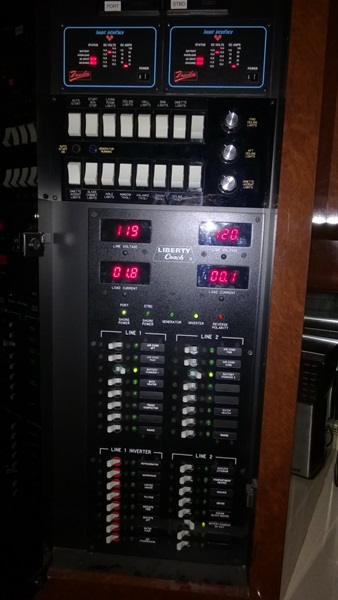
Oh and finally, how do I “read” the power panel to understand what the draw is, where my inverters/batteries are, etc..
Here is a picture of my panel (it’s plugged into the bad 20amp power at the storage facilty)
-
Charles, a GFCI outlet will trip. If you or the owner can replace it with a conventional outlet you are in great shape.
For long term storage without the need for heat or AC you can turn everything off except your refrigerator and inverters and you will keep your batteries charged and the refrigerator will run just fine.
If you cannot get the GFCI outlet changed you will need external chargers that will not trip the GFCI and then your refrigerator will run through the inverter and the charger will maintain the battery.
At least you can access your house batteries to do that.
-
Explain
to me how you can run 2 inverter/chargers during bulk/absorption
charge, a chassis battery charger, the fridge and all the other
parasitic 120v draws on a 20 amp circuit? -
Our Vantare Inverter chargers were defaulted to 15amps max charge on each leg….and I believe Ben told me that was where they needed to be…. I would turn those down to 3 amps when I wanted to steal more amps for running all the a/cs at once on a stinking hot Texas day !!
My inverters would go back to float mode very quicky at 15 amps charge rate but I never ran the batteries down much either.
I found the Trace inverters on the Vantare were a breeze once you figured it all out and could manage your loads to suit your needs…. I can’t do that on the Liberty yet as I still don’t know what’s what with the Heart Inverters but I am learning and made it through one hot summer here without tripping a breaker !!Diane
-
“Well even with just the three chargers on, it would trip the GFCI. “
I’m not an electrian or electrical engineer. Over on the Garage Journal Forum I was told by a number of the sparkys that a GFI or GFCI can go bad or “soft” over time and trip too easily.
Our house was between 15 and 20 years old. One GFCI in the main bath fed the circuit for the master bath outlet, an outside outlet (maybe a second outside outlet), and the outlet in the garage. The GFCI for this circuit would trip often, more often than I thought it should. So I replaced the less expensive “contractor grade” GFCI with more expensive “commercial grade” GFIs at each outlet rather than wiring all the outlets through the single GFCI.
Like magic, the “easy tripping” stopped. If you go back to the other storage facility, try getting the owner to swap out the current GFI/GFCI for a new, commercial grade outlet.
Keep us posted!
Log in to reply.