Prevost Community Forums

Find answers, ask questions, and connect with our
Prevost Community around the world.

  • Lithium Ion Batteries

    Posted by Archived on October 31, 2013 at 8:22 am

    On another thread the topic of Li batteries came up.

    I am starting this thread because I am thinking of a project that may not come to fruitiion, but if it does, it will be because of lithium ion batteries.

    Here is an overview. It is no secret there are two things I would like to see different on my coach. I understand why it is the way it is, but I think I can change it to what I want. I want to get my batteries out of the belly of the bus to a location where they are accessible. If I can do that, then it follows that I will have space available for the long range fuel auxiliary tank, something I had previously.

    I have 4 8D AGM or gel batteries. They weight about 680 pounds and are located behind the entertainment center and ahead of the fuel tank. They are not accessible unless I remove the entertainment center. I could make room for them in the front bay, but based on my front axle weight, moving them would put my front axle over the limit. But, if they were replaced with lithium batteries the weight would drop to about 25% of their weight which would allow me to move them to the first bay without exceeding the axle weight limit.

    That modification opens up the space that the auxiliary 90 gallon fuel tank requires. The full aux fuel tank weighs about the same as the batteries that were in that space so I would only impact the front axle weight by the weight of the new batteries, something I can do because I have the margins to do that.

    So here I am in the very early stages of thinking through my next project. I am trying to list the advantages and disadvantages. On the negative side is cost. I don’t have a clue about what I will incur in changing to lithium batteries and the assocated device to provide both 12 and 24 volts. I’m working on getting that information. The biggie as far as cost is the addition of the aux fuel tank. The reality is that if I cannot justify the cost of adding an additional 90 gallons of fuel, I probably will not bother moving my batteries or switching to lithium.

    However, I have to think about the last comment a little more. The advantages of lithium are beginning to emerge and we all should at least be aware they might be something to consider.

    I am a Lifeline AGM advocate. They possess good life, are likely offering good value based on their life span, and are a known commodity. Most of us use or have used them. As a rule of thumb we can assume whatever the cost of a set of batteries is now using gel or AGM, we can expect lithium to likely be more than double the cost. That is a drawback for people who may not care about the long term if they are planning to trade coaches.

    In most cases the installation of lithium will be easy but there will be situations that will require so changes or devices. For example to make it work on a 12/24 volt system a device must be used to create 12 volts from the 24 volt batteries. If the generator auto start voltage is not set lower than 12 volts it must be changed which could either be a setting change or might require a new auto-start. For safety reasons some alternator regulator failures must be looked at. If it is possible for a regulator to fail and allow the alternator to deliver unregulated high voltage a safety device must be considered to prevent a fire. High voltage to a lithium battery must be stopped.

    We are all comfortable with heavy batteries because that is what we have had forever. Lithium batteries are scary to some people, but the manufacturers are getting past the growing pains and things that have been issues are now solved. If nothing else the serious reduction in weight and space requirements might be all the justification some of us need to make the switch.

    So now I am on a mission to see if this becomes my next project.

    AL replied 9 years, 8 months ago 33 Members · 85 Replies
  • 85 Replies
  • Mike

    Member
    October 31, 2013 at 9:25 am

    Gil,

    I have spent hours researching a change to lithium. What I have found so far contradicts most of what your post says regarding charging them or installing them in my coach. But I know lithium batteries are being used in RVs so for the moment I am not going to worry about details. I do know my inverters and the generator “Watchdog” will work with them with no change. I may have to modify some numbers such as charging voltage or make sure there is no way to initiate an equalize cycle, but other than that my coach is good to go with the exception of the items I listed in my post above.

    But rest assured I am not about to reduce the number of batteries or amp hours of capacity even if I never use the full capability. I mentioned on another thread I never use my fire extinguishers or insurance either, but I want to know it is there. You are dragging around a half ton or more of batteries so I would think you would have a reason for keeping that capacity.

    The bottom line however is if I go ahead with such a modification to my coach it is because I can end up with long range fuel. Only a switch to lithium and the substantial weight reduction that comes from that change makes it possible.

    This project makes as much sense as changing from a perfectly good dash to a Silverleaf. Nothing we do as Prevost owners has to make sense. It just has to satisfy us.

  • John

    Member
    October 31, 2013 at 9:51 am

    Okay Jon I deleted my post. It made reference directly from industry and manufacturer’s data that obviously contridicts your own findings.

    Post pictures and details on your project, if you elect to go down that path.

  • Archived

    Member
    October 31, 2013 at 9:53 am

    Jon

    Lithium cobalt batteries are the ones with the power, they can also be dangerous. I know there are other metals that are being used in Li batteries, iron comes to mind but, they do not have the capability of the cobalt systems.

    There have been far too many issues with these things for my taste…….anything that happpens on an airplane makes the national news like the 787 scenario and (not quite as well known) the fix. Li has an atomic weight of 3, corrodes rapidly when exposed to the atmosphere, burns hotter than magnesium and must be transported in mineral oil. The batteries have a long history of thermal melt downs. Cobalt, aside from being a nice color, is another element that from all appearances seems to be on the ragged edge of being radio active in its natural ferrous state. Yes these batteries have been made safer over the years but personally, I think it is way too early in the game to consider an application modification as you suggest. You extra fuel tank may well just provide another accelerator for the fire that may well bloom from your batteries. I am always a bit leery when I see the term Ion, cathode and the like in descriptions of anything, reminds me of nuclear power plants and x-rays……… Any discussion anywhere if these things may cause a giant growth, looking all the world like a russet potato developing on the face or neck of people that attempt this fix, although that may take a few years!

  • Archived

    Member
    October 31, 2013 at 10:16 am

    This needs to be put in context.

    The specific type of lithium ion battery is what dictates its performance and safety. Some types are not suitable for our application, while another type is likely to be ideal. I do know Liberty has been using them for years now and the history has been excellent. You can bet I am going to eventually be talking to Liberty about this. I am not qualified to plow new ground.

    But in addition to talking to Liberty I have to have conversations with Prevost about an auxiliary fuel tank. This entire topic may end up dead if that is not feasible, and I can tell you that I not only have to make sure I can physically install a tank where none exists, the cost has to be viewed by me as not unreasonable. I don’t even know what that number has to be at this point. I will never try to justify the cost of a fuel tank based on being able to save a few cents per gallon. I am looking at this from the perspective of how many fewer times do I have to stop at a truck stop and what is that worth to me and Di.

    But even if the fuel tank is not feasible, I still am curious about lithium batteries from the perspective of eliminating over 500 pounds of weight and getting 10 years of life. What is that worth to me? I don’t know, yet. If I assume my normal 5 year replacement schedule on batteries I really need a lot of confidence in lithium before I make the change.

    I would like Gil to repost his objections. That is a selfish request because as I get deeper into this topic his objections are concerns I have to address and he has already done the work to help me know what I need to know. You can bet the farm that somene trying to sell Lithium batteries is not going to talk about what Gil posted unless I hold their feet to the fire.

    Obviously Liberty has confidence in their use of lithium, but offsetting that Millennium has the opposite point of view and both converters have some pretty savvy people. Their respective articles on the topic are in our articles section.

  • Archived

    Member
    October 31, 2013 at 10:39 am

    Jon, that’s why I started the other battery thread because my overwhelming curiosity of using fewer, lighter, Lithium-Ion batteries.

    I noticed that Liberty Coach has been using them since 2010, and from their website, they are sold on them.

    Millennium and Marathon on the other hand, object to using them even though the type that Liberty uses, are different than what air craft industry have used.

    I’ll certainly be following your progress as I continue to read and find new articles on the subject.

    Mark

  • michael

    Member
    October 31, 2013 at 10:51 am

    Marathon uses Lifeline because——–they just like Tom!!! Trying to get a little laughter starting this morning,

  • Archived

    Member
    October 31, 2013 at 12:18 pm
  • Alvie

    Member
    October 31, 2013 at 12:58 pm

    All I can say is the Millinium guy is SPOT ON! The facts are out there, a 747 taken down (crashed) because 1500 or so lap top batteries self destructed. The 787 issues and it goes without saying that Boeing has 1000 fold the resources (engineers and the like) more than the average organization, including rv manufacturers., The USPS with signs now in every post office, no lithium batteries accepted…..must have had a mail bag or two (non pun) burn down.

    No doubt these things are improving and will probably be just fine in due time, but for now……………

    Dig out your old chemistry book and read about lithium, if it looks like a duck, quacks like a duck, it usually is a duck……

    …..and Mark….the airplane Li’s are under infinitely more scrutiny than anything that can be purchased for an rv. Take it to the bank, they use the safest Li’s that are available, that is a given. Anything that is permanently affixed to an airplane (under FAR Parts 23 and 25 as appropriate) must have a technical service order issued by the FAA. TSO’s costs are borne by the manufacturer and all manner of hoops must be jumped through before ANY approval is given that would allow use on a certified airplane, Boeing 787 included.

    One of Jons links showed a battery company with “the safest Li technology available”….notice they did not say when compared to lead acid, or even Ni Cad. Even your lowly I-Phone, left in the sun will shut down when it senses too much heat…….and that is a little bitty guy. I can only imagine the equivelent of an 8d when it gets hot………….

  • Archived

    Member
    October 31, 2013 at 2:00 pm

    Sid,

    Marathon buying batteries from me, I just pinched myself, it really was a dream!:) They have big horsepower, I’m just a little fly spec in the big picture.

  • Alvie

    Member
    October 31, 2013 at 2:04 pm

    Gil,

    Don’t delete, leave it on the site, any info is a good thing.

  • Kevin

    Member
    October 31, 2013 at 4:35 pm

    If you want real-world info about this type of battery, then talk to people who have been installing them… that would be people with yachts. There is a lot of great info to be found here:

    http://www.cruisersforum.com/forums/search.php?searchid=5743597

    On that forum, look for any posts from T1 Terry. He seams to really know what he’s talking about.

    Also check out Technomadia.com for RVers who have been using them and reporting their findings.

    I will be installing a huge bank of them in my vintage bus, but they are not a simple drop in replacement for existing coaches. You have to make sure your charging setup is optimized for it and that there are systems in place to cut off loads before the battery is fully discharged.

    Read up on the cruisers forum to learn from real world users and ignore anyone that doesn’t have real world experience (that includes me) or has something to sell (bus converters who don’t use them). Listen from real world experience and if someone didn’t like their experiences, then listen real carefully. I find that most people who don’t like them either 1) don’t have any personal hands-on experience with them (and love quoting news stories that have to do with batteries that do not use the chemistry that are used in the batteries you are considering), or 2) did not fully research what’s necessary to properly impliment them and therefore ended up with a system that was inadvertently designed to make them fail. Have fun finding someone who implimented them properly and doesn’t like them… the only complaint I hear about is cost and lack of experienced people who can design a system for your needs without making you go bankrupt.

  • Archived

    Member
    November 6, 2013 at 12:03 pm

    After a considerable amount of time chasing information my plans to retrofit my coach with lithium are being scrapped. First, the battery technology is available and with each passing day the manufacturers are improving the product. They are lighter and perform exactly as described. I could find no negatives about their use on an RV using the needed technology to charge and control them. And that is the problem.

    The battery manufacturers are now building the right product for our use in an RV, but our existing systems have to be modified or replaced in order to use lithium ion batteries.

    Coaches built with that type of battery have those systems in place, some of which are very expensive. The bottom line is that while the technology is available the cost to retrofit my coach with the needed control systems, monitoring system, and DC to DC converters to get 12 volts from a 24 volt battery (equalizers won’t work) the math just will not work.

    In time if costs drop it might be worth reconsidering, but based on the cost to do a retrofit properly that is one project that will not happen on my coach.

    But with coaches getting heavier and heavier due to multiple slides and features it will not be long before we will see all new coaches built with lithium ion systems. When installing that type of battery in lieu of AGM or Gel is done the typical conversion is lightened by as much as 1000 pounds and that is significant.

    To those concerned about the safety of lithium ion, that is NOT a concern with the iron phosphate type used in RVs.

  • Archived

    Member
    November 6, 2013 at 7:28 pm

    We all know you have done the homework to do the battery project.

    With all do respect if anyone could pull a battery refit together…… it would be you. Jon

    Your commitment to this site supporting use with help and direction , is sincerely appreciated.

    Thanks

  • gary

    Member
    November 7, 2013 at 10:52 am

    Jon,

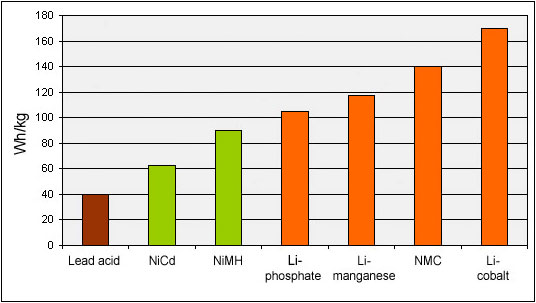
    The graph below shows the weight in Kilo’s per WH for various batteries. Although the iron phosphate may be the very best available regarding safety in lithium, to produce the amount of power required by our coaches they are still going to be very big and heavy. Assuming that each 8d is somewhere around 1400 watts and that iron phosphate batteries are still very expensive………….

  • John

    Member
    November 7, 2013 at 12:38 pm

    I don’t know where you got the chart, but there is one thing for sure. To get the equivalent power in a lithium battery as my 680 pounds of 8D delivers I need 250 pounds of batteries.

    That’s a little more than one third the weight. Nobody in their right mind would design a car or equip an RV or yacht with lithium batteries if they were the weights your chart shows. I am not sure why people are not giving these a serious look and are trying to find drawbacks to them. Right now the only thing I can find to prevent me from replacing AGM or Gel batteries in my coach is the dollars and cents. There are differences between what we now have and lithium, but as we gain more knowledge and experience with lithium and get past the learning curve on installing them in the RV the differences are nothing but good news.

    They charge faster, they supply a constant voltage from fully charged to just before they shut down, they last more than double the discharge cycles of conventional bateries, they reduce weight significantly, they are rebuildable at the end of their life, and the negatives are cost and the need to have specific controls to deal with their characteristics.

    I think as their use becomes more widespread the costs will tumble, and as far as dealing with their quirks, such as a sudden shut down when depleted to a certain point the technology is rapidly being refined to deal with lithium

Page 1 of 6

Log in to reply.