
-
IS Otr/bus air a must have or like to have?
Archived replied 9 years, 1 month ago 33 Members · 77 Replies
-

Ron asked:
“M and C, 101 AC using inverter. I thought I had these systems figured out. Here is my question. You say you have 4 acs run by 4 inverters. Are you driving down the road with 2 acs on plus the dash air. Are the inverters receiving power from batteries charged by an alt? Thanks”
Yes, normally the dash air is fine for us if the outside temp is in the 80’s. If it gets into the 90’s we’ll turn on one or two roof airs. I’ve run the roof airs without the generator but mostly with the generator running as it’s needs to be exercised often.
We have four alternators so when the engine is running, the inverters are receiving power.
Liberty has used Lithium Ion battery technology since about 2011 (I think). We have THREE LI house batteries powering our coach. It probably replaces 8-10 AGM batteries. Two slide coaches use TWO LI batteries.
Liberty puts the generator radiator in a side compartment drawing air from underneath the coach, Marathon puts the generator radiator at the front grill, Millennium puts their generator radiator on the roof. Current Liberty’s have switched to Onan generators where the radiator is built-in with the generator unit itself (tier four technology).
Mark
-
Thanks Mark
That is what I thought was going on. And use the generator with the same system if needed?
Li batteries. They are nice. How many amh do you have in yhr Li s?
-
Ron we have OTR and 3 14000 Cruise Airs, so if we were to run all three Cruise Airs going down the road it would equal the 42000 btu’s of cooling vs the whole bus air which my manual says is a 95000 btu unit, which is more than double the cooling or heating capacity. I’ve had very little problem with my OTR and wouldn’t want to go without it. This summer comming home from the desert southwest in 100+ degree weather our bus air stopped working, a low pressure switch that was leaking which was an easy fix. I started the generator and tried to run the cruise air’s with no luck, as someone mention the cruise airs set down low behind the front bumper and was too hot for them to stay running.
So for me even if you have 4 roof air units, each at 13500 btu’s that equals 54000 btu’s of cooling or heating vs the 95000 btu’s that the OTR puts out. Hope this helps in your decisions.
-
Ron,
CruiseAirs can be run by shore power, generator power, or on inverters. Marathon typical setup can run two CruiseAirs on inverters.
Another thing about OTR AC; If you run the ACs on generator, the generator will shut off about when you show 1/4 tank of fuel. This is to avoid the generator to use up all the fuel so you won’t end up stranded. OTR AC will run as long as the engine runs. We have gone to 1/8 tank at times, which would have shut off the generator (BTW, it’s hard to start if you run it out of fuel–ask me how I know!), but we could keep going to the fuel stop we wanted and still have AC.
-
Ron,
Per is a daredevil … we never go below 1/4 tank 🙂
And like Per said, Cruiseairs are powered thru Shore & Gen (4 A/C’s), or Inverters (2 A/C’s). We generally never run them off the Inverters since we understand it puts a good deal of stress on the Inverters.
-
Sounds like the ones that have OTR would not be without it, and the ones that don’t have it are happy without it.
If you have never had OTR, then you don’t know what you are missing.
It has been a requirement in all 3 buses I have owned, and I would not be happy without it.
Later model coaches like Mr. Mark, with the ability to run A/C’s using 4 inverters, may be a different story.
It’s certainly another system to keep up with, but worth it in my book.
-
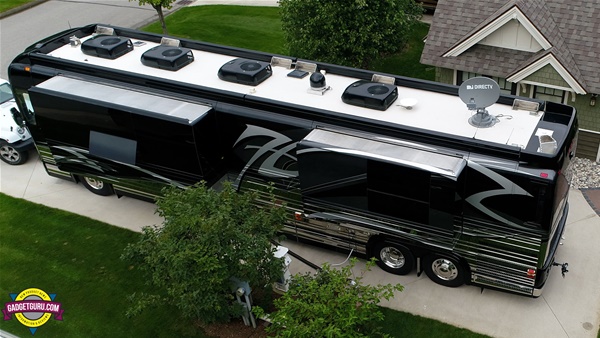
My bus has four roof airs and while I’m doing my best to dodge high heat and humidity areas this Summer, since it’s based in South Florida, there’s been days when I’ve been on the road in 90-degree, high humidity conditions. Typically I run the dash air and two roof units while driving and the bus has remained cool without the need to run the generator while driving.
-
Ron asked, “ How many amp hours do you have in your Li s? “
Ron, I’m not sure, I’ll investigate and get back with an answer.
We are basically ‘pole-to-pole’ users. Our LI batteries can go down to a 30% charge and the generator is set to come on to recharge.
Per, I get antsy when the fuel gauge approaches 1/4 tank (I do not ever want to run out of fuel). I start looking for a LOVE’s fuel station when the gauge hits about 1/2. That might require several hundred more miles of driving as I might pick the furthest one on our route for that day. If I recall correctly, the most I’ve driven on one tank before a fill-up was 1,100 miles. (We have a 230 gallon tank).
Mark
-
Per will correct me if I am wrong, but based on his admission that full time use of the Jake is not as fuel efficient as only using it when needed, I am theorizing there is an economic consideration to running his fuel to a near empty condition.
First, we know the less weight we carry the better our fuel mileage so an empty tank makes a lot of sense in that respect. A second and likely consideration is when the tank is at a less empty condition he is still a 1/4 tank from less expensive fuel.
I admit I am picking on Per, but I do exactly what he is doing. I have a window for refueling and it is between 700 and 1000 miles. With my 208 gallon capacity, minus 10% (we likely cannot put our entire listed capacity in the tank) I have 180 gallons useable at least, maybe as much as 190.. At 6.5 MPG my theoretical distant to fuel exhaustion is 1170 miles. The most I have ever put in is 160 gallons so I know my process of determining where and when to fuel has a safety margin built in.
When my fuel gauge needle is laying on the big E I need somewhere around 160 gallons or less so Per and I are not doing anything risky. My fuel stop planning is based on needing at least 100 gallons, always using a Love’s, and not going past my 1000 mile mark. So far so good.
-
Um 298 gallons, 1600 mile cycles, refilling about 220 gallons.
-
Jon,
Actually we use close to the same system. I’m looking at fuel stops between 800 and 1,000 miles. The most I have put in the tank is 170 gallons, which means I have about 60 gallons left, plenty to go a long ways. I also like to see how much fuel I have left at low readings on the guage. I usually don’t go below 1/4, but if I get close, I switch over to OTR.You also make a good point that OTR also has OTR heating when you need it. For cold-natured people, you can stay nice and warm in very cold weather when driving. If Buddy Holly’s bus had had it, he would not have gotten aboard that airplane.
-
Ron,
I’m away from the coach and it’s literature.
From looking online at Lithium Ion 24v Mastervolt batteries, I think we have 180 amp hours per battery (we have 3). The batteries that I looked up weight 123 lbs. each.
I hope I’m not off base but will be with the coach in a couple of days to investigate further.
Mark
-

Mark
Lithium are the way to go. The lifespan is up to 10 times as long, a third of the weight, charge quicker, and like you said they can be run down to 30%. Little maintenance.
Ron
-
If switching over to Li was that simple and the benefits were as described we all would have them.
In 27 years of ownership this is the first time a potential buyer has asked about battery AH on a forum. Nothing wrong with that, but after 27 years of ownership of three coaches that is one thing I never knew (still don’t) about my coaches. Why???? Because I am buying an entire coach and I have never seen a potential purchase in which I could change the number of batteries, or determine if what was available would work.
I have had a coach with 6 group 31 deep discharge wet cell and two coaches with 4 8D AGM. I still don’t know how many AH I had, but I do know on all coaches I could go through the night without needing to run the generator, but also not being able to run air conditioners. If I have to run my A/Cs or Webasto I will just run my generator all night. I don’t know if there is a coach on the market that is any different.
-
If our coach is on, the OTR air is on. If it ever broke, I’d fix it. If it kept breaking, I’d keep fixing it. I’ve never traveled in heat on a coach without it but don’t see how dash air with two roof airs keep up when it’s 90+ degrees outside. OTR is 120,000 btu I believe and even it takes a minute to cool the coach when it’s that hot.
It is nice to stop after driving all day and not have to wait for the bedroom to cool down before you can sleep. Most of the time the cruise air thermostats won’t even kick on for 20 minutes after driving b/c the coach is already so cool.
Log in to reply.