
-
House Battery vs Inverter Output
Posted by Archived on October 27, 2013 at 1:14 pmI hope we hae some electronic gurus on here to help me wiith this.
I am trying to figure out how long my house batteries will run based on the chart from LifeLine.
A 8D at 12V about 60 +- degrees will supply 25 AMPs of draw for 425 minutes give or take.
My question is how long will this battery run if the inverter is powering 25 AMP at 110 V to the coach.
How much power does it take in 12 V for the inverter to output a given amperage in 110 V ?????????
To my dislike, CC did not put any means to monitor a draw on the house batteries or how much load the inverters were putting out. Can monitor Shore and Gen only. I am going to talke to someone about trying to come up with a way to monitor the house battery usage.
Archived replied 12 years, 6 months ago 10 Members · 28 Replies -
28 Replies
-

Theoretically about 20 min.
But a single 8D will not sustain the required 250+A. You’d need about 10 8D batteries to get to the 25A long-term discharge rate. If you use more than the 25A discharge rate, the effective capacity is lower. Also, you should only use about 50% of reserve capacity to avoid damaging the battery. Throw in an inverter efficiency of 90% you could power that load for about 2.5 hours if you had 10 8D batteries. If you only have 6 8D batteries, you’ll be closer to 1 hour.
-
Hard questions like yours are answered by Gil or Ben. But knowing and accepting the fact I am going to blow some smoke, here is my spin on what you describe.
First, you have to understand how your coach is set up. On my coach and I think yours, if you have input to the coach (and inverters from a 120 V power source the 120 volt loads are not drawing power from your batteries. The 120 volt input is by-passing the inverter and supplying power directly to the 120 volt devices and loads.
However your 12 or 24 volt loads are drawing power from the batteries and as long as the inverter has the 120 volt input the inverters are acting like battery chargers. The question is if your inverters are supplying enough charging current to offest the current draw from the 12 and 24 volt loads. The answer is in how your inverters have been set up for charging current.
In my coach if I turn on all the lights I draw more from the batteries than the inverter replaces. However, at some point I turn off the lights and go to bed and then the inverters have 8 hours to fully charge the house batteries.
Did that make sense? If you owned a Vantare the information I gave above would be invalid.
-
Jon you are correct. My inverters pass thru Shore or Gen power and only charge during those conditions.
I meant 25 AMPs not 250.
I pretty much get it. I just did not know how much an inverter will draw from the batteries at 12 volts to convert that to 110 volts.
I have 8, 8D batteries so at 425 AMPs that is a total capacity output of 3200 minutes at 12 volts drawing 25 AMPs at 12 volts. Taking into account the 50% rule, that would be half (1600 minutes.)
I gues my question is how much of that 3200 minutes would be usable from the 110 volt side of the inverter if they were puting out 25 AMPs at 110 volts. Is there a formula for calculating the amount of 12 volt power supplied by the batteries to the inverters to out put 110 volts at 25 AMPs of load.
-
I have seen all manner of descriptions of inverter efficiency. Why 94% sticks in my mind I don’t know, but use 90% as a safe efficiency factor. The other side of the coin is the batteries. The ratings are for new batteries so as they age there will be some loss of efficiency from them as well.
If you really want your head screwed up, try to figure the phantom loads we all have, ranging from small loads such as the clocks and alarm system, to larger loads such as cooling fans.
Bottom line is when I try to figure how long I can last I try to go by previous experience because the theoretical stuff is just that.
Of course my Liberty can go four days with two air conditioners running full time, and all the lights on. Yours cannot because it is a CC. Can you hear the posts in response now?
-
YES, I HEAR IT COMING IN THE DISTANCE, RUMBLING LIKE THUNDER AT A FAR DISTANCE.
-
Charles,
The easy
answer is to simply multiple your 120V AC current draw by 10 and you have a
rough equivalent for your 12VDC current draw.
For your purposes, this is likely good enough, because there are several
other factors that come into play. If
you want to be more precise then the formula is AC Volts * AC amps = watts / DC
volts = DC Amps. Here are a couple of
examples that show the DC current draw with a fully charged 12V battery and one
at full discharge. Keep in mind this is
for illustration purposes only and it’s not recommended to fully discharge a
battery. To do so significantly reduces
the number of discharge cycles the battery will support.120 * 25 =
3000 / 12.8 = 234.4120 * 25 =
3000 / 10.5 = 285.7Total
battery capacity has to be factored and it’s not a simple math equation where
you divide current draw into the total capacity. A scientist by the name of Peukert determined
a batteries capacity varies by the current draw. If a battery’s capacity is rated for a 20-hour
discharge cycle, which is the standard, its capacity is reduced if the
discharge time is shortened. As an
example, if a 20-hour discharge rate equals 100% of the batteries capacity, a
discharge rate of 1 hour would only provide 45% of the capacity that was
available at the lower discharge rate of 20 hours. This is the single greatest factor in
determining the number of batteries you should have in your battery bank.I’m not sure
what your goal is. I will say a constant
120V/25A load is significant, but it’s not the only load factor. Indictive loads are different from resistive
loads. Inductive loads have significant
start-up current. We also have many
devices that run directly off 12VDC (such as lights, water pumps, Webasto, etc),
so those loads need to be factored. You
are already aware of the inefficiency of the inverter. Although slight, it too needs to be factored.BTW, our
coaches and those from other converters don’t have AC amp meters on the
inverter loads because they aren’t critical and provide limited
information. What is critical is
understanding your current load from your power source. So, with commercial and generator power you
should have AC amp meters on both legs of the incoming AC power. When on batteries, which is the case on
inverter power, you need to have DC amp meters.
You should have them on your Link 2000 or Xantrex basic remotes. Keep in mind you need to add the DC current
readings if you have a single battery bank supplying power to two inverters,
like we do. It would be easy enough to
add 2 AC amp meters to the inverter output, which would be beneficial to those
required to do AC power management while on inverter power or those that have
Trace inverters that are configured to supplement the incoming commercial
power. -
Now Gil, you know Liberty measures the AC loads coming through the inverters. In fact it likes measuring them so much, when we are on shore power it measures them twice.
We do not measure the DC current loads. It is all academic anyway. because there are so many variables.
-
Jon, I’m not aware of any inverter that doesn’t display DC current on its remote display. What model remote do you have that doesn’t have a display of DC amps? BTW, the same display is usually used to display DC amps going into the batteries when the charger is on.
-
thanks Gil, that really helps. I just didn’t have any idea how much 12V power was required to run an inverter putting out say 20 AMPS at 110 volts. No particular reason I wanted to know about how long my batteries would supply such a load.
I have a 99 CC so I don’t have any automation like Crestron etc. My Trace controls only display batter usage by a bar graph, time left to run, time left to charge and percent of charge. I have 8, 8D’s and all lighting inside is LED and TV is LED so I could probably go a pretty good while on battery power. Frig is std home type so that would be the most draw not counting use of microwave or Webasto.
-
My Freedom 2500 remote only had a crude bar display showing charging current. I have Outback inverters now, and since I haven’t had to change batteries or had problems I haven’t taken the time to explore the endless pages of information available or programming capabilities. At some point I will have to, but for now all is good. The page displayed now shows battery voltage.
-
Buddy,
Peter’s Royale would go 20 hrs before hitting 12.2 with just the fridge and parasitic loads with 5 8DL’s.
-
Jon,
The crude bar on the Xantrex basic remote is good enough for most. In fact, I went from the Link 2000 intelligent remote to that basic remote; that’s another story. Outback makes a very good product and I’m pretty sure all of their remotes display DC current.
Charles,
We have the same coaches that were originally equipped with Freedoms. Many have replaced them with 458s. With Trace inverters, you have a more capable inverter/charger than you likely need as it has more features than probably anything used in the RV industry.
Tom,
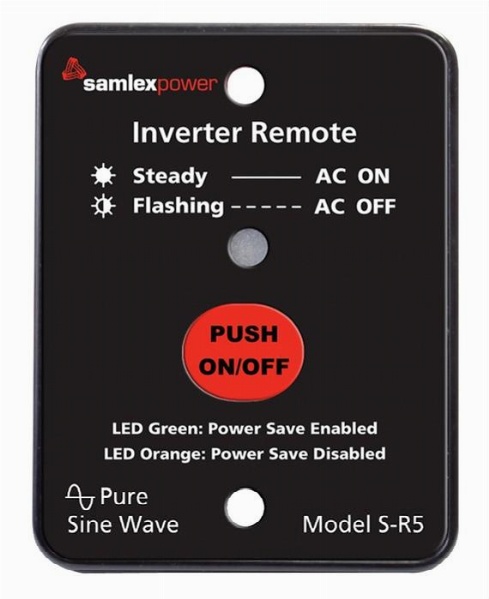
I’ve never heard of Samlex inverters in the marine or RV industries. I’ll have to at some point add that to the ones I already know (Xantrex, Magnum, Outback, Victron, and Chales Industries). It looks like you have a 1500W inverter. How many do you have? The remote you have is for someone that doesn’t want to know anything other than the inverter is on. For those that want/need more, you might want to try this remote. Even this one is a bit weird in that they display the output in percentage rather than amps.

Log in to reply.