
Prevost Community Forums

Find answers, ask questions, and connect with our
Prevost Community around the world.

  • Holding Tank Odor in Coach

    Posted by Walter on January 27, 2016 at 2:39 pm

    Hi,

    Like many others – I had this problem. Here’s what happened.

    We have been “camping” in the bus in the driveway to figure out what is and isn’t working, what we need to buy for the bus, and just to make sure we’re all set before going to a remote location and fining out we didn’t pack something important.

    This meant we used the sinks, toilet, shower, washer, etc… and in one instance I left the tanks for a week before going back into the bus. When I did – I was HIT IN THE FACE with some strong odor – brining creedence to the statment “the grey tank can smell as bad as the black tank.”

    My nose zereod in on the toilet room and then as I opened the undersink cabinet – it was even stronger. So, I then looked at the venting device (air admittance valve) and took it out thinking something might be wrong with it. When I did that – I almost passed out on my way out of the bus as now nothing was in the way of the odor coming out of the tank. I then found my gas mask and went back in. What I learned was that the smell I was smelling was indeed coming from the grey tank – and probably through this vent device.

    Although there didn’t seem to be anything wrong it – I went to lowe’s and bought a new one. Now – here is the conundrum you face at Lowes… There is this one for 5.99 that is exactly like the one Marathon put in:

    And then there is this one that is 25.99:
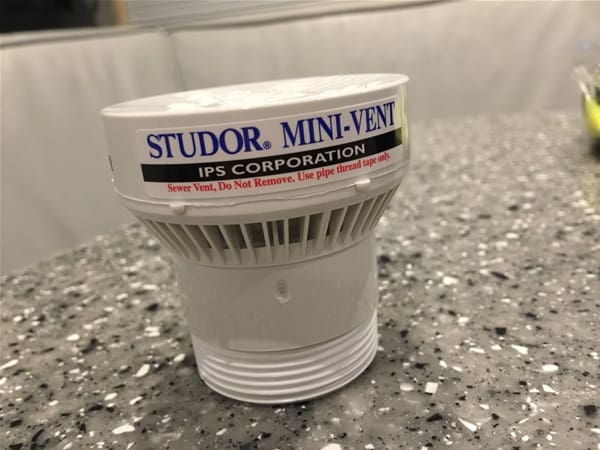
    So I did what anyone would do – I bought both. Well, actually, I bought 2 of the cheap ones and 1 of the expensive one since as I knew it at the time, there were 3 vents inside the bus.

    Then, I put the expensive one on the vent in the toilet room, and the cheaper ones I put on the vent for the Galley Sink and the Vanity Sink.

    After a while, I went back and…. still smells. Ugh. But, the smell was clearly not coming from the Toilet room… it seemed to come from the Galley Sink cabniet and the vanity cabinet. Also – from the Shower.

    SO – I kept seaching the net and reading… and like everyone… I thought that there was a broken pipe somewhere.

    I also kept looking in the bus. As I was looking, I did discover that there was a vent for the washing machine that is behind a very well camouflaged panel. So, back to Lowes and I put another cheap vent on that one. There are 4 vents inside this 2003 Marathon.

    Now that I had replaced all the sewer vents in the bus (Side note, I did read on the net that the shower doesn’t have a vent and I was able to trace all the pipes and see that indeed there is no shower vent) I tuned on the fantastic fan thinking I was on my way to odor free nirvana.

    Nope – the smell was getting even stronger as I was trying to clear the bus of odor.

    OK – then I looked at the vent under the Vanity sink since the smell was eminating from the cabniets. I put my hand up there to feel it and to my suprise I could “feel” air coming OUT of the vent. Exactly what the vent is supposed to prevent. So I thought “Hmmmm…. that’s strange.” (actually I thought WTF?)

    So – Back to Loews. I bought 3 more of the expensive sewer vents for a total of 104 bucks in SEWER VENTS.

    But now…. with masking tape over the drain in the shower AND with 4 $25.99 sewer vents I’m happy to report NO SMELL. I even turned on the Fantastic Fan – with all the windows and stuff closed to “test the vents” – No smell. Awsome!

    Now, I haven’t been driving with it yet… but I suspect these better vents will hold tight.

    Lesson learned – don’t buy the cheap stuff… and there are 4 vents in this era Marathon… not 3.

    Thanks for looking!

    Walt

    DON replied 9 years, 6 months ago 16 Members · 32 Replies
  • 32 Replies
  • Archived

    Member
    January 27, 2016 at 2:54 pm

    Walt,

    The plumbing codes only allow air admittance valves under very limited circumstances because they can be unreliable. I don’t have any idea how any of the converters plumb their fixtures, but if they can vent all devices using a conventional vent system through the roof of the coach there will be no issues such as you described.

    The key to identifying a failing air admittance valve is to give the coach the sniff test with the windows closed and the vent fan on. If one is starting to leak (fail to close) you will get an odor. And it does not matter if you flush your tanks every time you dump or not. The odors coming from the tanks are nasty, even after flushing unless you have a tank flush system that removes 100% of the contents.

  • Corey

    Member
    January 27, 2016 at 6:43 pm

    Walt,

    I don’t have this issue “now”; however, for future reference, the vent cap you replaced was under your bathroom sink?

    Are all your vent covers “inside” the bus vs. on the roof?

    Also, what actually goes wrong with these vents? Is there some sort of flap that goes bad after a certain time?

  • Walter

    Member
    January 27, 2016 at 9:58 pm

    On our 2003 Marathon XLII there are 3 locations where the vents are. There are a total of 4 vents Inside the bust – with a single “tank” vent on the roof.

    The cabinet under the Galley Sink there is 1. Looks like this: (you can see the vent in way back in there)

    In the Toilet room cabinet there is 1:

    And, the vanity sink cabinet:

    Now, the fourth vent (for the washing machine) is accessed through the Vanity Cabinet… I already did the work and closed it up (stupidly) before I took a picture BUT….

    Look about 7 o’Clock in the picture – see that nylon strap loop? You pull on that and that panel comes out and you’ll see the 4th vent for the washing machine. You will have to remove the rectangular panel in the back there first (on mine I did – you might not) If you put on your X-Ray vision glasses – you’ll see the vent it in the picture behind that panel. If you don’t have them handy… trust that this is where it was on our bus.

    Changing them out was actually pretty easy… just took a while to find that 4th one behind that panel there and pony up for the big money 26$ pieces of plastic.

    Walt

  • Dick

    Member
    January 27, 2016 at 10:11 pm

    I agree – I wish they just vented everything to the roof and put a 1-way valve up there. That wasy you couldn’t blow out the P-traps. I also think that becuase of the problems with air pressure, the P-traps should be 2 feet tall instead of the normal house version that is only a couple of inches. Hmmm…. I wonder if I could retrofit that up….

    Frankly the fact that there are odor problems at all in these busses is ridiculous. All that money and R&D spent on electronic doodads instead of a little thought put into how to make sure the bus doesn’t smell like a sewer.

    I suppose I get it…. electronics, TV’s, and Accent lights sell. Guarantee of no smell probably doesn’t.

    Walt

  • Rick

    Member
    January 28, 2016 at 12:12 am

    Libertys don’t have that smell problem.

    Not trying to start anything. Just sayin’ so all the prospective Prevost buyers are aware.

  • Archived

    Member
    January 28, 2016 at 6:21 am

    There is a vent on the back of the head hunter toilet and mine failed,so my Liberty had a problem also.

  • Larry

    Member
    January 28, 2016 at 7:48 am

    Good to know but I think my toilet vent is on the roof since I followed the pipe going up and didn’t see anything. Probably is a good thing it’s on the roof …

  • Corey

    Member
    January 28, 2016 at 8:11 am

    In my royale it would smell going down the road looked for smell and replaced the vents under the sinks and so on , when I found it , it was behind the wall and both the black and grey vent pipes join behind the fridge it was cracked just before it went through the roof and the smell would travel across the top of roof inside and come out around the microwave , so I replaced the vent pipe and put one of those vent caps on called the cyclone the smell stopped right away , I think somebody had hit a tree branch when driving and hit the vent on the roof when driving and it cracked down inside the wall behind the fridge.

  • Peter

    Member
    January 28, 2016 at 9:19 am

    Walt,

    Your screen name does not allow email. if you turn that one, folks could email you.

    I notice you do not have a toad yet. Are you interested in one? Our 2013 Jeep GC is going to be for sale soon.

    We are in Indio, CA.

  • tom

    Member
    January 28, 2016 at 9:37 am

    Put your Jeep in the Flea Market boys.

  • Archived

    Member
    January 28, 2016 at 9:55 am

    Will do once we put it on the market!

  • Archived

    Member
    January 28, 2016 at 11:03 pm

    Walt

    you say you have one vent going to the roof, have you checked to see if it is plugged up?

  • Peter

    Member
    January 29, 2016 at 12:59 am

    I did, and it appears fine. I bought a camco sewer vent device for the roof. It spins around to follow the wind and is supposed to use the wind to suck out odor. There is some device like it on there now…. But it doesn’t move. Only points forward. For when your driving I figure. I think this camco one will be better. I’m going to put that up there. When it’s not raining on the weekend.

  • glen

    Member
    January 29, 2016 at 6:26 am

    While a roof vent should allow both air entry and exhaust it should not create a negative system pressure when we drive. Our first coach had what looked like a pressure venturi cap on the roof vents and as we drove the negative pressure created vacuumed the water from the traps. A rotating cap will have a negative pressure area at the back side opening with the drop in pressure greater as speed increases.As the water in the traps was reduced by driving we could hear gurgling. As long as we used the sink after we stopped driving, no odors, but if we did not refill the traps we got the smell.

    There really is no down side to a roof vent just terminating with an open pipe pointing skyward. What little rain can enter the vent is going to end up in the holding tank and not in any quantity that will cause a problem.

  • Dick

    Member
    January 29, 2016 at 2:51 pm

    I would assume these under the sink vents are one way valves to allow air to enter the system and on exit. So the tube to the roof is really your exhaust and the under the sink valve should prevent a negative pressure on the system. But I have been wrong before. Just doesn’t make sense that air would be vented out under the sink. Defeats the purpose of the water trap.

Page 1 of 3

Log in to reply.