
-
Glendinning Cablemaster CM-7 stopped working
Posted by Gerald on December 12, 2012 at 9:25 pmWe are all loaded up and ready to go on a 2 week escape to the sun. Literally the last action was to retract the shore power cord……and nothing! It will not move in or out. It worked fine a week ago.
There is power at the on-off switch. The two relays (in / out) seem to be ok but not engaging when I press the momentary in-out switch. It has been cold but not freezing. My guess is there is some problem with the limit microswitches but they are all but impossible to get at. I believe there is one at the rear of the inlet which gets tripped by a plastic collar next to the plug and another one at the end of the cord.
I’d rather not drag the shore power cord behind the bus for 2000 miles. Although my wife/daughter are ready to give it a try.
Any ideas? Anybody had a similar issue?
Stuck in our driveway (it could be worse)
Thanks, Gerald
Peter replied 13 years, 8 months ago 10 Members · 19 Replies -
19 Replies
-

Gerald,
I went to google and found the Glendinning company web site. Your model CM-7 is listed along with a trouble shooting guide.
Maybe you have searched on there site ?
Just trying to help
AL
-
Al, thanks. I did look at their site. I also have the installation manual. Unfortunately, Marathon custom-wired the cablemaster and did not use the Glendinning relay board that is shown in their manual. So it is a bit tougher to determine what each wire is supposed to be doing. I might have to get the bus indoors to do some quality trouble shooting.
-
You can manually extend/retract the cable in an emergency situation. I replaced the motor on my Glendenning last summer – call their 800 number as Al suggested and have your model number available, they are very helpful in diagnosing their units. As I recall the cost of the motor and UPS shipping was $79 or so.
-
I’ll give the manual approach another try. If I support the cable close to the hawse pipe, I can stuff it back in inch by inch. Manually pulling the cable out is not an issue. The problem might be my motor too. It would be unlikely that both limit switches fail at the same time (i.e. no in or out operation).
Orren, do you happen to know where Marathon puts the breaker for the cablemaster?
It is not in the bay nor is it one of the Techlink breakers at the inverter switch panel.
We are planning to leave this morning with or without the shore cable. Bought new snow tire chains to make sure we can get over the passes. Never a dull moment.
-
Did you bypass the relay module to rule it out? You can just check for voltage on the output of the relay box when you toggle the switch for in or out.
-
I don’t know where Marathon has their breakers, on my Liberty the motor was controlled by a 20A fuse on the electrical panel in bay 2 – driver side. I replaced the fuse with a circuit breaker as part of the repair. This fuse had blown a couple of times before the motor failed completely, so there was some warning of a potential problem.
-
Threegreens, if your still at home scratching your head. Maybe you could use a hot wire jump from an external battery to try and power the reel.
JIM
-
Well I stuffed the cable back in manually. I had to remove the panel below the switch to get access to the cablemaster. Pushing and pulling at the same time I got it to go back in. We were off.
On our way we stopped by a shop run by former Marathon employees and they managed to get it going again. It looked like the “helicopter/mil-spec quality” wiring board system Marathon uses had an intermittent failure. All was good again – or so we thought. They had never seen that type of failure. We were off again.
An hour from there our car with my daughter following the coach was rear ended. No injuries just a lot of damage, but the car seemed driveable. We stayed overnight to decide whether to continue on or abort the trip. The next morning the cable would not retract again….arghh.
I manually pushed and pulled it back in and we went back home. Got to take care of the car and think about the cable master issue.
As systems go, the cable master is not very complicated. An on/off switch, an in/out momentary switch, two normally connected limit switches and two relays reversing motor polarity. How hard can trouble shooting be….
Found a schematic that describes the Marathon wiring perfectly
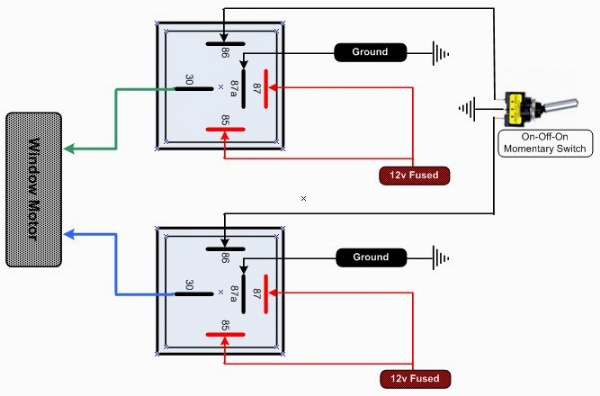
Tested the motor by supplying 12V directly to the motor after isolating it from the relays. It seemed to run fine but I assume it has some internal brushes that could be worn and cause intermittent behavior. I have no explanation why directly wiring relay coils vs using the supplied wiring blocks got it to run for a day.
Failure seems to correlate to partially extending the cable in cold but non-freezing temperatures over night.
Jim, yes I’m tempted to hotwire the whole thing. It would be a last resort on an extended road trip.
———————
I have been scratching my head on where the cable master fuse/breaker would be. I just remembered that I saw a breaker labeled “Cablemaster” in the battery bay when I replaced the house batteries. There were about 10 DC breakers of a type I had not seen before. No obvious way to tell whether they were closed or open.
-
Gerald,
One thing we learned a long time ago was to have a plan for every conceivable event. The obvious first choice is to have whatever spare parts might be needed, within reason, to make a simple repair. That would be to replace relays or fuses or lights or maybe even a brake hose.
But we cannot afford to be a rolling hardware store so on a lot of things I try to have backup or ways to bypass something. My back up water pump is an example.
In the case of the cord reel we carry a spare cable that plugs into the shore power on one end and onto an exterior receptacle on the side of the coach on the other end. If the cord reel pukes I will drag out the shore power cord and deal with the cord reel when I get home.
Maybe I worry too much, but so far just by having an alternate plan for as many on-the-road problems as I can imagine there hasn’t been anything that has caused distress. If it is mechanical it is going to break.
-
Jon,
that is a great idea. I don’t have a second plug-in but just adding 15 feet to the existing cable wouldn’t add to much resistance.
-
The cable master problem had us scratching our heads for the last weeks. The shop 100mi away “fixed” it twice only to have it fail to retract after a cold night with the cable out.
Finally had an opportunity to really dig into the wiring myself. The schematic above helped although it turns out Marathon does not switch relay coil ground but the 12V side. The limit switches were in series with that. Power to the motor terminals on the relays came directly from the house battery via a dedicated fuse in the bay. No problem there.
Power to the relay coils via the SPDT switch was missing. It looked like it was supposed to be provided by another 4 wire cable vanishing into the bowels of the coach. I figured this cable was going to the RF remote control unit which never worked since I owned the coach. But why would the manual SPDT switch operation depend on the RF remote unit?
Finally found where the remote control unit was located. It is in the sidewall of the aft cupboard above the bed so that the antenna can receive RF signals from the handheld remote through the stateroom window. Turns out the 3 amp fuse to the remote control unit was blown. I replaced it but still no power to the relay coils. The power for the remote unit was supplied by another 3 amp fuse in the rear wiring closet that made intermittent contact. Credit goes to someone at Marathon who decided to label the cable master remote wire in English vs just numbers for all the rest. Otherwise I would have never been able to pick out the correct fuse out of the sea of fuses in the back wiring closet. With both fuses replaced I now have remote control operation and what seems reliable cable master operation.
Who would have thought that the wiring relies on two different sources of 12V from two entirely different places in the coach. Maybe the RF remote was an option that was installed later.
Total cost was four hours of my time and 50c worth of fuses and now I have remote control operation of the cable master as well. Lets hope this is the end of this story.
-
Gerald Congrats on getting your power cord working. I would have been wilder than a wet hen had I been
ready to leave on a 2000 mile trip and something fails at the last second! Rick
-
Thanks for the update. When it comes to motorhomes, and doesn’t seem to matter which manufacturer or converter you look at, that wiring diagrams and their wiring logic could be so much better. I remeber troubleshooting an awning motor that just didn’t have the power to close the awning on our 2008 Beaver when it was fully extended. I wasn’t the initial owner so I assumed the problem was new; it was not. Both the power and ground wiring was not sized for the load. After increasing the wire gauge all was good. BTW, two different shops had no clue where to look for the problem.
I’m curious why anyone would need or use a remote for retracting the power cable. I’m thinking this is one of those “it’s cool, but impractical” upgrades.
-
Our cord reel is on the “wrong” side of the coach. It is in the small compartment just behind the passenger side tag wheel. I can flick the switch and let it play out the amount of cord I need if I am good at guessing how much, or if I use the remote I can walk around the back of the bus with the plug in hand playing out cord as needed to get to the shore power.
It’s one of those tiny little things that come under the heading of nice to have, but not required. Two observations. First, our bay layout does not allow the cord reel to be anywhere else. I don’t like where it is, but I can accept the fact it has to be where it is. So to make a less than ideal placement less acceptable the option I have to use the remote is justified. The second thing to note is the remote doesn’t really simplify retracting the cable because I just unplug then go to the switch and reel it in.
-
Jon,
Oh, Liberty put the cord in the wrong place. Now I see the need for the remote. Country Coach put it in the right place; just below the fuel door on the driver’s side. Sorry, I couldn’t resist 😉
Log in to reply.