
-

Good post Russ. How about taking it one step further and explain the difference between 220 3 wire (such as a dryer) vs the 220 4 wire with neutral.
Let us know where to send the check!! 🙂
-
Russ describes the situation very well.
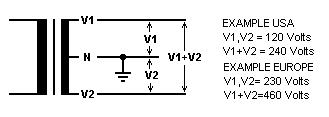
Our 240/50A circuits are not two phase but a split 240 Volt phase, the split phases are NOT independent legs. An open neutral requires current to return via the other leg, the actual voltage on your device now will be determined by what is turned on in the other split phase leg roughly following Ohm’s law (it is really an AC circuit so reactance comes into play). The two loads are now in series across 240V.
Do not use the coach until you have an electrician check out your wiring situation. Tell him to look for open neutral situation in either the cord, plugs or transfer switch.
Gerald
-
Tom, the only difference between the 220V 3 wire and the 220V 4 wire is the lack of the neutral wire. The phase is not split so to speak since the circuit has only 220V loads.
-
I’ll give the dryer question a shot….
Remember when we didn’t have electricity – well I don’t go back that far, but I easily remember when convenience outlets had just two sockets and everything that plugged in was just two wires. The three wire 240vac dryer kind of springs from that time. I don’t think you could purchase one like that today. Remember, we are discussing 220vac dryers, not 110vac dryers.
The old 3 wire 220vac dryer uses the two hot wires and neutral and NO safety ( green or bare ) ground wire. In the dryer there was a jumper between the neutral and the metal case of the dryer. This would provide a path for fault current if one of the hot wires should come in contact with the case and allow the breaker to trip. It is just not as good a situation as a separate grounded conductor since the neutral carries current and can have voltage slightly above ground.
The neutral connection is needed because the dryer controls ( timer, lights, etc. ) operate from the 120vac it gets from a phase to neutral. The dryer coil itself just uses the 220vac from phase to phase. Russ
-
Bob,
Thanks, Now I know that I need to have Liberty check the Neutral connection / Termination points.
Thanks,
Rocky
-
Russ, Or Bob
Can You give Me a Visual picture of the path that the A/C takes thru the cord to the coach appliances?
Thanks,
Rocky
-
simple: From power company you have two hot lines line one and line2 and one commonn (ground) ordarly a red line 1 a black line 2 and a white ground(commmon). At you home or comercial connection you have a completely seperate wire a earth ground ;usually a long rod driven in the earth with a with attached earth neutral. No connection with power grid!This apears in your electrical system as a green wire and should never be mixed with the white(common white) as it will defeat the complete system safety. It’s main purpose is to give a place for elect power to go to ground in case the white wirre fails==the only way else would be thru you or thru your coach to groung causing death or a fire. In this case/subject I feel the connection is a loose or partial broken white(common wire) before coach. you can lay it on ground on way and all is good and move it and it wont work. would ck ends first and look for discoloration in cord or contacts. That to coach only. hope that helps. Bob
-
I finally have my brain around this and thanks to Gerald, Russ and Bob.
Now you all really have my attention because if my understanding is complete and accurate every single one of us has a need to be very much aware of the potential we can all have a smoking mass of charred metal if we are not observant. Not attempting to scare everyone, but before we even get our 120/240 volt power to our electric distribution box we have multiple likely failure points for the neutral connection.
Start at the power cord plug. then go to every connector along the way, possibly at the plug on the side of the coach or the cord reel connection, or at the transfer switch. Knowing the high potential for damage is there any way a coach owner can get an attention getting warning of such a loose or open neutral circuit?
-
The potential open neutral problem is one downside of our 240V/50A hookups. A wiring problem in our coach or the campground can apply up to 240V to our 120V appliances. EMS won’t help, they don’t cut off until 600V or so. Just testing the voltages before we connect is insufficient. The problem appears as loads are applied.
The safest would be to use only 30A connections. An open neutral would then reduce voltage, which is generally not a problem.
The 240V/50A hookup would have to be tested under full load on each split phase to ensure the neutral can carry the current. Now carrying around a 120V/50A load is not very practical. What might make sense is to create a test adapter that brings out both split phases and plug in a large heater or hair dryer in one of the split phases and then the other. If you plug them in at the same time, the neutral will carry only the difference which is not what you want for the test.
Below is an example of what happens when the neutral wire in the pedestal is undersized. Since the problem appears only after running the load for several minutes it is very hard to protect against.
-
Gerald,
If we are willing to accept the risk that the neutral electrical connection between our transfer switches and our electrical panel bus bar is tight and the wire is sized properly, it appears to me we can create a device that inhibits power from passing through the transfer switch to the panel until it imposes the necessary loads and measures acceptable results. Our coaches have surge protectors built-in in a lot of instances to verify polarity and ground, so it is not beyond reason to add one more device because I suspect a bad or loose terminal at the power cord plug or anywhere in the line up to the transfer switch is more likely than a lighting strike or power surge.
I would want one that sounds a loud alarm within seconds of flipping the breaker in the power pedestal. If I ever have a problem with excess voltage the only electrical device easily removed and replaced is a lamp in the living room. I don’t even want to think about replacing other appliances or AC units.
-
After checking into it some more, it looks like there are portable EMSs that do have overvoltage protection (>135V) not just surge protection. They should protect from campground related neutral issues. I’d expect this to be the more common case.
These EMSs would not be able to protect us from neutral issues somewhere in our coach wiring though. Devices behind a neutral break on our coach could still see up to 240V.
Assuming our coaches are wired correctly to begin with, a newly surfacing problem could be caused by a burned neutral contact in the automatic transfer switch (typ. caused by transferring power while loads are still applied). So, if your 120V devices go up in smoke, have your transfer switch/relay checked.
-
very old school:: when on wet ground I still touch any coach part before using hand with back of fingers. Why ? if there were a charge your fingers contract. If you had a grip you are now the ground. If you touched with the back of your fingers you just get tingled. Do this especially in Mexico. Their electrical standards in buildings etc are not the same as ours. FWIW. Been shocked in Us campgound in last 5 years. Bob
-
If you did not understand what Bob G said, the back of the hand/finger touching a hot wire will cause the fingers to close, pulling them away with the reflex from the voltage source.
Touching the hot wire with the pad of the finger often causes one to fatally grab the hot wire.
JIM
-
My old habits die hard but still surprise me how often I get tingled especially on Sticks & Staples. Only have to get hit wrong once. Thanks for your better explanation!
Log in to reply.