
-

Tom you are probably right I was going on memory from another discussion on this topic.
-
We (well actually that should be “I”) ran out of fuel trying to stretch it into a Pilot truckstop in Alabama. We lost the prime and had a host of other problems because of it. Really un-good man.
Now we have a new traveling rule … “1/2 tank rule.” …. When it hits one-half tank we fuel it up, regardless. No worries, and no concerns.
“While parked on the Interstate actually had someone knock on the door asking if they could use my toilet.”
Now that one Al, it has to be the winner of the string. I loved that, it really conjoured up an image in my mind, let me tell you.
Kind of like those Orkin bug commercials … “Uh, could I use your telephone?”
hahahahaha
BCO
-
I am in awe that we really do not know how much fuel our coaches hold. Add me to the list.
Perhaps I am being silly for my expectations, perhaps flying has screwed up my thinking, but common sense suggests if I own a vehicle I expect the manufacturer to be able to tell me how much fuel I have onboard available to me. I don’t expect necessarily for the number to be to the gram with respect to accuracy, but I do expect to know how much fuel I can expect to be available to me once I fill the tank.
Prevost……..Can you clear up this topic because right now I think we are all confused.
Does the 208 gallons listed for my coach and the 298 gallons listed for the previous coach accurately reflect how much fuel is available before the engine goes quiet? My car and planes listed XX gallons capacity and that was pretty close to how much fuel I could access. But if I believe the comments here all I know at this point is there is some space in my tank allowed for other than fuel. In my case is that to suggest when I have a 208 gallon tank that is about how much fuel I have to use, plus some small amount that is unuseable? or do I only have a 208 gallon tank, that when full holds 90% of 208 gallons of fuel (or 85% or 95%) and the remainder in sailboat boat fuel?
At one time one of our members on his XLII had fuel stolen, then he drove thinking he had full fuel (but an erroneous reading) ultimately running out of fuel. When he refueled he actually took on a little over 208 gallons. That suggests we really have 208 gallons of useable fuel, but from the posts above you would never know.
Another topic is the accuracy of my fuel gauge, which reads empty with the needle laying on the red mark, yet I can only pump in about 150 gallons of my presumed 208 gallon capacity. Let’s clear up the first question, and then we can address the fuel gauge question.
-
BCO, what did it take to fill your coach and how big is your tank supposed to be?
There has been some discussion on the accuracy of the fuel gauge on the Silver Leaf glass dash. After a couple of calibration adjustments, I’m pleased with how Silver Leaf reports fuel levels.
The first thing I did was to determine when Prevost’s fuel tank sensor begins to drop below the full reading. Putting 10 gallons at a time into the coach and measuring the sensor’s resistance I determined that the sending unit reports the first 30 gallons of fuel consumed as full. Knowing this I set the tank capacity to 180 gallons instead of its actual capacity of 208 gallons.
I then fine tuned the empty calibration over a couple of fill ups and have it calibrated such that I’m happy with what it’s reporting. The other day Silver Leaf reported I had 53 gallons remaining. I filled up taking on 147 gallons. So, 147 gallons plus the 53 gallons reported remaining is 200 gallons. Being off by only 8 gallons more accurate than can be seen on any standard needle gauge.
My generator was running at the time, so I’m pretty sure I had most, if not all of the 53 gallons still available to run the engine. My SilverLeaf dash changes the fuel reading to RED when you hit 25%, which is what I hit when pulling into the pump. So, I will continue to fill up by the time I hit 25% until someone can tell me the actual fill capacity and how much fuel is in the tank when the pick up tube can no longer suck fuel.
I’m with Jon, why is it hard for someone to answer the real full and empty numbers. Surely the bus operators want to know these numbers so theyt don’t carry more fuel (weight) than they have to.
Hoping to never run dry!
-
My main tank “is supposed to hold” 150 gallons of fuel. The last time I checked it, the main guage was showing a little less than half-tank and it took 83.1 gallons to fill. It also “foams quite a lot on fill up’s and I shut it off when it clicks off, so most of the time, I figure I am a little less than full” which is what the guage will reflect.
My Aux tank is 75 U.S. Gallons (I used to hold it to 60-65 for weight and slopping reasons – spillage). Right now, I am running about 15 gallons in it for reserve and that is about it.
On the guages? I have to agree, regardless of who makes it, most fuel guages do not necessairly reflect “a true gallon reading” as I have found the case to be. Most are close at best and that is about it.
I’m also with Jon, why is it hard for someone to answer the real full and empty numbers especially when you are laying out the big bucks for a coach. It appears that the operators want to know these numbers so they don’t carry more fuel (weight) than they have to.
At my age, by the time I have run out a half-tank, believe me, I am ready to get up and walk around for sure. Might be prudent to add here that running dry can be an expensive and miserable experience, it pays to keep an eye on things.
So in answer to your question, my old Iggle holds roughly 225 gallons, but I seldom run it with that much fuel on board for reasons I have explained.
BCO
-
It even gets better…..
I have long range fuel, the aux tank added by Royale. The aux tank gravity fills via a hose from the main tank. The aux tank is taller than the main tank, so when fueling, there is know way for the fuel to ever completely fill the taller tank. So what is my usable fuel? Who knows, but I surely know it isn’t 250 gallons.
Thanks for pointing this out to me at OKC Ed…
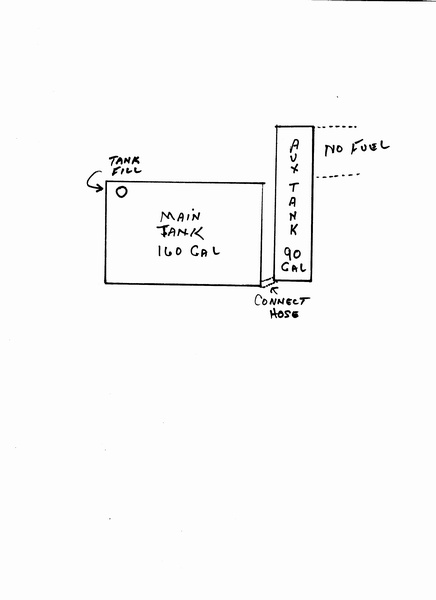
-
How does the aux tank vent air? Truk where did you read the 95%?
Anyone know the demension of these tanks?
-
Tom
At some time in the past I remember one of the guys that worked for Royale said the tanks Royale installed where 60 gallon tanks. Did a rough measurement of my aux. tank and it works out to about 60 gallons. I use this as my reserve. Have used up to 180 gallons knowing there is still some fuel left. Most times start looking for fuel before th needle gets to 1/4. Of course every thing added to eachcoach may never be the same.
-
Greg – There is a vent tube at the top of the aux tank. The 95% label is inside the fuel door.
Larry – The build sheet shows 160 and 90, but I question those numbers as well. I thought the standard fuel tank on our vintage was 208, not 160. You’re probably correct, the tank doesn’t look big enough to hold 90 gallons and if you have already done the math, mine is probably 60 as well, but usable would be much less because it can never be full.
160 and 60, or a total of 220 sounds more like what I may have. This trip last week I put 157 in and the needle was just off the empty mark, but as we all know, the gauge is a crap shoot.
Maybe John Klopp has already calculated all of this….
-
I seriously doubt Royale would be installing a fuel tank. They ordered shells to their specs so the fuel tank(s) was undoubtedly what was offered by Prevost.
FWIW my 87 came with a 160 gallon main and a 90 gallon aux, my 97 came with a 208 gallon main and a 90 gallon aux. The 87 was a 40 foot coach so the length of the coach may affect what Prevost offered.
-
Your aux tank was probably center mounted just like the main tank, the Royale tanks are added in an upright position in the rear of the first bay and I was told they added them, but whoever told me that could be wrong.
-
The aux tanks on both my coaches with long range fuel were behind the OTR in the third bay back. The two tanks in both cases were so close they were almost touching with only space needed for the hose and clamps keeping them apart from one another, which makes me wonder if an aux tank cannot be added to my current coach because the space is likely there. Got to go under it and look. Wouldn’t that be great!
-
Except for the extra weight….I bet you find that you really don’t need it anyway. I seem to be able to find enough places to fuel that I wouldn’t want to lug around the extra weight.
I know you don’t like truck stops…I don’t either, but they are a necessary evil sometimes. I do get out as quickly as I can. Too many idiots around those places.
-
I agree with all you say Mark and I am finding I have a comfortable 900 mile range now based on mileage and capacity. With another 90 gallons all of a sudden I now do most places in FL as a round trip, a visit to our daughter in western NY as a round trip, an oysterfest becomes a round trip. My point is 70% of all my driving with the 97 coach involved quantities of between 200 and 220 gallons. Some were more, some were less.
The advantage of that is we can leave home full and fill up upon our return, usually buying the cheapest fuel along our entire route ($3.85 right now) while avoiding the added stop required currently. Additionally our likely local fuel stop is a small Pilot with only 3 diesel truck pumps and it is usually empty. In the last several years I had to wait for the pump once. I’ll gladly pay to drag the extra weight around for the convenience of not refueling on the road.
-
The aux tank in my Royale is located at the rear of the front compartment. The Prevost build sheet does not list an aux tank but also the Royale build sheet does not list an extra fuel tank. From the understanding I had Royale was adding the aux tank to most every coach for a time. The samller size may have been related to front axle wieght. I know there is two because a couple of years back the hose connecting the two tanks began to leak. Takes a big bucket to hold all that fuel. That is why I had Wayne in Phoenix do the repair before he closed and became a bus broker. The guys he had working there had great knowledge of a Prevost bus.
Log in to reply.