
-
Flat Tag.
Posted by Roy on February 4, 2017 at 8:50 amAfter traving 425 miles yesterday, we woke up to a flat 365 tag tire. My question is what is the normal protocol. Replace tire or fix if possible? The good news we are home. Parked at an RV park near our home that we use for staging. Thanks for your replys.
Roy
Tom replied 9 years, 8 months ago 19 Members · 39 Replies -
39 Replies
-

My short answer is: find out why, then do whatever Michelin says to do
-
age of tire? could be as simple as valve core. I would prob replace it if over 7-8 yrs old . 10 yrs is max life and that depends on area of country. My opinion from research and past experience. We move our older tires to dump trucks to live out their life.
-
Thanks for the info tire is a little over a year old. I guess my real question is when a tire goes totally down does that damage it?
Roy
-
I found an inner drive tire very low during a pre trip inspection. I did not know when it went flat (e.g. sitting or during my last trip). So I filled it with air and it easily held until I got to a tire dealer. They found the leak – leaking valve core. I had them dismount the tire and visually check to see if any internal damage if it was driven below specified air pressure. None found – remount, new core, age ok, good to go ever since.
This is where a TPMS would really come in handy….. some day 🙂
-
All the advice about having the tire checked internally is absolutely correct, and if you think you drove on it with less pressure than required by 20% replace it. The problem with the tag axle is almost all of us with 365 tires on the tag really don’t know the correct pressure because the charts do not go below 80. For example if the axle weight calls for a pressure not even on the chart because it is below 80, the best we can do is extrapolate and maybe come up with a reasonable estimate. Maybe the correct pressure is 70, so theoretically 20% less would be 56, in which case if the tire still had that much pressure it would be OK. Completely flat, and driven on leaves no doubt the tire is damaged.
The cost of a tire is chump change compared to the potential cost if it fails catastophically and running on a tire with low pressure usually results in a sudden failure.
But the real issue here is if a valve stem schrader valve has a leak why wasn’t a valve stem cap with a seal used to prevent air loss instead of having it leak? A valve leak is fairly common and a cap with a seal is the best way to prevent air loss from the tire. Usually the problem is a very small piece of foreign material in the seat of the valve and a blast of air when adjusting pressure makes the debris go away and allows the valve to seat, but on those occasions when the valve leaks the cap is the safety device.
-
wasn’t one of our members injured when he inflated a flat that failed during inflation and exploded?
1999 XLV X-6872, liberty #440 -
Yes. A member arrived at a rally with an inner drive very low on pressure or almost flat. He had a tire service company refill the tire. When he got home he was topping off the pressure and the inner tire that had the low pressure exploded. The force was so great it blew the fender off the bus, knocked him against the garage wall and caused serious injuries.
He might post on here to fill in the details. He said he was alive because it was the inner drive tire and not the outer one. He felt if the outer one had exploded he would have borne all of the explosive force.
-
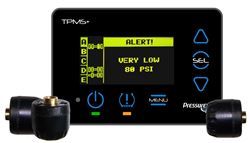
Pressure Pro boy’s, don’t leave home without it.
Contact me to order yours today….
-
This is not an attempt to help Tom sell more Pressure Pro but a dose of reality.
Our tire pressures are critical to our safety. Michelin and others have inflation pressure charts which list the correct inflation pressures based on the axle weights. If you have not fully loaded your coach with your personal belongings, filled it with fuel and water you need to do that. Then you need to set your tire pressures according to the charts. If you add more pressure that is OK, but running with less pressure than called for is not good.
If a tire is run at 20% or more less than the pressure shown in the chart it should be pulled from service. The tire is likely to have been damaged. A Pressure Pro or any tire pressure monitoring system is going to alert you to a low pressure situation before a tire gets damaged.
Running a tire at low pressure does not show damage unless you break the tire down and examine the inside of the tire so unless you know the pressures have not been low you are unaware the tire could fail. A TPMS or routine tire pressure monitoring is the only way you can prevent that hidden damage from occuring.
If the tire is damaged no TPMS is going to help you know that tire could burst at any minute. Unlike a slow leak from a nail or a road hazard a tire damaged by low pressure driving will likely fail catastrophically and suddenly. At that point you are going to have control issues and you face the prospect of coach damage from the exploding tire and a tire carcass that can start tearing up components like air bags and brake chambers.
If that sounds scary, it is. If you do not have a TPMS give serious consideration to getting one. And until you do make sure you are checking tire pressures at every opportunity. Even the use of an IR temperature reading gun will alert you to a tire whose temperature is out of line with the others, likely due to a difference in pressure.
Be safe out there.
-
Just to add to Jon’s as usual complete and concise advice…re-read Al Herman’s post on what to do if you have a blow-out. How to maintain control is absolutely critical. Geo.
-
If I remember correctly, the cost of a TPMS is about or less than the cost of a tire….Cheap Insurance
-
s
I want to thank everyone for their thoughts and information. I little background info, we were bringing the coach home on our maiden trip. We were not heavily loaded but the tires had been set to 107 front 100 drive and 90 on the tags. I am familiar with wheel weighing and setting to the chart with maybe + 5psi. But had not been weighed yet. the tires are about 18 months old, but for whatever reason, the valve stems had not been replaced with the tires. My plans were to head to ETLC have the valve stems replaced and some other zeroing work done. The coach has 25k miles ( yes I know non use is hard on it) the good news is that it spend most of its life in a hanger in North Dakota ( cooler climate ). The last set of Mitchen’s I bought for my Foretravel were purchased locally from a reputable commercial tired dealer, but, they did not have new valve stems to fit. So I really don’t want to go back there.
Monday morning I will will call Coach-Net and have them send someone out to try and fix the flat. Then I’ll move it to the storage unit were I keep it about 5 miles away. Next I’ll go about ordering a new tire. I’ll have to have the local guys install it. Does anyone know that proper size valve stem I need, so I can make sure they have one?
I am seriously considering a Pressure Pro TPMS. I had SOB unit that was a real pain, always giving false alarms, more trouble than it was worth. So if Tom, can assure me that Pressure Pro works better and that sensors are not leaking, I maybe interested.
Thanks again for all the comments. They confirmed some of my info and added new important info.
Roy
-
Roy,
If you are considering the Pressure Pro, the 365 tire valve stem usually used is a little too short so you might want to get the sensors and then fit the shortest valve stem available that allows the sensors to be attached. Leave the old one on until then. The tire mechanic can air up the tire and tighten the stem to stop the leak until you can get new stems.
I am not an expert on examining a tire for its condition but the mechanic can dismount the tire and do an internal examination. A strong clue of tire failure is if the inner skin (lining) on the tire sidewalls has any discoloration or darkness. That is from heat of running an underinflated tire and is proof that tire is highly likely to have a “zipper” failure. I am sure the tire inspectors know of other things to look for, but if that discoloration is seen never reinstall that tire because the probable tire failure will be sudden and it likely will do alot of damage as it comes apart.
-
The sensor seals were redesigned years ago, we as a group here haven’t had a leaking sensor issue.
Log in to reply.