
-
Clean sheet design: inverters, batteries, etc.
Posted by Chad on May 3, 2021 at 9:21 pmThis is the part where you help me spend my money.

I’m thinking about making some big changes to the house electrical. What’s prompting this (and I know I’ll catch hell from Jon!) is that I ripped out the Prevost OTR a/c and heat this week. While chasing some issues, I decided that it was either beyond economical repair, or simply beyond my patience to keep addressing aging parts that are really inaccessible. Removing everything was a three day project, and probably deserves its own post. My equipment took up the entire first bay, so I have plenty of room to play with. Altogether, I’ll bet I pulled 1000 pounds of parts out. I may have to weigh it.
My current house setup is a manual rotary transfer switch for selecting among OFF/SHORE/GEN/INVERTER. The generator is a circa-2004 13kW Wrico with a Kubota engine. I just gave it some love, including new engine mounts and slide-out roller bearings. The improved smoothness and the greater ease of access have really boosted my enjoyment. The older 1750W inverter wasn’t original and only covered one house leg. I already yanked that. A few years ago I replaced the two Crown-Raritan 60A converters with two Iota DLS-55/IQ4 smart chargers. Batteries are currently flooded lead acid, but I’m leaning heavily toward a LiFePO4 conversion. My new Iota chargers can’t handle that, so they’d have to go. Like I said – clean sheet.
I’d rather hear your ideas right now than share my own, but I think I have to start with the inverters. My cabling is pretty accessible, so I can upsize most any run if I need to. I might as well go big, so I’m looking at a couple of Magnum 4024 inverters. I have a 12v Coach, but my 50DN is 24v with almost no demand, and I think I could reuse the 2/0 cable that was feeding 24v to the OTR system, to now feed the inverters. I think I could make this work with the 12v house side using my existing Victron DC/DC converters and battery isolator, but haven’t really worked that out yet. I might be off base, in which case a couple of 2812 inverters might be better. I’m eyeing a 240v ducted mini-split though, so I want capacity.
I’d love to hear some thoughts, unless they’re about how dumb I was to remove the OTR. That ship has sailed! What do you wish you had in your Coach?
1984 96" with 8V92TA
(remodeled Liberty Coach)
Greenwood, MOMarshall replied 3 years, 10 months ago 25 Members · 45 Replies -
45 Replies
-

Chad,
I’ll leave the electrical details to those in the know regarding Lifepo4, but when you figure it all out, contact me for Relion battery pricing. Assuming you’ll want 8D’s, here are the choices:
RB100
RB100-LT (internal heater)
RB200
RB300
RB300-LT (internal heater)
You can also talk to Relion Tech with your questions.
1984 96" with 8V92TA
(remodeled Liberty Coach)
Greenwood, MO -
Chad, the only downside to pulling the OTR system is you lose backup heat and air. But since almost all the conversions currently produced rely solely on driver’s air and the house roof or Cruisairs it is certainly an accepted method of staying comfortable.
The electrical system which will be updated can be as complex or simple as you choose. If I were to start with an outdated system I would do the following. Start with an automatic transfer switch. By doing that if properly set up, it will prioritize your electric source, with inverters being the default source. If shore power is available it will switch to that source. Some inverters will recognize when the loads exceed shore power and will allow the inverter to supplement the shortage. The highest priority for a transfer switch will be the generator.
With updated inverters acting as battery chargers in the presence of shore power or generator power you likely will want to reconfigure the bus bars in your electrical panel, with inverter fed devices having separate bus bars. You would get to choose what circuits you want always powered such as the refrigerator, outlets, TV, coffee maker, etc. You may have to consider the gauge of wire feeding your electric panel so it can carry the loads you put on the inverters.
I heartily recommend LiFePo4 batteries because of not only the significant weight savings, but the amount of usable power is significant. Depending on loads when dry camping those Li batteries will reduce the amount of times the generator has to run.
What you might consider is setting the electrical system so you monitor the amp hour usage as the means of triggering auto start. Most auto-start systems look for low voltage before kicking on the generator, but Li batteries have an almost flat voltage curve before they need to be recharged. When that point is reached the available power is all but gone and it is easy for the batteires go into shut down.
Copy what the converters are doing. They do it right, including providing systems that are safe and function well.
-

Thanks for the replies, fellas. I think the Magnum MS4024 inverters take the place of an automatic transfer switch, but I might have misunderstood that. It looks like keeping everything 24v until converting it for the two house 12v legs is workable, and more efficient. I’ve read a couple of places that relying on the alternator to provide significant current to the inverters can harm the alternator, but I don’t know if that would apply to the heavy 50DN. My data plate shows 240A at 24V. There’s a lot of good info out there, but mainly geared toward smaller, lighter motor homes and trailers.
Due to the snowball effect, I’ve started so many projects in the last week that I probably have about a snowball’s chance of ever getting the bus put back together again. In pulling old switches and wires from the dash that are no longer used, I’ve pretty much committed to rebuilding my dash panels. A laser etching machine is on the way to create new custom switch panels with backlit lettering. I’ll probably take the opportunity to rebuild the driver gauge and radio/backup camera panels too. The use of space was pretty inefficient, and I still have to find room for a TPMS display.
What I have to decide now is if the investment on the electrical side is justifiable compared to just running the generator continuously when heavy loads are needed. I may try that approach for now as I decide what a complete redesign might look like. As you might imagine, I get as much enjoyment from working on the bus and learning new things as I do from taking trips. There is never a shortage of projects around here. I’ll report back if I move forward with any changes to my electrical.
-

Chad, as newer coaches with inverters are set up the alternators never directly feed the inverter. All alternator output is used for battery charging, and is regulated by the voltage regulator.
Inverters are used only for house batteries, and when shore or generator power is available the inverters are battery chargers, with shore or generator power merely passing through the inverter to the alternating current circuit breaker panels.
You do need a transfer switch manual or automatic to select the appropriate power source and to isolate any other alternating current power source to avoid cycle issues.
-
Keep in mind that just because it’s a clean sheet installation, that installation does not have to be complicated? You need the alternators to charge the house and engine batteries when the engine is running and the inverters to charge the house batteries when plugged in or running the generator.
So you will need an isolator or 2 to get the power to the batteries from the proper sources. You will need a transfer switch (automatic units are cheap enough) that allows the circuits to be powered by only one source at a time and ensure no feedback. It should not take a lot of work (but plenty of planning) to use the existing wiring to and from the various sources to get yourself up and running.
-
There ae inverters now that have 2 AC inputs and handle the switching. You can also set different input restrictions for each input. These eliminate the need for a transfer switch. Victron is one of several.
-
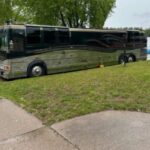
Hi Chad,
The simplest and easiest way to upgrade the house electrical in a coach of your age is to split the house battery bank into two banks – one devoted only to powering your AC appliances through an inverter (or two) and the other devoted only to powering your 12vdc lights, pumps and appliances. By now your coach probably has been converted from incandescent to LED lighting so the 12vdc loads are quite light involving mostly pumps, fans and perhaps a 12vdec appliance or two. Most of the house load is powering your AC appliances through an inverter(s). You can make the inverter house battery bank LiFePO4 if you want to (highly recommended) and leave a couple of your existing lead acid batteries to handle the 12vdc loads.
I wrote a multi-part series on how and why to do this that was published in recent issues of bus conversion magazine if you are interested. You can leave your alternator and it’s wiring alone. You will only need to add a couple of new components and you will wind up with a modern house electrical system that will be properly recharged while driving, while plugged into shore power, from solar sources if you want to go that way, or while the generator is running. And, you will have way more battery capacity for extended off grid stays than you have now.
Jerry
-
Jerry, I remember that you mentioned that article last year. Is it available somewhere online yet? You are correct in thinking that my DC loads are pretty light now. Apart from the AC/DC refrigerator, I don’t think I have any really significant DC loads. One thing I haven’t considered is just tying the two house banks together. Easy enough to do. My only concern would be killing twice as many batteries with the refrigerator when I forget to plug shore power in after a drive. I did that last year. I guess a generator auto start would help there too.
The only reason I’m thinking about going “big” with the inverters is because I am exploring using a ducted mini-split setup on the coach. Those all appear to be 240v units, so I think I would need two inverters tied together in phase. My interior doesn’t lend itself to using the wall-mount 120v mini-split systems like some home builders use. I also have the option of sticking with my Cruisairs (two of the three need to be rebuilt), but they draw a lot of current and I’m told not to expect much from them when rolling on a hot highway. Roofairs might work, but I’d have to do some ceiling modifications to prevent loss of headroom. Finish work isn’t my strength.
My primary concern now is whether I can safely use the output of the 50DN to power the inverter(s) on the road. It seems like I have plenty of available capacity, but I don’t want to cause premature failure of the alternator. She’s a little tough to get to under the bedroom. If I can’t count on using or banking a good portion of that 24v 240A output, I’m better off sticking with running the generator for AC loads.
-
Chad, is your current plan to use the new mini-split air-conditioning unit(s) with the existing OTR ducts? I’m intrigued! Please share your plan. Thanks, John
1984 96" with 8V92TA
(remodeled Liberty Coach)
Greenwood, MO -
I considered that for a bit before removing the blowers, but I don’t think it’s feasible in my case. My blowers were in pretty bad shape, and I don’t think the existing ducts would be of much use without them. I think you’d need really high velocity to make use of the narrow branches between those main side ducts and the window vents.
My OTR was all contained in the first bay, and my second bay is pass-through storage with some minimal systems on the aft wall. So I effectively have the first two bays open now to run vents, and could route some insulated ducting a little aft. I could probably even reach the driver with a little creativity. The first bay driver’s side door is completely ventilated, so that’s a natural spot for a mini-split outdoor unit. It’s also right about where all of the electrical runs converge, so I could make good use of space if I do something extensive.
I really learned a lot about my bus by removing the OTR system. I had always thought that the two rectangular “bump outs” where the floor meets the side walls were full of a lot of chassis wiring and pipes. It turns out that they are basically just empty ducts. When I removed my dinette to install vinyl plank flooring I saw a lot of 120v cable runs on top of that rectangular box. At the time, I guess I thought I was looking at the stuff inside the box. It turns out that Liberty built a sort of “false top” over the duct to create additional space for their conversion. I never realized there was a small cavity above the larger cavity there. Pretty slick.
-
Here’s a photo of the inside of the driver’s side OTR duct, taken from the first bay looking aft. You can see the end of a curved air deflector at the top. The two pipes at the bottom are the coolant pipes, running aft to the shutoff valves behind the main engine radiator. I gave up for now on removing either those pipes or the AC refrigerant pipes along the passenger side. They seem to be anchored at some intervals. I do think I could fish some flexible ducts back in the remaining space, so the ducts could still serve an HVAC purpose.
I don’t think I could cool the bedroom with a mini-split mounted in the first bay, but I’d be okay with that going down the road. If I could cool the rest of the bus, I’d be very happy. Research continues!
-
Hi Chad.
To your question, “Is it available somewhere online yet? “. Yes, go to the Bus Conversion Magazine web site and you can subscribe which will allow you to download all previous editions of the magazine.
If you are thinking you can run a 220vac mini-split AC off 12vdc batteries through inverters, do the math and calculate the 12vdc amp draw. Then think about the size of wire required to carry that many amps (don’t forget the inverter losses) and the size of a battery bank required to run that unit for very long………
You are way better off just turning on the generator when you want to run that unit while not near a power pole.
Jerry
-
I am constantly amazed at how much resistance there is among owners who will avoid running their generators as an alternative to inverters.
A typical A/C unit on a 12 volt bus house system is going to pull 130 amps @ 12 Volts, loading the alternator and inverters. Run a second A/C so the rear of the coach is not like a sauna and the 50DN is maxed out.
-
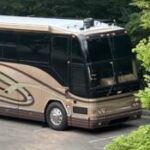
Hi Chad reading and since you started this I was thinking we use a aqua hot to heat a coach ,how about a chiller and cold water to cool your coach. Piping and lines instead of ducts.Very interesting your project good luck .
2000 Featherlite H3-45
2024 Jeep Grand Cherokee
Leesburg, FL -
Jon, I’m not opposed to running the generator. I just went through my Wrico 13kW pretty thoroughly. If I reinstall the Cruisairs, I think the generator will be the only way to go. I’m just considering all of my options at this point. Although I’ve been looking for ways to lower my power demands, I had previously ruled out the ultra-efficient ductless mini-splits since the indoor units didn’t fit my layout and available space. Now that I just gained so much bay space by removing the OTR, I’m taking a fresh look at things. Having simple systems in my 1984 coach may seem like a handicap at times, but it sure makes it easy to imagine starting with a clean slate. It’s not like I’d be shelving any expensive equipment.
I’m not hearing anyone say that relying on the 50DN to provide high current (either charging batteries or running loads) is a good idea, so it’s hard to imagine spending $3-4k for two inverters and another $5k give or take for LiFePO4 right now. I’m mostly going to be pole-to-pole or in generator-friendly spots anyway. If I start boondocking, my needs might change. Those ducted mini-splits I’m considering are just so efficient that they had me thinking it should be possible to run them on the road sans-generator. I guess I was being too optimistic. I’ll still explore installing one of those vs. the front two Cruisairs though. I have parts to rebuild one Cruisair, but I’d frankly like to do away with them. Ironically, I just bought a boat with two more. Can’t escape the damn things!
I do appreciate all of the feedback. I’m trying to figure out the smart move here.
Log in to reply.