
-
Aux Air Leaks
Posted by Archived on July 28, 2015 at 8:14 pmI
know this subject drives us all crazy and I thought I had the
solution. I stopped worrying about the little aux air leaks and if
the aux compressor had to run a little every 3 – 4 hours, so be it.
Well that just doesn’t work, because even though I want to ignore it,
I can’t let it go. So the aux leak is an ongoing pain in the ass work
in progress when time permits.I
found one today, hidden in the steering bay that could only be seen
with a mirror and flashlight. You know the one, you have squirted
soapy water until the cows come home, listened with the electronic
stethoscope and were convinced nothing in there could possibly be
leaking.A
tiny hairline crack in the brass fitting blowing a bubble that could only be seen by a
grasshopper.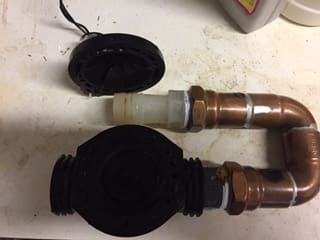
Now if I could just find the rest..
Peter replied 10 years, 8 months ago 13 Members · 23 Replies -
23 Replies
-

What’s the part number for the grasshopper that finds leaks in small places? I know I could use at least one, maybe two of them 🙂
-
When it comes to finding leaks there is no substitute for patience and a lot of time. If you do not want to chase leaks yourself take it to a shop and have the mechanics there make your coach leak free. You will send the shop owner’s kids through college on what that will cost.
There is no single way to chase leaks either. Real big ones can be heard with your ears or a stethosope. Those are the easy ones. They are also the least common.
Soapy water is the next method and a large percentage of leaks will show up using soapy water. The problem with soapy water is you have to have enough access to the fittings and devices so you can see them in the area of the leak. Air bags are a good example of where not all leaks are ever going to be found using soapy water because large parts of the air bags where leaks can occur are not visible, and you cannot get at those areas with soapy water, such as the bottom “can”.
Some leaks can be heard using an ultrasonic leak detector when the previous methods won’t work. An internal valve leak is an example of where the ultrasonic leak detector might “hear” a leak not found with your ears or soapy water.
When all else fails the ultimate is a pressure gauge or bubbler device that is connected to a leaky circuit, and the device is moved down the circuit, one fitting or device at a time until you get past or up to the leak point. That method always works, but it requires the utmost patience, lots of time, and an ability to follow an air circuit from its start to the end, one fitting at a time.
I’ve gotten my coaches “leak free” twice and I know it is possible that within a day after completing the work a new leak can show up. If you don’t like someone lock them in the garage with the bus and don’t let them out until your bus is leak free. You may never see them or your bus again.
-
Jon,
Would you please bring your ‘bubbler’ to the Know Your Prevost training in October. I would like to see it and make one. Then I can patent it and sell enought to members to pay my annual PC dues.
Fred
-

That actually is one designed by Hector. My last resort equivalent is a pressure gauge manifold. I can bring that. The key is not the device as much as having a means by which you can start at the beginning of an air circuit, pressurize it and see if it leaks. If it does go to the next fitting or device, pressurize it and see if it leaks. Keep going until you get to a point at which it does not leak. The last point you tested is then the source of the leak. Or you can start at the end of the air line and work towards the supply.
Hector may have an article about the “Texas Bubbler” in our articles section.
-
I use a pressure gauge with a ball valve and air chuck and air line fitting to hook to air line , fill with air mark gauge with tape then wait to see if gauge moves then move on , I start at part I am checking first then move into air flow
-
Trying to remember to check for AUX air leaks inside the bus and putting it off time and time again.
When I read on a PC post that the air pistons and connections for the bed lift are notorious for AUX leaks. Both
pistons had been replaced as part of leak repairs by Marathon. Wednesday I had several little things to do inside
the bus. Raising the bed I used the electronic detector passing it over the top air line at the 90 degree fitting. Bingo
the meter goes into the red, The air line did not seal pushed into the fitting connection. Trimming 1/4 inch off the
line I re-attached the line. It still leaked not as bad but a leak is a leak. Bottom line replacing the connector fitting
with a brand new one solved the problem.
With this repair the overnight AUX air leak down test was now minus 4 LBS.
1999 XLV X-6872, liberty #440 -
caught this over 4th heard air sound was losing aux pressure turns out crack in air line at gauge truck repair where i store had what i needed to fix TAG1
-
Oh….if anyone runs accross Truk4u would you pass along I lost 5 lbs of AUX air over the weekend… Friday to Monday.
Thanks…signed
Rock hard aux air in KC
-
Al, maybe I should have you come up here and work on mine a bit. It isn’t horrible, but sure not as good as yours. You could go get some smoked fish from Russ. Just sayin…..
-
BA knows the Aux King is nowhere near Kansas City.
It’easy to keep the leaks down parking the Queen in her garage in the summer.
Later
bv -
Tom and Al , if you had a Liberty when a leak is detected it repairs it self , no input from the owner LOL
Log in to reply.