
-
Always something else!
Posted by Per on August 1, 2016 at 7:39 pmCame up to Prevost Ft Worth to have some engine oil leaks fixed, and have the engine serviced at the same time, since they had to replace the oilpan gasket anyway. Found the tag axle seal they replaced in May was leaking again. They will fix that under warranty, but in the process of removing, the brake chamber got damaged, and had to be replaced, so Jeff will have one less chanber to replace. Met another PC member; TXPrevost, and had an enjoyable chat with them–always nice to run into fellow PCers.
Archived replied 10 years, 1 month ago 12 Members · 16 Replies -
16 Replies
-

I guess it’s always something with an RV. We had
a rain here, it was not particularly hard or blowing but all but one of my
bays leaked excessively, ruined some clothes and two pair of boots.What
I noticed was that 3 or more doors were filled with water, inside the door.Have
to get this repaired and am looking for recommendations as to who might be best
suited. I’m concerned with Prevost because I’ve been communicating with them
for two weeks about a windshield and side glass. Gave them the part numbers
they just can’t seem to figure out what they need to order or how to do the
work, so it’s still not scheduled. The last communication a day ago was “send
pictures of your windows, so we can see what your talking about”.Could have already replaced these with aftermarket glass
Makes
me wonder about the bay doors. -
I would highly recommend Donnie Myers RV service in Sanford FL for the glass work and leak repair. He replaced both windshields and eliminated bay leaks on my coach. My experience has been he fixes problems right the first time without me having to “supervise”. Great experience.
-
For some reason, it seems like weird things always happen when we leave Prevost/Marathon in Ft Worth. Stopped to fuel up in Abilene, and when I got out of the seat, the button for the steering wheel did not work. After finishing the fueling, looked at the switch, and the collar nut had worked itself off, so it was a simple matter of putting the collar nut on, and tightening it. The down the road, all of a sudden the generator starting making a racket. I had heard the sound before, and knew it was deflated air bags. I figured I had a bad air leak on the Marathon side (it’s isolated from the coach aux system), but when I checked, I found the adjustement knob for the generator air bags had shut off air flow. Simple matter of twisting the knob to get air back in the bags, so no big problem.
I’m starting to think Jon has arranged for some gremlins to harass us Marathon owners. If other Marathon owners have problems like this, maybe we can uncover a conspiracy!;) -
I’ve done a little business with Donnie and he was great. However, he told me that his priority is Feathlite coaches first and, if he can squeeze in other brands like Marathon or Liberty he will if he’s not too busy, but it’s not something he makes a priority.
-
Made it to Ruidoso Motorcoach Ranch. Gorgeous place, and quite a few more coaches here this time. Bad news in the “always something” category; the tag axle seal Prevost replaced is leaking badly again. Is it really that hard to do a good job on the axle seal?
-
Replacing a seal is a relatively simple job, but I think the key to success is the care taken to insure clean mating parts, and an abundance of care with the force fit of the seal into the hub.
The inner part of the hub seal rotates with respect to the outer part that is a press fit into the hub. If during the installation the thin sheet metal outer shell of the hub seal is distorted or somehow pinches the inner portion of the seal the rotation between the inner and outer portions of the seal is going to drag.
I have replaced 6 seals on my own coaches out of the 12 hub seals that the coaches had. Each coach had around 250,000 miles on them when I sold them and none of the six I replaced ever had to be replaced. The replacement seals had varying miles on them, some in excess of 100,000 miles.The hub seals I did not replace on those coaches were original. When I bought my first hub seal from a local supplier he told me he loved it when people did not put in hub seals correctly because he got to sell more hub seals. What he meant was do not dent or distort the outer metal ring, seat the seal in the hub so it is not tipped, and after fitting the seal to the hub, put your fingers in the center of the hub seal, spread them until they touch the inner hub seal, and make sure the inner portion rotates freely.
And then when re-installing the hub onto the coach keep it perfectly straight and never allow it to tip of cock sideways when seating it over the spindle or axle housing.
-
Had my coach Level 3eed at Houston a year or so back and it would overheat at speed. Slow down and temp would go down to a safe level. Made it home 125 miles and couldn’t figure out problem. Called my Guy that used to help me on it and someone at Prevost has shut the air vavle to use to drop pressure for belt removal. Had to be as it’s up above your head and have to really know where it’s at on my 1991 XL. Sometimes I think they like to keep you on your toes.
-
Having that bellows tensioning on your vintage coach indicates it has OTR. Couldn ‘t you tell when the AC wasn’t working? I cannot remember if the alternator is on one of the belts with the air powered tensioners.
-
Chris asked me to ask is your leaking hub possibly coming from around wheel seal rubber stopper? You’ve gained quite a bit of elevation from Ft Worth Tx, and the pin hole in the stopper could be plugged. We have this issue a lot of times when changing elevations. Take a pin or skinny Phillips screwdriver and push it thru the stopper hole which allow excess pressure out. We’ve also had similar issue with drive axle flange seals. We have had differential vents plugged and gear oil seeping around the paper flange seal. One thing we do when we buy a new to us coach is replace “diff vent”. This isn’t your tag issue, but similarly hub plug vent hole could be plugged up. Just a thought
-
Jim is right in that a significant change in altitude with the vent hole plugged has the potential to push hub oil out the seal. Usually the rubber cap that has the vent hole is loose enough, but if it is a tight fit and the altitude change is enough the pressure differential can be a couple of PSI.
-
it’s 2500 miles away.
Can you recomend someone closer to Utah?
Thanks
Ray
-
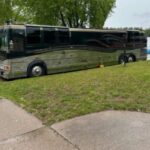
Dumb question: Where is the vent hole? I can check it, but it sure spewed a lot of oil out!
-
Per, there are two things to remember about hub oil. As Jim explained the center plug has a pin hole in the center. It is barely visible, and it does have to be open. A large sewing needle is best for pushing into the hole just to insure it is open.
The oil level in the hubs is going to be much lower than most folks realize. On the types of hub covers I have seen the clear plastic center portion should have the hub oil about 1/8″ above the metal portion of the hub cap. There is usually a circular line molded into the ciircumference of the clear plastic part that is 1/8″ away from the metal portion and that line usually has a marking to indicate the oil level.
Overfilling the hubs can cause an oily mess sometimes. On steer and tag axles the presence of oil is a typical indicator of a hub seal leak, but not always. Leaks across the face of the aluminum wheel, originating from behind the chrome hub cap can be an indicator of over filling, a missing center plug or a loose plug or cap. Make sure the 6 screws holding the hub cover to the hub are tight to rule that out. Make sure the center plug is in place and the pin hole is open and the oil level is near the bottom of the clear plastic center portion.
A hub seal leak usually does not show up inititially from the face of the wheel, especially from behind the hub cap. It is first noticed by poking your finger through one of the holes in the wheel, and if you get an oily black finger that is probably a hub seal leak. If you get dry dust that is brake dust and the hub seal is not leaking. If you think it is a hub seal leak you can confirm it by looking across from the opposite side of the coach and shining a flashlight on the back side of the wheel. It will generally have black oil streaks radiating from the center of the wheel.
Over the years there have been many posts about hub seal leaks, but one thing needs repeating. If you have one get it fixed as soon as practical. They usually never leak so fast you will all of a sudden seize a bearing, but the longer the seal leaks the more likely your pads or drum brakes are going to absorb that oil and your brakes will be compromised.
-
One of the first things I did after I saw the oil on the car and the side of the coach was to look from the opposite side, and sure enough, the inside of the tag wheel was wet with oil. To confirm, I got a swipe with a paper towel from the back side of the tag wheel, and sure enough, it was wet. Took the hub cap off–I guess the vent holes you are talking about are the four pinholes in the red plastic cap. The oil level was down to the fill level, so pretty sure it is the seal. Planning to go back to Prevost Monday, and see if they can do it right this time!
-
I am sure you see a hub seal leak, but since I have had six plus one on the current coach that was fixed by Prevost in Nashville I have never had one leak so bad I saw oil anywhere on the toad.
To get oil on the toad in sufficient amounts to be visible beyond the normal crud you get from being behind the coach and picked up off the road you probably have a leak somewhere.
A lot of air moves behind the coach, in the engine area, and under the coach so a clue is often found inside the engine doors, as well as a film on the rear of the coach. I think a large hub seal leak would get some oil on the lower part of the toad, such as from the tow bar down in the front of the toad, but nowhere else. That is pure speculation however.
Log in to reply.