
-
After market shocks
Posted by Paul on June 29, 2014 at 7:19 pmAfter Market Shocks:
Has anyone had any experience with the King line of shocks in their bus? Some time back I was looking into new shocks, and had an informative discussion with the owner of the King product. But, I don’t have any user input on these, and they are mucho expensive. Any comments?
Paul
Peter replied 12 years, 3 months ago 9 Members · 16 Replies -
16 Replies
-

Paul, not familiar with those units, but the consensus here seems to be Koni on the front and Prevo on the rears.
-
Went onto there web site, appears off road.
-
I’m not convinced I need a Koni on the front. I am replacing my fronts this coming month and I will order the standard OEM shocks.
The only way I could be convinced a set of Koni shocks justifies a price about 5X that of standard shocks is to drive the same bus over the same course on the same day when equipped with each set of shocks. Even if I really wanted to do that I am not sure I have the sophisticated ability to discern the differences and I certainly have no way to measure changes to performance such as amount of rebound, compression, handling changes, etc.
If standard shocks cost $60 and last as little as 40,000 miles and Koni shocks cost $300 and last forever, it would take 15 years before I broke even.
-
Just a Knoxville minute “pete”. I think you should bite the bullet.
Many PC members have moved on from shock
technology going back to the 1930’s. With some up dating along the way by some very talented engineers.
Installed Koni’s on my last 2 RV’s. The most noticeable differance on the Prevost was felt on highway speed.
Longer bus (40′ to 45′) tag axle, less sway, less recovery bounce from road dips. Koni setting choice soft which is the Koni out of the box
setting.
New shocks about $750 lasting 30,000 miles and Koni costing $2020 and a 100,000 mile warranty.
-
For a long time I heard folks who needed the latest and greatest sing the praises of IFS and how they had to have it on their coach.
So after driving an old fashioned solid axle Prevost for about 300,000 miles at the time I drove my first IFS equipped coach. Except for the turning radius I couldn’t feel the difference. And my test drive was not around the block, but was a 200 mile drive on a brand new XLII.
I would be willing to bet some serious money you could not identify a coach with Koni shocks compared to a coach equipped with OEM shocks in a blind test.
-
Jon,
I echo your sentiments with the exception of not being able to tell the ride difference. I know I could pass your blind test. 🙂 The Koni is a great shock and the build quality is up there with the best, but I find them to be too firm in my H3 application, even on the softest setting – personal preference. I’m staying with OEM. So I guess we don’t quite have concensus.
-
I have Koni’s all the way round. After replacing the front 2 with Koni’s…..I could tell the difference, so I replaced them all. I have a great ride. BUT, if I had replaced them with new OEM’s, they may have made the same difference. The only thing else I have, is knowing, I have the best, or at least I think so, which is all that matters.
-
Just bought and installed a pair of Koni’s on the front of our coach. It rides much better that before. See the thread I started here a couple of weeks ago on the subject. I have driven about 1100 miles with them on the coach since I installed them 2 weeks ago.
I purchased the Koni’s online from LTB Autosports delivered to our door via UPS for $382 for the pair. I’ll be putting stock Prevost shocks on the rear 6 positions soon.
Hope this helps?
-
I guess concensus was too strong a word……let’s just say that many owners prefer Koni up front and Prevo in the rear.
-
Are the Prevost shock parts #’s the same for both the front and rear? I have new fronts I may want to move to the rear.
I also have heard good things about the Road King shocks, not cheap but rebuildable and I think just about lifetime use on an RV, many use them on class 8 trucks.
-
The front shocks are not the same as the rear, they mount totally different, at least on an H.
-
My ’04 H3 with an 18,000 lb IFS axle took:
Steer (2): Sachs: 630251, $73.97
Drive/Tag (6): Monroe: 65407, Sachs: 630134, $47.81
Prevost(TN) said that the 18K lb IFS takes a different shock than the 17.2K lb IFS.
-
G-man,
I had a set of Road King shocks made for the steer axle on our 2005 XL-II. On there upper tower mount they use a metal to metal special mount with no rubber bushing. A little differant from everything on the shock market.
After 500 miles I took them off. A very harsh ride that I complained about to RoadKing. There comment was the shock was charged based on the front axle weight I gave them, 17500 lbs.
A very expense trial.
I’am always looking for a better ride. Nothing wrong with Prevost OEM new shocks, which of course would be better then the regular OEM worn out shock.
Koni has a longer service life then OEM by appox 3 times. So with that being said doesn’t it make a strong case for an investment in a premium long lasting shock.
-
Some manufacturers use delrin, nylatron, and even steel in place of the big soft rubber donuts used to isolate our shocks from their mounting perches. You might recall the current trend of frequency, displacement, and acceleration sensitive shocks. We all know that shocks are velocity sensitive. These other techniques are aimed at softening the shocks over some road inputs and stiffening them over other inputs. For instance, you might want a soft ride over cobblestone surfaces but a firmer ride over long duration disturbances, wavy asphalt, lane change manuevers, etc. I’ve always felt that the way to get both in a cheap shock is by using large and very compliant rubber donuts to attach the shocks. The large donuts deflect over the choppy low amplitude stuff softening the ride, but over large amplitude displacements the donuts quickly compress allowing the shock to provide most of the damping. Voila, a poor man’s frequency sensitive shock! 🙂
-
David,
Good post…….. I believe Prevost was trying to accomplish some of what you say. Using a banjo mount on the upper
tower and then shaft mount on the lower takes full advantage of the rubber flex bushings.
AL
This Koni shock mounted on bus would be reversed in service on Independent Front Suspension…IFS front ends.
Shocks on drive, tag axles use banjo on upper and lower ends mounts.
shaft mount
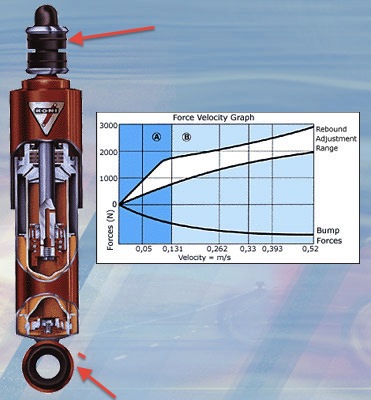
Banjo mount
Log in to reply.