
-
Adjusting Engine Compressor Governor – Caution
Posted by Archived on September 22, 2013 at 8:21 amYou may see on the other “site” the recommendation to boost the governor pressure to 135! Don’t do it, Prevost states max air pressure not to exceed 125. This is an attempt to solve a nose heavy bus by doing the wrong thing.
Mark replied 12 years, 11 months ago 10 Members · 20 Replies -
20 Replies
-

Our coach air pressure is set by the engineers and it satisfies a number of requirements. It meets the standards for supply pressures for brakes. It is as required to operate the suspension as long as the axle weights are within the specified limits. And our engine driven air compressors which are rated for a 25% duty cycle are sized to work within the system parameters.
But every now and then someone says their coach will not come up to ride height or will not rise above ride height. While the problem could be mechanical such as a failed valve coil or non-functioning Norgren valve, often the problem is the front end (the usual place for the problem) is too heavy.
Some coaches begin life too heavy. That’s a dirty little secret rarely discussed for fear on some forums of losing advertiser dollars. Some get too heavy because the coach owner wishes to put the Harley in the first bay along with the entire printed IRS and OSHA regulations. But when the coach is too heavy on the front axle and the coach will not rise the easy solution is to jack up the coach system air pressure. Forget about the fact the tires are likely overloaded. Forget about the fact braking is compromised. Let’s ignore the fact bearings, wheels axles, etc now all are being operated in excess of their ratings. Just pump up the air pressure and ignore the real problem.
Don’t do it.
Your coach was designed and certified by some very smart people. They created standards for certification that are designed to keep you safe. They set limits because everything on our coach is in balance when you operate within limits. All suspension components are functioning and their limits are not exceed. The brakes are sized for the specified weight limits and beyond that your already lousy stopping distances are compromised. But if you feel taking an aspirin to deal with a brain tumor is acceptable, then you will likely accept increasing air pressure which puts your air bags well in excess of their pressure limits is OK. It’s a cheap fix. What the hell. Who will know? Go for it. (Sarcasm off)
The good news is some coaches have non adjustable governors to protect the coach owner from people who think rules and limits only apply to other people.
-
Isn’t the specification actually 115 and a maximum system design for 125? If so, anything over 115 should be avoided.
-
120 is the number most often mentioned and with a tolerance of +/- 5 PSI we can see variations.
The Haldex air dryer found on a lot of the XLII coaches has an integral governor set to operate within a pressure range of 108 to 123. That is quite consistent with the pressures discussed in the shop manuals for almost all models I have looked at.
This is a VERY touchy subject because most owners are put in the middle of a problem not of their making, unless they are just loading their coaches unreasonably. The Prevost limits were not grabbed out of mid air. The weight limits are what the coach was certified to and the braking system was designed and tested to the standards based on those weight limits. But when a converter puts a coach in the market with excess weight on the axles it is unlikely an owner will make a purchase contingent on being able to load their stuff in the coach and still have the coach within limits. So coaches reach the market and then when they will not do what they are supposed to do someone comes up with the idea of giving them more air.
Even Prevost has advised that from time to time because they know sometimes that is easier than telling the owner to contact his converter, or to unload his stuff from the first bay. I have never seen an air bag that did not say maximum pressure: 100 PSI. So right off the bat limits are exceeded. If someone has the problem my recommendation is just as bad an idea as raising the air pressure, and that is to encourage the front end to rise. Lift the tag axle and insure the aux system pressure is at the max the air system will allow. Generally that will nurse the front end up. That is what a lot of folks have done over the years on heavy front end coaches.
Once an owner has a coach that is fat on the front keeping front end weight to an absolute minimum is important. That’s a tough sell when the owner has just spent serious money to get the coach. This problem is not new and I remember when Bill Campbell, one of the owners of Prevost at the time brought up the topic and told owners to weigh their front ends. That went over like a fart in church and the two converters who we guilty of producing nose heavy coaches at the time apparently expressed their displeasure at the mentioning of the issue. It was never brought up again and around that time Prevost issued a pair of service bulletins one to add a second set of shocks to the front, and the second to replace the original bags with what became known as “Mae Wests”.
Bus owners are not unlike pilots in the respect some pilots think if they can get the doors closed they are good to go, don’t worry about weight and balance. We see the same in a lot of coach owners who think because they have a Prevost they can put any weight they want in the bays or on the hitch and they are good to go. Nope.
-
So, if the bag limit is 100 psi, and as you’ve stated before there are no pressure regulators going to the bags, we are all exceeding the bag specs when we have the leveling system set to maximum height, and well before hitting that pot hole or driving down the washboard road or when we lift the tag axle.
Mine, like many others, is set to 115. That works well except I can’t raise the tag or preevnt the rear from some serious squatting when trying to lift the tag. Maybe, 120, 125 or more might help that. More than one Prevost person has told me it is a common issue with converted coaches and I’m not overweight. Okay, maybe I am, but my coach isn’t.
So confusing…
-
It’s an easy adjustment Gil and 125 will make you happy. 135 is nuts!
-
Gil,
I think you might be surprised at how much pressure is actually in our air bags to maintain the driving height. I haven’t done this on my current coach, but did on my 97. I limited the system pressure to see what it took to bring the coach to the driving height because when I did it there was a lot of discussion similar to what was taking place on this thread.
Going by memory I think my 97 had 22,000 on the drive, 10,000 on the tag, and 14,000 on the steer. With an aux system pressure of 70 the rear came up to the drive height. It took 100 to bring the front to drive height. Going strictly by noting my pressure gauges I am seeing about 100 PSI capable of bringing my 17000 pounds of current front axle weight up to drive height. The air bags are clearly a greater diameter. The only way we can really tell however is to put a pressure gauge on the line to the air bags.
The point is it appears the air bags are sized to work within the pressure limitation based on axle weights that are at or below the Prevost limits.
Just like our tires the working pressures are beyond our control and there is no doubt a large bump in the road is going to greatly increase air bag pressures. I think the reason higher pressures are used may not be solely related to lifting the weight, but to do it in a reasonable period of time. And just an aside, when we raise our coaches for leveling purposes we are often greatly exceeding the design pressure rating, but when we do that the pressures are static. The same thing applies when Prevost uses a wheel lift to raise our coaches and they lift the entire rear under the drive axle shifting all the weight from the tag to the drive tire(s) likely sending their pressures well above the stated pressure limits.
I have used the lifting of the tag as a means of getting more lift on the front or to more quickly lower the rear. Because of my driveway slope I need to do both (at different times) and raising the pressure would speed things up but I prefer not to start becoming a test pilot.
-
FWIW, I carried a brand new OEM governor as a spare and the paperwork stated it was 125psi.
JIM
-
Here’s what I discovered doing a little poking around.
Here are some DON’Ts from Goodyear:
— Do not exceed 200 PSIG internal pressure in compression or in any other condition.
— Do not exceed the 100 PSIG maximum inflation pressure without application approval from Veyance Technologies, Inc., manufacturer of Goodyear Engineered Products.
— Do not exceed the maximum extended height. To do so may cause structural damage to the air spring assembly.
Here’s what Meritor says about the dryer on my coach:
Pressure requirements
— Maximum pressure 140 psi (965 kPa)
— Minimum governor cut-out pressure 115 psi (793 kPa)
Here’s what Prevost says in their troubleshooting manual:
Governor cutout. Cuts out at the correct pressure of 120-125 psi
Conclusions:
— I need to increase my pressure by at least 5psi to get to 120 psi minimum. How is this done? Do I have to replace the compressor’s govenor?
— I have no idea how drive height is limited to 100 psi without a regulator. It would seem a heavy coach MAY push more than 100 psi into the bags.
— I have to assume if more than 100 psi gets into the bag at drive height that pot hole is going to come close to collapsing the bag and very likely exceeding the 200 psi limit.
— I would still like to know the Goodyear numbers to better understand the per axle limits. Knowing which bags you have would also allow someone the possibility of putting stiffer bags on.
— How is maximum height of the bag not exceeded, especially when leveling? It may be too coincidental to think the maximum downward travel of the bag mount just happenes to be at or under the bag’s maximum heigth.
-
Gil,
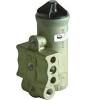
They’re easy to change and usually attached to the compressor, but some are remote mounted. You can find them at any truck supply place or Napa, about 35 bucks. You just unscrew the plastic cap and you’ll find a set screw locked in place with a nut. Just loosen the nut and you turn the set screw in or out depending on more or less pressure, but I don’t remember which direction, CRS. I carry a spare, I’ve had to change a few. I would go to 125 if I were you. Also, my concern with high pressure such as 135 is all the various fittings, hoses and connections that can fail, not so much the running gear.
-
Gil, We do not have any pressure regulator for the air bags on our coaches, but if the coach axle weight limits are not exceeded I believe that at ride height 100 PSI will not be exceeded.
As we increase the pressure in the air bags the coach rises. We do not need maximum pressure to reach the fully raised height. On my 97 I played with pressures out of curiosity and found my coach reached the maximum height on the front axle (limited by the shocks) at a pressure greater than the driving height pressure, but less than the coach’s 120 PSI maximum. It wasn’t a great difference but it was measurable. I think around 5 PSI but cannot remember the specifics.
I suggest you do increase your air system pressure to the maximum limit as specified by Prevost. It will increase the speed of raising the coach.
My current coach shows 120 PSI max pressure, but the Haldex data sheet says 123 so there are some minor variations. Both our coaches are going to be slow to respond when we want them to go up compared to my 97 which had the solid front axle. That configuration did not have the small “ping” tanks that have the effect of increasing the volume of air in the air bags, so when we want the coaches to rise we have a greater volume of air to bring up to the needed pressure so try not to compare your coach with an older one without the “ping” tanks.
-
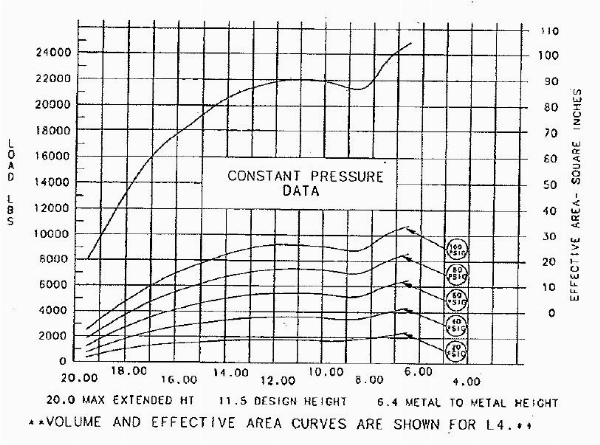
Here’s a Good Year air bag used on some later model Prevosts, part number 1R14-079. This is a static pressure curve. You can see nominal max static pressure of 100 psi. At that pressure the max load is just north of 18000 lbs for a two bag steer axle at 11.5″ design height. You can also see for a given design height to handle an increase in load an increase in pressure is required.
-
One thing we need to remember is that the axle weights for our coaches do not accurately reflect how much weight the air bags are lifting. Each air bag is only lifting the chassis and not the axles, wheels, tires, etc.
So imagine if you will how heavy a coach is if the air bags will not raise the coach unless the system air pressure is up to a much greater figure than the limits established by Prevost.
Great post David.
-
Thanks David…just what I was looking for. I sure would like to have it for all bags on a 98 chassis.
-
Gil,
I have these part number mappings:
Prevost P/N : Goodyear P/N
630151 : 1R12-377
630239 : 1R14-167
630126 : 1R11-096
630105 : 1R11-089
630125 : 1R12-319
If you can find the mapping for your coach, Goodyear will happily provide the charts.
Log in to reply.