
-
Air fitting joint compound?
Posted by Ron on April 19, 2012 at 6:45 pmIt’s a simple question, but my search came up with no answers. Is there a DOT industry standard pipe joint compound used on the pipe thread part of air line fittings? Is just any old plumbing pipe thread compound acceptable? Teflon tape? I don’t want to introduce more leaks by using the wrong brand. Thanks.
Jon replied 4 years, 2 months ago 9 Members · 9 Replies -
9 Replies
-

I will yeild to the opinion of our air systems guru Hector, however I have had good luck with the stuff I buy at the local hardware store (pipe dope) less luck with Teflon, but I’m left handed so that may be my problem with the tape.
-
Well, this should bring many opinions from those that do their own work. I use Teflon tape. I have successfully used it for many years while I worked in the petroleum industry. The material is approved by numerous fitting vendors as compatible with their products used in gaseous service. For example, the molecules of air are much larger than molecules of hydrogen. The key is to get a correct application of the tape on the threads. Also, Teflon tape will not harden or crack, causing leaks.
Their is a right way and a wrong way of applying Teflon tape to a threaded fitting. First, always start the Teflon tape two threads back from the end of the fittings thread (the part of the fitting that is inserted into the threads). This will prevent tiny strings of the Teflon tape from being extruded in the air/process line (causing havoc plugging small orifices). Second, wrap the tape on the threads such that when the fitting is screwed in, the tape will will “tighten” and not become lose when threaded in. Simply put, grab the fitting in your left hand/fingers, with the threads pointing outward. Wrap the tape, starting from the top of the fitting, wrap away from you and pull under, then wrap min of 4 wraps and 6 in better.
I know this sounds technical in describing what many of us have done hundreds of times. This is the approved process demonstrated by representatives of this product.
Hope this helps. It works for me.
Hector
Also, posted this on POG
-
I will go with Hectors explanation.
Have used it for years on taperd pipe fittings for refrigeration pressure sensor connections. -
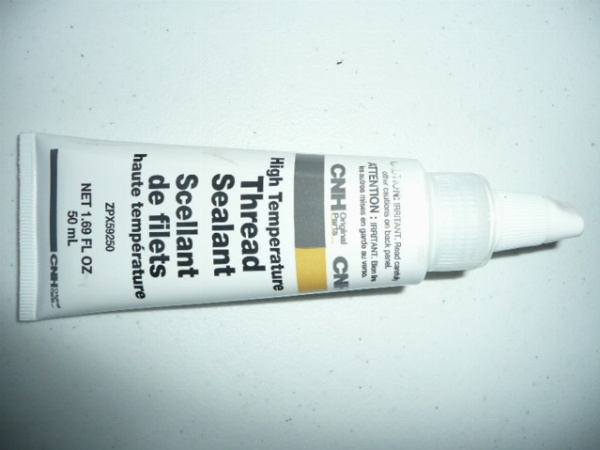
And then there are those who swear you need two wraps of teflon under your thread sealant. The answer appears to be whatever you’re comfortable with. I’ve been using Hector’s method, but wasn’t sure I was doing enough. The Loctite thread sealant is priced about the same per ounce as your wife’s best perfume. Jim, where do you buy the CNH stuff?
-
John Deere, New Holland, Case, Catterpillar dealers and similar places that deal with hydraulics.
-
I have used teflon tape for years, but mostly on liquid holding fittings.
Wondering if there is a betterjoint/thread sealant for air fittings etc. ?
How about permatex hi-temp thread sealant?
-
Hi Luc, This is a Highly debated conversation, working with air fittings for 30+ years on high speed automated assembly equipment, I use teflon tape and paste depending on the application. The pro’s and con’s for me are below:
Pro’s for using Paste
1) It is a paste, so in theory you would get better adhesion to the pores in the thread surface.
Cons for Using Paste
1) Messy
2) Can contaminate valves if too much is used
3) Not the best when you can only apply it to one of the two surfaces. As you thread the fitting in, the top thread tends to wipe off the thread sealant, leaving a mound on top.
4) If you don’t seal the cap properly, it will dry up and be unusable
5) replacing the fitting requires a lot of clean up and high chance for valve contamination, as sealant will drop into valve spool as the fitting is removed.
Pro’s for using Tape
1) Easy to use
2) No Mess (this is a big one, thread paste gets everywhere)
3) Doesn’t dry up or expire, always there when you need it
4) removing the fitting and resealing is much quicker.
Con’s for using Tape
1) You must be careful what direction you apply it. The wrong direction it will un-thread itself from the fitting
2) You must wrap more than one revolution. I use 2 or 3 turns.
Thread paste i use:
https://www.amazon.com/gp/product/B002BY02PQ/ref=ppx_yo_dt_b_search_asin_title?ie=UTF8&psc=1
Teflon Tape I use:
https://www.harborfreight.com/12-in-x-43-12-ft-thread-seal-tape-10-pk-63943.html
Another thing I do when working with pipe fittings is I wire brush all the razor sharp edges off the threads before i use them. These fittings are being fabricated cheaper and cheaper these days, and if you look closely at the threads there are many fine burrs on the threaded surface. Wire brushing them or using scotchbrite will soften the edges. I hope this helps.
Interesting paper with some more information:
Log in to reply.