
-
Water Softner
Posted by Tim on February 18, 2016 at 12:12 pmHas anyone installed a portable or permanent water softener in their bus? I’m noticing that most campgrounds have really hard water & that using a softner may improve scale build-up.
Walter replied 10 years, 7 months ago 7 Members · 16 Replies -
16 Replies
-

Our current bus has a built in softener. We love it.. Kinetico. But prior to that, we used a portable one from Travelsoft. Worked great. Recharge was with rock salt (Like for ice cream makers).
Its a great alternative to the built in one. -

Tim,
Our coach also came with a Kinetico softener as original equipment.
-
My coach has a Kinetico water softener also. I LOVE it! Been told by many they’re the best. My favorite advantage to the Kinetico is that it recharges based on gallons used, not based on a timer. So water softness is always consistent and with the two tanks working one after the other there is never any “down time” while regenerating.
-
BBB, Did you install the unit? If so, what model & cost for the unit? Looking at some models at Camping World, but no doubt not as good of quality as the Kinetico products.
-
One thing I have learned by modifying parts of my coach is that any upgrade for the systems usually takes a lot of thought. The reason is space is at a premium so converters make use of every cubic inch and additions to systems such as the plumbing system may call for some effort. Adding a second small water pump was even a challenge due to space limitations so installing a softener is going to be a real challenge.
When dealing with plumbing, the flow dictates where in the system items have to be connected. Then there has to be space, not only to position the addition, but to position it so it can be serviced. Whether it is a pump, an accumulator tank or a water softener having space to access it for service is important. Then there is the consideration of freeze protection.
I ended up putting a second accumulator tank in my plumbing system to make the back up water pump capable of flushing the Headhunter toilet. But my only option was to put it under a sink in a cabinet in the bathroom because there was no viable place to install it in the heated plumbing bay. All this makes me respect how how hard it is for converters to not only fit everything, but to do so in a manner that deals with all the other side issues.
-
Space is certainly a consideration. Still deciding whether I really need one in the first place. After some research, like many things in life, there are pros/cons to adding soft water to your RV. I noticed on an earlier post this summer, Tom gave his away … So there are drawbacks to adding one.
-
Tim, i would go for the portable travelsoft softener to see if you want one. Cheaper, no hassle, no installation, just store it in a bay when traveling. When in use, it stays right next to the campground water. Fill your tank and you are good!
-
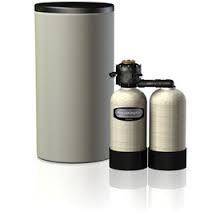
Tim, my water softener was original to the bus, installed by Royale. Here’s a link to the same type of Kinetico I have. I think specifically it is model # 735, but I’ll check when I get back to the coach.
http://www.kinetico.com/water-softener/kinetico-signature-series.aspx
-
I’d say that the biggest drawback to soft water might be the fact that it seems to take longer to get the soap off with soft water. If you’re connected to water and sewer it’s no problem… but if you are working with tanks you could fill up your grey faster or use up more of your fresh. I guess it would depend on your situation.
But… the bennifits are certainly true. In our house we have none of that white scale buildup… the glass shower door is cleaner etc…
-
You bring up a good point about the soap not rubbing off as easily. Took us several tries with many different brands of soap. Found that body wash comes off easier, and for bar soap regular dove soap works best. If you’re dry camping and want to use as little water as possible and worry about getting the soap off, we turn the water softener bypass valve. Then we’re back to the hard scaly water and wiping down the shower. But the soap comes off easily haha.
-
Here is an explanation on softened water. Take it for what it’s worth. Your experience may vary.
Slippery Soft Water, I Can’t Get the Soap Off!
This has to be the most common misconception with soft water.
Fact: With soft water the soap rinses off immediately.
Fact: With hard water you will have a soap residue left on your skin.
Irony: With soft water, your skin feels slippery leading you to believe that there is soap left on your skin when there’s not.
If you have a water softener salesperson come to your home he/she will probably show you a demonstration that will amaze you. I wish I could do it for you right now but the best I can do is describe it to you. If you have a hard time believing this, all you have to do is invite a salesperson to your home and ask to see it for yourself. This demonstration will allow you to see for yourself that soft water does not leave soap behind; and hard water does.
The salesperson will draw a sample of hard water from your kitchen sink into an Erlenmeyer (pear-shaped) flask. He will then connect his portable water softener to your sink and draw a sample of softened water into another flask.
With the same amount of water in both flasks he will add an equal number of drops of greensoap to each flask. Greensoap is used because it is a very simple soap with no sudsing solutions added. Think of it as a liquid form of an Ivory bar soap which is 99% pure soap.
When the flasks are shaken you’ll see an impressive amount of suds in the soft water flask. You’ll also note that the water below the suds is perfectly clear. The hard water flask won’t have any suds at all, and even worse, the water is gray and cloudy with flaky stuff floating in it.
This flaky stuff is the difference in soft water plus soap and hard water plus soap. The flaky stuff is soap curd. It’s a natural reaction of the soap and the calcium in hard water. You’ve seen it before and maybe didn’t realize it.
- It’s the bathtub ring
- It’s the scum on your shower doors and tile
- It’s spots on glasses and silverware
Now the disgusting part. If that soap scum can stick to a glass door or a smooth tile surface, just think how easy it is for it to stick to something very porous… like… your skin?
The salesperson has another demonstration to prove this to you. He/she will have you wash your hands in a stream of soft water provided by the portable softener. You will use a small bar of Ivory soap. Ivory is soap; it doesn’t have all of the chemicals found in other bar soaps that are added to chemically soften the water. Once your hands are lathered you will rinse them off, one at a time. One hand gets rinsed with soft water while the other gets rinsed with your tap water.
Once your hands are dried you’ll be asked to lick the back of each hand. Which one tastes like soap?
See, you did get the soap off, but only with soft water!
When I was younger, before I had soft water in my home, I had many battles with dandruff. I tried all kinds of concoctions to stop my head from itching. In 30 years of having soft water I haven’t had a bit of trouble with dandruff. Sometimes when I’m away from home I’ll start getting the itchiness after a few days of hard water, but not the problems I had before. I can only imagine that I must have had soap curd on my scalp for all those years, no wonder it was itchy
-
Great explanation Alvie. I had the wrong idea about soft water…
Steve
-
Haven’t pulled the plug on a portable unit but I appreciate all the information …
-
Tim,
We use the On The Go softner which we bought from amazon. Been using it for over a year, mostly well water, get about 1200 gal, before a recharge. This will very depending on the hardness of the supply. One benefit is you use regular table salt to recharge.So far we have no mineral build up on any plumbing. For us it fits perfectly next to the water fill bay. We would not be without one, but thats a personal choice. We also use a filter connected to the inlet side for any water entering the softner to filter out any sediment.
Log in to reply.