
-
Frozen Bus and No Power
Posted by Liam on February 19, 2015 at 8:49 pmI just did a periodic check on my bus in the garage. I keep it plugged into 50a shore power, have the Webasto set to warm the water bay if needed, and have electric heat on inside the bus.
Eneterd the bus to a warning that “bad shore power ground” and all the batteries hovering around dead. So no heat, 30 degrees in the bus, and faucets already frozen.
Power panel shows full voltage on both legs. Removed the surge suppressor from the loop and re-plugged – no change. Surge suppressor indicated bad ground as well.
Started the generator figuring if it powered the bus, the fault was in my building wiring (although my 2-phase big garage light works). Genny starts but never gets switched into service. Makes me wonder if the fault in inside the bus.
Any ideas?
BTW, how tollerant are the PB pipes and tanks to a below zero freeze?
Thanks
Oh, and reason I don’t drain the bus is the elecric drains are impossible to get to – the bus was originally in the south, and I fear they will stick open from lack of use and paying for electric heat is cheaper than tearing out the whole water bay to replace valves. Perhaps I will have that joy in any case.
Deleted User replied 11 years, 7 months ago 12 Members · 19 Replies -
19 Replies
-

Doesn’t sound good. I would be looking for some other kind of heat like forced air kerosene blowers are something untile you get it figured out. Maybe small electric heaters with power cords though sliding windows. Had the same happen with a stick rv out in West Texas years ago and busted all the plastic and rubber parts. Split the full water tank also. Drained it all after that. Good Luck.
-
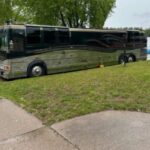
I’ve got a Liberty, so here is what I’d do.
How much water is the fresh and black/grey tanks?
If you have electricity in the garage, put heat guns, small heaters, hair dryers in the water bay and in the cabinets under the sinks and by the toilet.
Is the water pump hard wired or does it plug in? Is the water pump plumbed to the fresh water tank with a flex line and hose clamps or is it hard plumbed and soldered?
Have you drained the water heater? Can you by pass it?
If plumbed with soft line, unhook line between water tank and water pump at the tank. Get 15 gallons of RV antifreeze, a 5 gallon pail, and enough extra hose to get from the bottom of the 5 gal pail to the water pump (I spliced my soft line into the water pump with a long piece to go into the pail, used 5 feet). Plug the water pump into shore power or a generator. Fill the 5 gal pail with anti-freeze (if the antifreeze is warm or hot, this might help at this point). Close all the faucets. Start the pump. Have someone ready to pour more antifreeze in. Open each faucet until you get the pink RV antifreeze to come out for a few seconds. Then close the faucet. Do each faucet. Run the water in the refrig door until you see pink. If you can get power to the refrig, make ice until you get pink ice. Clothes washer, if you can get power to it run it run a partial rinse cycle which will put antifreeze in the washer and then pump it out.
Once you have pink coming out and into the drains fresh water lines should be protected and the traps will be protected.
The Liberty has a spigot for cleaning the dump hose. I made a hose (three or four feet) to go between that spigot (driver side) and the fresh water inlet in the same bay. The water pump pushed antifreeze into the fresh water inlet to protect that plumbing and antifreeze went into the freesh water tank.
I used clear plastic hoses so I could see what was going on.
I had power when I did this, so I didn’t have to jury rig wiring for the water pump. You’ll have to figure out how to get electricity to your water pump.
Have questions, 262-365-9088. Up 11:30pm or so CST. I winterized mine twice this year. First time I wasn’t as thorough as above and froze up the Headhunter 5 water pump and a water filter that didn’t work. $1,250 plus labor to replace. This is what I did the second time after getting my hands on the Liberty manual and talking to Jeff Rowe.
Good luck!
-
We stored our first bus in our barn for 10 years in the Jamestown NY area. Winters were long and we could count on minus 20 temps, sometimes lasting a week at a time.
Despite the fact the barn had spaces between the boards I would not run the generator or heaters while in the barn unless the doors were open. I would feel the same about running the Webasto, Espar or AquaHot.
I did not rely on the bus systems, nor did I ever drain or winterize it.
A 1500 watt electric heater on the kitchen counter top plus a 500 watt heater in the water bay was all I ever used to prevent freezing. The coach did not have an automatic transfer switch so I selected shore power on the big switch, insured I had power to the outlets and I was good to go.
Even if you have to run extension cords get electric heaters in the water bay and the house. If the freeze goes on for an extended period it is likely to do serious damage.
-
Liam: Where are you and how cold will it get? If you have water in the tanks, below zero will likely damage them. By PB I presume you mean PEX. I don’t know about the flexible PEX piping, but when the water freezes, the fitting will likely crack.
My Liberty uses a heat gun fastened to the top of the water bay pointing down to heat the water bay. Seemed pretty effective when I needed it on our trip south before I winterized the coach upon our return.
-
Warmed up enough to do some serious debugging.
The wire-nut connection for the neutral input to one inverter melted-down destroying the neutral connection and charring the hot connection. I will need to remove and repair one inverter. That wiped-out power to the passenger side of the bus and in turn the oil-filled radiator I was using inside the bus.
I absolutely HATE wire-nut connections. They are illegal in building DoD components. Thank God there was no fire.
Whoever did the inverter upgrade years ago used a bunch of them in rewiring the inverter bay. Now I will have to find and replace all of them.
I think my tank bay is OK. I do what Jon does and found that the warmth thrown off by the water heaters alone is almost enough to prevent a freeze.
-
Glad to hear your making progress Liam. Another cold weather tip for the bay’s is a 100 watt bulb or lamp, that will keep it from freezing.
-
100 watts of heat doesn’t seem like much, but if its on 24/7 that could do the trick.
-
It is not the output of the heater or the light bulb alone that prevents freezing.
The most important thing is the bay has to be well insulated and sealed. That is usually not an issue, but if there are open holes, such as to use for a sewer drain or a water hose they have to be covered. Then the water tank has to be full. It not only has to be full, it has to be full and getting some heat into it before the bitter cold weather sets in.
If the tank has 100 gallons of water in it, and that water temp is well above freezing when the temps drop below zero the heat source, plus the heat in the water is going to keep the bay temps above freezing for a long time. Then when temps go back up a little, the heater or light bulb will put the heat back into the water for the next round of cold temps. Prior to sub zero temps my water tank temp was 55 degrees. After a week where the temp never got above zero, and the cold temps fell to minus 20, the temp in the bay had fallen to just above 40 using only a 500 watt heater. As soon as temps rose to where daytime temps were in the 32 degree range the water and bay temp got back to around 50.
The key to keeping the entire coach protected however is to make sure the water bay and the coach interior never falls below freezing. Most if not all coaches have water lines running inside cabinets or pipe runs that are usually along outside walls. The cabinet doors should be open and there needs to be sufficient heat inside the coach to keep those water lines from freezing. The amount of heat is going to be dependent on if the glass is thermo-pane or single pane, if the coach is exposed to wind, and how low the temps will drop. As long as my first coach was in the barn, somewhat protected from wind a 1500 watt oscilating fan heater kept the interior at 50 or above. When temps were sub-zero for a week it got down to 45 but went back up quickly as temps rose.
-
Jon: Libery’s manual (circa 1999) outlines a procedure for winterizing the water system using RV anti-freeze which is pretty much what I outlined above. Upon our return from Florida a few weeks ago this is what I did (coach is outside, on east side of a large garage). There is pink anti-freeze coming out of every faucet, spigot, line, ice makers, shower, etc.
What’s your opinion on this method of protecting the coach?
-
I think it is an excellent way to protect the coach. In my circumstances I was using the coach all winter long in the frozen north because I was doing trade shows and seminars using the coach extensively. I just did not have the option of winterizing, and then de-winterizing.
I think if an owner is putting the coach out of service for a while and the coach will be exposed to freezing temps there is no doubt the safest method is to get pink stuff flowing from everywhere.
A word of caution, however. On my coaches there were a lot of places for water to be that might make winterizing difficult if it is done properly. For example, the 20 gallon HW tank is going to take a lot of anti-freeze unless some specific plan to deal with dilution is employed. Ditto with the accumulator tank and the water holding tank.
Then there are the places nobody gives much thought to. How do you winterize an RO system? How about the lines to the clothes washer and the lines internal to the washer? Ditto if there is a dishwasher. Does an RO unit effectively remove anti-freeze from the water as it passes through, and if so is the coffee maker and the little spigot on the sink protected. I think you see my point that while winterizing is a superb way to protect a coach and make it immune from damage due to loss of power, it is not without its drawbacks.
Right now my bus is in a heated garage. But last week when we were having ice storms and power outages I got ready to protect the coach and the garage and the house by getting my generator hooked up and ready to feed power to the house and garage, while enabling us to heat the coach with the heat pumps as needed.
-
LIam,
make sure you check all 120V devices on both legs of the split phase. With a neutral connection gone, the return current is forced to flow through the other half of the split phase. You can get up to 220V on your 120V device. It all depends on what was turned on in the other half of the split phase and where the break in the neutral connection occurred (i.e. was there another device from the other phase sharinig the neutral after the break.)
Gerald
-
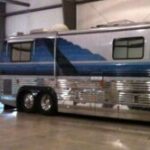
Jon brings up some good concerns. Let me share how I dealt with them.
the 20 gallon HW tank is going to take a lot of anti-freeze unless some specific plan to deal with dilution is employed.
The Lilberty instructed to start out draining the water heater and set the valves to by-pass it. I first pulled the plug on the water heater so it couldn’t be accidently turned on and burn out the elements. Then I drained the water heater. When I pumped the RV anti-freeze in, I could hear the anti-freeze going into the the water heater, I realized while I had drained it, I didn’t bypass it. So I drained some of the anti-freeze back out so I could use it. Came out very pink.
Ditto with the accumulator tank and
I had drained all the lines before running the RV anti-freeze through the system. So whatever water was in the accumulator and/or lines was minimized. I used around 14 gallons of RV antifreeze which should have resulted in giving the accumulator tank a good treatment of ant-freeze.
the water holding tank.
The Liberty instructions said to dump the black/grey tank and dump the fresh water tank, which I did. Next year I will probably raise the front of the bus and drop the right side to get as much water out of the fresh water tank as possible and do the opposite with the black/grey tank.
The Liberty instructions said to run a hose to join the sewer clean out spigot on the drivers side over to the fresh water in connection in the same bay to treat the water valve in the fresh water connection which I did. With the water pump on, when I opened the valve on the spigot and the fresh water inlet the pink antifreeze moved through the hose and I could hear it running into the fresh water tank. I drained a little out of the fresh water tank and it came out pink.
Then there are the places nobody gives much thought to. How do you winterize an RO system? Does an RO unit effectively remove anti-freeze from the water as it passes through, and
I don’t think my 1999 Libery had a reverse osmosis (RO) system. It had some kind of charcoal/sand water filter system that I didn’t drain initially before we went south to Florida (I used the RV antifreeze upon our return from Florida). It was two large PVC pipes plumbed together. When we got to Jeff Rowe’s on our trip down for some work, those were all cracked to hell (frozen) and junk. Jeff said that system’s effectiveness was questionable in the first place (I recall hearing the term “boat anchor”), his team removed it, and did a little plumbing to eliminate it from the system. I will probably install a RO system in the future and have to allow for it to be drained and probably bypassed. Maybe removed and bypassed?
How about the lines to the clothes washer and the lines internal to the washer?
The Lilberty instructions said to run the clothes washer on the rinse cycle, which I did. That put about four gallons of RV antifreeze in the washer and then run the spin cycle to get it out. That should have protected the lines to and from the clothes washer as well as the lines internal to the clothes washer.
Ditto if there is a dishwasher. if so is the coffee maker and the little spigot on the sink protected.
No dishwasher; had there been one I would have done the same thing as I did with the clothes washer. The coffee maker in our 1999 doesn’t have a water line to it and we don’t have a “little spigot” on the sink. I hope I don’t find either of those two in the spring!
I think you see my point that while winterizing is a superb way to protect a coach and make it immune from damage due to loss of power, it is not without its drawbacks.
Jon is right. One of the issues I see with a Prevost conversion is that we can’t see all the plumbing, but we need to understand where all the plumbing is, where it comes from and where it goes, so that when someone winterizes with this method they ensure everything is adequately addressed. During a “drain” where you open up all the valves which are supposed to drain all the pressure lines gravity does as much as it is capable of doing to get the freezable water out of the coach. But not having seen the coach built, I can’t tell you if there is a place for it to hide and getting that hidden water purged and all the lines filled with anti-freeze is the challenge.
The Liberty manual said to have eight (8) gallons of RV anti-freeze on hand. I used about fourteen (some of it went on the parking pad when I inadvertently left the fresh water holding tank dump valve open. Next year I will start the job with 20 gallons on hand and an assistant to pour the anti-freeze into the five gallon bucket; its not too expensive and it should last from one season to another.
I plan on unwinterizing the coach in mid-April and I’ll let you know how all this turns out!
Anyone out there with other experiences, better ideas, suggestions, etc … I would like to hear them.
Dick
BTW: If the coach has no power, unless the water pump is hard wired to the coach, this process could be done using shore power, an extension cord, and if the water pump cord has a twist-lock plug a pig tail might need to be made up. (If the water pump is hard wired, someone with some ingenuity should be able to “rig something up”.) If the coach has air valves and there is no power in the coach to run a compressor … I would have to think about that one for a while. If you can reach the auxiliary air compressor and plug it into shore power, that should solve that problem.
-
Dick did a good job. As I pointed out earlier however there are coaches that have an RO system. There are coaches with a built in coffe maker and / or a refrigerator that has water in the door and an ice maker. Those devices may be able to get winterized but the owner has to give as much thought to them as the rest of the coach. An RO system has an accumulator tank so my point is the complexity of the coach plumbing system means to winterize a lot of thought and effort must be employed.
-
Good point on the RO Tank, it was behind the refrigerator on my Liberty.
-
If you don’t have a barn up north, the easiest and best way to winterize is to leave the bus in Fla,Ariz or So Cal. I personally would probably not buy one that has been winterized especially if it has an Aqua-Hot. Geo.
Log in to reply.