Prevost Community Forums

Find answers, ask questions, and connect with our
Prevost Community around the world.

  • Chasing an oil leak

    Posted by Archived on September 11, 2017 at 8:28 am

    I had an oil leak for about 4 weeks that finally was found and repaired at Prevost TN last Wed & Thursday. My local Detroit shop had found what they thought was the issue prior to us leaving for our last two trips. There was a fitting that seemed loose, as well as a couple of turbo drain hose clamps that were very loose. They thought this would take care of it. Got it all cleaned up and it seemed fine after we ran it for about 15 minutes.

    Fast forward to our trip to Petoskey. Got over there and there was oil visible in the same area as before. Not enough to show on the dip stick, but a small mess. Left Monday last to head down to Lexington, KY for an overnight on the way to TN to see relatives. Get to Lexington and the leak is much larger, but still only a quart down on the stick. Head over to the local Freightliner DD shop and they say it was a loose hose clamp on the turbo drain again. They fix that and we ran it for 20 minutes on high idle and it seems ok. So off we go to TN.

    Still leaking when we got to ETLC for some Crestron work. They find a loose oil filter (I saw that one as Dan was tightening it…got a couple of turns at least) and clean the area and again run it for some time without anything showing up. We figure good to go, so off for Goodlettsville we go. I stop to check things over after about 80 miles and this time the leak is getting bigger and now is all over the back of the coach and has started to coat the front of the Jeep as well. Only down on the stick about 2 quarts now so I filled it and headed for Prevost.

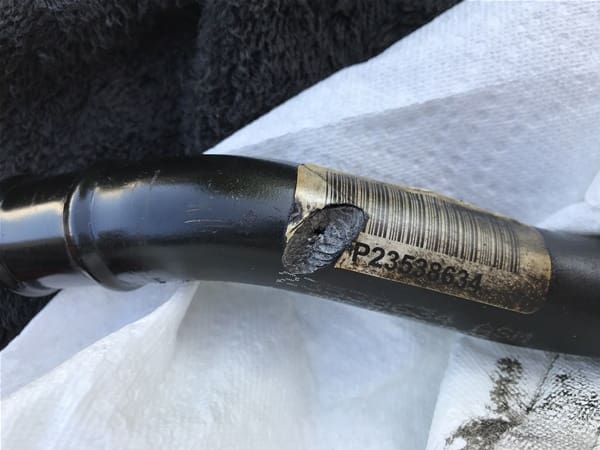
    Get there and it is down another 2 quarts on oil, and we have a real mess inside the engine compartment on drivers side and Jeep is really covered. They got us right in for a look. There was so much oil it was hard to see, but the tech cleaned off the area where the original leak was found. Wiped it off with shop towels and had me run it. At idle and fast idle, he did not see anything so he squirted soapy water solution over the area and had me run it up to road speed. After that it only took about 15 seconds for him to find it. Turned out to be a braided steel line rubbed a hole in the steel turbo drain line on the back side where it could not be easily seen. They had a local DD shop come and do the repair as they no longer work on Detroit engines outside of troubleshooting etc. Got it fixed Thursday and no longer leaks.

    Seems that since we never ran it faster than idle or fast idle at the other places, it did not leak fast enough to show up.

    Here is the picture of the turbo drain line we replaced. We also replaced the braided hose, which is a coolant line for the newer Detroits turbo control module. It had been replaced on a recall campaign previous to us owning the bus, and it was not installed correctly and was rubbing for at least the 50,000 miles that I have had the bus.

    So today, I am off to the parts store for cleaing supplies to finish getting the remainder of the oil off.

    Archived replied 9 years, 1 month ago 6 Members · 12 Replies
  • 12 Replies
  • Archived

    Member
    September 11, 2017 at 9:29 am

    Thanks for that good post Mark. A heads up for us all on the risk of chaffe.

  • Dick

    Member
    September 11, 2017 at 10:36 am

    Glad you got it sorted out Mark and a good oil leak tip..

  • Andy

    Member
    September 11, 2017 at 12:51 pm

    A great part of my lube time is spent trying to see stuff like that and I admit some of the chafing that goes on I have a hard time detecting. This is a perfect example of why a detailed visual inspection when we get an oil change or lube is very important.

    On the plane my mechanics and I were anal about stuff like that and I try to be as aware on the bus also but there is so much going on all I can do is hope I caught something. If a 2 hour lube and oil change ends up taking 5 hours because the extra three involve a total inspection it is well worth the effort and expense.

  • Archived

    Member
    September 11, 2017 at 2:42 pm

    Jon,

    I would be happy if my DN50 would stop finding another place to leak, and my tag axle seal holding oil.

  • Dan

    Member
    September 12, 2017 at 5:31 am

    The DN50 has three potential places to leak and all are easy to solve if someone takes a little care. The seal behind the pulley is common and often just tightening the six bolts behind the pulley do the trick. If not pulling the pulley and replacing the seal and O ring is an easy job.

    The back plate has a rope type seal that sits in a groove in the plate. Another easy fix if tightening the bolts does not work. The threaded fitting for return oil flow is the last leak point and that is just a pipe fitting with a hose going into the crankcase. Pipe dope or teflon tape cures that. I think the key is using care and making sure everything is clean before assembly.

    The hub seal leak has no fix other than replacing the hub seal. I have no clue why some hubs never leak and some seem to have chronic leaks. I do know when replacing hub seals it takes a gentle hand. If the correct tool for inserting the hub seal is not used then some other means of presss fitting the seal in place is required. I have used both the tool and a flat 2 X 6 both of which will allow the seal to be pushed in place. The key is to never directly hit the seal but to use something (like the small length of 2 X 6) that takes the tap from a hammer while distributing the force required to press the seal in place. Once the seal is in place I verify the inner race will rotate freely within the outer race.

    Replacing the hub is then the key to success. It has to go straight onto the axle housing and must be perfectly lined up as the hub is put in place.If the hub is tipped while being installed it can damage the seal negating all the work replacing it. The axle bearing nuts then have to be tightened exactly as called for in the Prevost service manual. I have been lucky so far because I have replaced 6 hub seals on my coaches and none ever leaked again. I do not know why most of my hub seals never leaked, and why some originals did but never again after being replaced.

    BTW, a slight leak on the 50DN isn’t worth the effort. If mine shows slight evidence of a leak behind the pulley for example, but not enough to see oil running down the alternator body since the last oil change, I just clean it with brake cleaner and ignore it until the next oil change.

  • Alvie

    Member
    September 12, 2017 at 8:39 am

    Actually, Jon, my 50DN found another place to leak. It is on the lower right side through an allen screw. Not sure what it does other than possibly work as a drain plug, but it leaks pretty good. Will get it fixed next week.

  • Archived

    Member
    September 12, 2017 at 9:02 am

    Jon, Per’s leak is at the four o’clock position in the middle of the case (front to back). It is an Allen plug and when rotated counter clockwise, it tightens. And when rotated clockwise it also tightens. It likes to live in the middle, so it leaks. We were parked next to each other at Driggs, so I saw it leaking. I think Per’s 50DN is twelve volts not 24.

  • Archived

    Member
    September 12, 2017 at 12:36 pm

    Never heard of that leak, but I will look at mine to see if it has the same plug.

  • Archived

    Member
    September 12, 2017 at 1:40 pm

    Dan,

    I’ve been told our coaches has one 24V and one 12V alternator, so I assumed the 50DN is the 12V, since the other alternator is definitely 24V as indicated on it. When I looked for info on what the allen screw does, the specs on the 50DN indicated it is only 24V, so now I’m not so sure. Perhaps Jon can educate me.

  • Archived

    Member
    September 12, 2017 at 2:35 pm

    Marathon and others who typically have a 12V house system and who do not have OTR use a 24 volt alternator with about 140 amp rating for the chassis. Then they use the larger 12V 50DN for the house so one or two A/Cs can be run via inverter. The 50DN output is about 270 amps.

  • Harry

    Member
    September 15, 2017 at 4:54 pm

    Per I chased a roadside tag leak for a year, I replace 3 gaskets myself and Prevost FTW replace it 3 times, still no luck and a big mess. Prevost FTW kept trying at their expense and finally found the issue and fixed it, the issue was that the hubcaps that Marathon use’s has three studs that screw into the hub and hold the bracket that my hubcap screws to. The 3 studs were not screwing in as far as they should and were not tightening up and kept leaking. We bought some allthread and made new studs a 1/4 inch longer and reinstalled and the problem is fixed. You might take a look at this on yours. Just finished replacing the front seal on my generator and fixed a leak there.

  • Archived

    Member
    September 15, 2017 at 10:35 pm

    Thanks, Mark! I’ll share this with Prevost FTW on Monday. I have the hubcap off–hate to pay them to remove and reinstall the hubcap on their time–and I will take a closer look at the studs.

Log in to reply.