
Prevost Community Forums

Find answers, ask questions, and connect with our
Prevost Community around the world.

  • “Radiator” vs overflow tank Cap

    Posted by David on August 6, 2017 at 11:51 am

    Into second month of our trip and decided to order some parts from Prevost. One was a replacement cap for the coolant overflow/reservoir tank as the old one was badly rusted, though apparently working fine. When replacement arrived was very different from original, which prompts me to think I ordered wrong thing. I asked for a “radiator pressure cap.” Fouled up by using inaccurate or unspecific verbage on the phone order. Likely a case of be careful what you ask for, you might get it.

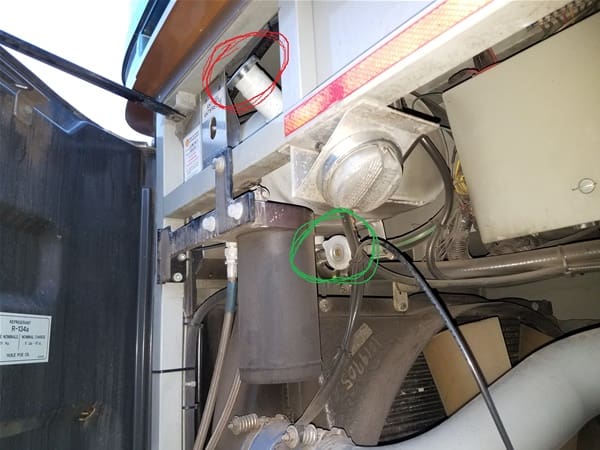
    In any event the new cap has a spring and extended gasketed seat like most radiator caps have. What I needed, I think was a flat cap with a simple gasket. Looks like it is an unvented cap designed only to seal off the fill neck in the reservoir. I did screw the new one on and it seems to seat and seal as there is a secondary step in the fill neck where such a seal would occur, but was not sure if it was sealing so put the old one back on before heading down the road with unknown cooling system integrity. Yes I know the old cap looks terrible but that is why I am trying to replace it. Photo of new and old caps below. The cap I am wanting to replace is circled red in the second photo.

    In the hosing below tank there is another pressure cap (circled green in second photo) that is stamped 14#, that is what I think I received a new one of.

    Question is, can I use this cap on the fill neck, or do I need to order or find locally another cap matching the old one? It seems that if the new one does seal on the tank, I would then have two places where the system could vent at 14 psi, and on the downside two places it could fail to hold 14 psi if the spring broke or weakened.

    Harry replied 9 years ago 6 Members · 5 Replies
  • 5 Replies
  • Bill

    Member
    August 7, 2017 at 5:01 am

    You should use the correct one. The pressure relief alows coolant to be purged and there is no place for it to go in that location. The other has a overflow tube connected to it…

  • Andy

    Member
    August 7, 2017 at 7:50 am

    The red circle is where the flat cap goes and the green circle is where the pressure cap goes.

    The purpose of the locations is to prevent hot coolant from spewing when the pressure cap is released. Do not remove the flat cap with the pressure cap still set. Let the poressure out first.

  • Archived

    Member
    August 7, 2017 at 9:32 pm

    We have an H3-40, but it has the same system with a cap for the filler tube on the surge tank and a separate cap for the pressure relief function. I just went through the same thing. Looked them up in my CatBase system and there were two different part numbers. I called Elgin, IL and ordered one of each. The filler cap is just that, a plain cap that seals. The “pressure relief cap” is what most of us think of as a radiator cap. The fitting it goes on has an overflow drain line. My pressure relief cap also has a number “14” stamped on it. I presume that is PSI as the part is listed in CatBase as “pressure cap, >14 PSI”. In looking at my engine manuals, 14 PSI is a bit higher than what DD specifics for my engine (8V92TA 2-cycle) but I trust that the engineers at Prevost knew what they were doing and speicified these parts in consultation with the folks from DD. My understanding is that the pressure relief cap should also allow air to vent back into the surge tank to keep coolant lines from collapsing when the engine/coolant cools off and contracts in volume.

  • Greg

    Member
    August 7, 2017 at 11:53 pm

    Do lus old 1991 XL guys not have two caps? I only find the cap for the surge tank. What’s different in their thinks between vehicles?

  • Harry

    Member
    August 8, 2017 at 4:06 am

    I think older coaches had a single cap with the pressure release feature. Later models I think had a second cap on top of the tank in a very difficult place to see and get your hands on.

Log in to reply.