
-
single grade vs mulit grade
Posted by Greg on October 25, 2012 at 11:06 amIs there any good reason why DD 8v92’s must use single-grade oils? Reading about multi-grades oils, it seems like they are a better concept than the single-grade oils. Better oil flow on start up and still have the protection at hi temps. So what is the reason DD says not to use them. 8V or S60 we are still dealing with metal to metal surfaces.
John replied 11 years, 8 months ago 11 Members · 14 Replies -
14 Replies
-

Good question for which I do not have the answer, but I do know Detroit Diesel insists on straight weight oil and not all are acceptable. Only those that meet their spec are acceptable. Fortunately there are many choices available, just not at every truck stop.
-
We used a converted GM 4106 for 17 years that required straight 40 weight. Rotella was at every truck stop, but in 15/40 and 30, not 40. I bought cases of Delo 400 and always carried with me. You know how those old 8v71’s liked oil. I miss that two-stroke sound though- nothing like ’em. Paul.
-
This is DDC response
Greg,
Detroit Diesel has not produced or supported 2 stroke engines for a number of years.
Your question could best be answered b by an MTU sales and service provider. See the link bellow to find a location in your area.
Thank you, DDC CSC Steve Marr
-
Has allot to do with ash content and upper cyl lub in two stroke. Do as you want. Your two stroke will use less oil and smoke less with the correct oil and last longer. A good 40 wt cf2 oil will serve you well. Believe me this subject has been beat to death on the two stroke boards. Bob
-
Back in the early 90’s when both the 92’s and 60’s first came out many coach operators had both so just bought 10W40.Bulk oil for their fleet…. What happen their 92’s started breaking down quicker and not lasting as long. Didn’t take them and Detroit long to figure out problem. FWIW. Bob
-
This is a response from my friend Ken Brewer who has an expertise with lubricants:
“I have used Mobil 1 in the Bluebird. But at some point in the 23 years we have owned it, I checked to see if Cat, DD, or Cummins had this approved for used on their (heavy) diesel engines. They had not, and I, at this point, do not believe this has changed. But I will confirm this in the near term.
There are (or were) a number of excellent reasons I can come up with for this, and why I stopped. Diesel engines have potential blow-by and condensation of gases, vapors, and fuel in the crankcase different from gasoline engines. Diesel fuel has some (greater) amount of sulfur in it, even now with ultra-low sulfur fuels mandated. This means H2S04 and similar compounds; sulfuric and sulfurous acids, and probably other bad actors in combination with water, coolant, metallurgy; rings, seals, bearings, bushings, hardened/plated/heat treated surfaces, valve springs, etc. The exact nature of technical (chemical) differences or modifications arising with a diesel engine as opposed to gasoline can be huge. This is not new, but it is constantly reviewed; metals and materials used in different engines, and varying engine types, demand specific testing by each engine maker to determine what will, or may, result in warranty, reliability, and compatibility issues.This is always ongoing as oil technology and formulation advances in one area or another occur. Of course diesel engine manufacturers are immediately aware of synthetics and partial petroleum/synthetic blends and their performance differences before they ever hit the general market, and there would be very good reasons behind an endorsement or specific approval, or not. And this is why owners’ manuals are quite specific about what should or shouldn’t be used. As I have said many times before, you do not just up and use a different oil because the label is new or more colorful, or advertising is intense for a new market introduction. Certainly not until you know what the question(s) is/are and the intended target for the product. Unless you wish to gamble with trouble, and perhaps the chance of voiding warranties. You can use lemon or cream to flavor your tea, but not both (unless you want the result).I have had more than a passing acquaintance with many immediate and long term lab and field testing and runs to determine if there may be issues with any oil or oil additive, as I was employed in the distant past by a corporation supplying various intermediate fluids to engine oil manufactures, one being Quaker State;; VI improvers. I don’t think majority of this information is out of date And I think I might have talked with you on this. There are many specific topics to discuss about lubricants most do not imagine. Since this is a chronic repeater of questions on oils, perhaps a general seminar on lubrication issues (including greases, vegetable oils, and products like teflon) one perhaps ought to be aware at the next or one of the next rallies.Hope this helps. Let me know. Edit as required.” -
Greg,
When we bought our bus in 1998, I was new to the 8V diesel. So I started off by asking everyone (truckers) I could about diesel engine use and service. Mose people would say about oil, Rotella is the preferred oil in diesels. So after hearing this from quite a few guys, I ordered a 55 gallon barrel of Rotella T 15-40. I changed my oil and filter as usual and then set off for Florida in 2002. I had been using Mobil Delvac 40 weight so I wasn’t antisipating anything to change, wrong. My 8V started thowing the new oil out of it system after a 1000 miles. By the time we left the keys and headed back to Nebraska, I was adding a couple of gallons of oil evey fuel stop.
When we got home, I orderd a 55 of Mobil Delvac straight 40 and have been using it every since. It was under the numbers of 1240 and 1640 and back to 1240.
Just to keep it simple, THE 8V NEEDS A STRAIGHT 40 WEIGHT OIL.
-
Foaming of the 15/40 was the biggest problem 40 w does not foam as bad the 2 strokes dump the oil back into the pan from a valve on the block causing the oil to foam
Ash is a by product of the additives added to the oil all has changed over the years ash is no longer a problem with the new oils 15/40 or 40
The 1640 and 1240 were 2 different oils fwiw both are still on the market the 1640 was 1.4 ash content back in the day I don’t know what the content is now, someone just sold you a barrel of 1640 in place of the 1240 I guess
I am a big Delvac fan DD shipped the engine with 1240 and that has always been good enough for me I never used anything else and have had great results from the Delvac1240
-
Because a two-cycle cylinder fires twice as often as a four-cycle and because a two-cycle doesn’t benefit from an intervening cooling intake stroke, the piston’s top ring reversal (TRR) temperature is higher. These higher temps break down the viscosity additives in multi-grade oils returning the oil to it’s base grade viscosity – not good.
In short, heat is the issue. Check out the oils flash point. Most four-cycle TRR temps are less than 350 deg F, well below the oil’s flash point. Two cycles are hotter than this at the top ring at piston reversal, where the piston stops and reverses direction.
David Brady, Wanderlodge LXi, Series 60, Asheville, NC
-
Bottom line: Do what the manufacturer recommends. Doesn’t get much simpler than that.
-
Thanks Guys, you have helped me understand the reasoning behind the recommendation.
-
I just used my last two gallons of Shell Rotella “heavy duty” T 40w to top off my 8V92 and the extra reservoir. Nobody I can find around San Diego stocks the same replacement, but I understand from posts here that O’reilly’s can order it.
I did find recently that NAPA stocks a “straight grade” 40w T1 oil with only slightly different specs. On the Shell website it is listed as a “medium duty” oil, but 8V92 is listed under compatible applications.

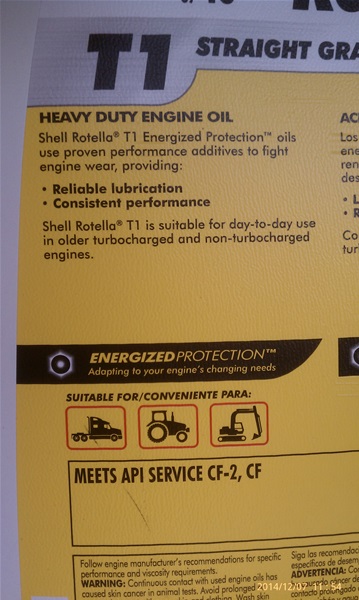
So, two my questions are: 1. Is this OK for my 40,000+ pound busrv in general highway use? 2. Can I mix this oil with the old T-heavy duty 40w before my next oil change?
-
I am not an expert, but based on the fact both are Shell straight weight oil I suspect they are compatible and acceptable.
A Detroit dealer should be able to confirm this.
-
I order my Rotella straight-40 from Amazon. Cheapest price is a box with three 1-gallon jugs. Shows-up free shipping in 2 days with my Prime account. Doesn’t get any easier than that!
Log in to reply.